
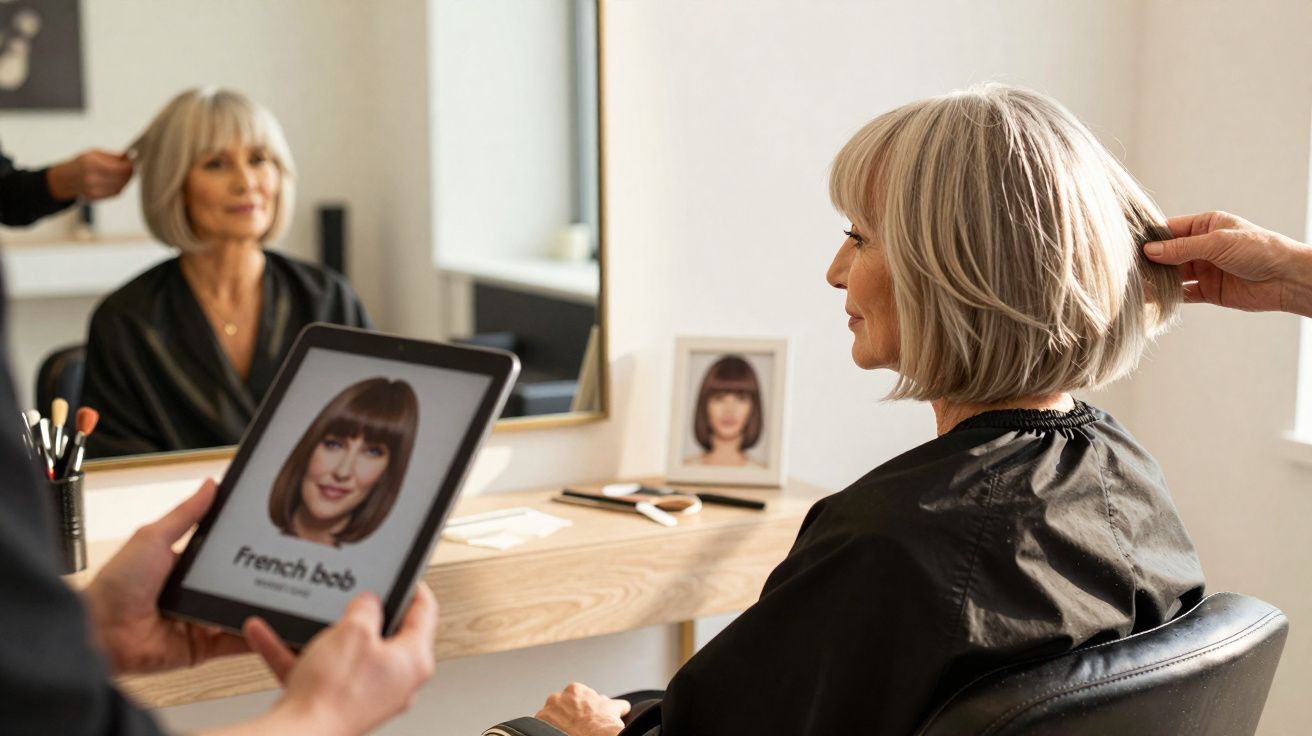
It was a wet Tuesday, and in a salon full of steam and chatter, three women in their fifties sat shoulder to shoulder facing the mirror.
They’d arrived with the same brief and the same hope: “I want it fresh. I want it short.” Yet within half an hour, the results could not have been more different. One looked instantly brighter. Another appeared sharper and full of energy. The third seemed, all at once, a decade older - her expression tougher, her jaw more pronounced, her whole face heavier. Same scissors; three outcomes. The stylist exhaled and murmured, almost to herself: “That’s the one cut I wish women over 50 would stop requesting.”
She wasn’t warning against grey hair, nor trying to put anyone off a bold pixie. She meant a very particular short style that magazines and mood boards adore - the one that reads effortlessly chic on a 25-year-old model, yet can turn strangely severe on a face that’s laughed, lived, and carried stress. It’s the cut that doesn’t give you any grace, and it can add years more quickly than fine lines ever could.
The short haircut that ages the face after 50 (the “French bob” problem)
Ask a handful of hairdressers to name the least flattering short cut after 50, and you’ll hear the same description repeated: a very stiff, very blunt bob that finishes exactly at the jaw, cut as a straight, weighty line - often paired with thick, blunt bangs. Online, it’s frequently labelled the “French bob”. In day-to-day life on a mature face, it tends to behave in a far less forgiving way.
The issue isn’t short hair. It’s short hair that’s rigid: heavy, blunt, and unlayered. When that bob forms a solid block with no graduation and no air through the ends, it magnifies angles rather than softening them. The cleaner and more graphic the perimeter, the harder the overall impression becomes.
A blunt line parked at jaw height creates a firm border right where many faces after 50 are changing. It draws the eye directly to the lower half - the jawline, marionette lines, and the neck - and it can make any softness or downward shift look more pronounced. On a 25-year-old with very smooth skin and naturally tight contours, that’s rarely a problem. On someone at 55 who has lived a full life, the contrast can feel stark.
Add in a thick, straight fringe (bangs) and you often shorten the forehead visually, which pushes attention even more decisively downwards. The result can be the exact opposite of what most people want: instead of looking “fresh”, you look stern - sometimes even a bit “headteacher”.
A common salon storyline
Hairdressers see a familiar pattern. A client arrives with mid-length hair - often worn tied back day after day - and asks for “a change”. She produces a photo of a young actress with a geometric bob and says: “That, but shorter… and really straight.” The cut is executed beautifully; the hair looks glossy and precise. Then the mirror lands the surprise: the style reads older, stricter, and less open.
Claire, 57, went through it before a major work event. She swapped shoulder-length hair for a jaw-length blunt bob with heavy bangs. “In photos I looked drained and closed,” she said. “People kept telling me I seemed ‘very serious’ - and later I realised they meant harsher.” A few months on, she went back asking for softness. Just a couple of centimetres added and a whisper of layering changed the way her whole face was perceived.
Why it clashes with the way faces evolve after 50
From a technical point of view, the “hard jaw bob” tends to fight natural facial changes. After 50, many people lose volume through the cheeks and temples, while the lower face can look fuller or heavier. A blunt, horizontal line at jaw level visually reinforces that drop - like a shelf the eye can’t move past.
Used intelligently, hair can work like subtle contouring: light layers, movement at the ends, and gentle graduation can redirect attention upwards and add life around the cheekbones. A rigid bob often does the opposite: it stabilises everything, locks the expression in place, and creates a boxed-in silhouette. The problem is geometry, not “age”.
The maintenance trap no one mentions
There’s also a practical downside. Ultra-structured bobs only look their best when they’re styled to perfection: regular blow-dries, smoothing, careful brushing, and constant fringe upkeep. And realistically, very few people keep that up every single day after 50 - with work, family, caring responsibilities, and the general pace of life.
So the razor-clean shape you leave the salon with can turn into a heavy, shapeless block a few weeks later: stuck between too short and too long, with the harsh outline still there but none of the intended elegance.
How to choose a short cut that lifts instead of ageing
Going shorter after 50 can feel wonderfully freeing - provided the structure brings softness rather than severity. Many stylists advise a simple rule: avoid stopping exactly at the jaw. Either go slightly below it, or choose a cut that clears it entirely. A soft bob that skims the collarbone area, or a shorter shape that opens up the neck, can instantly lighten the lower face.
Layers are the quiet superpower here. Not aggressive, choppy layers, but fine, almost invisible shaping that breaks up the “solid block” effect. Done well, this creates movement around the cheekbones and temples and prevents that helmet-like finish. Even a very short pixie can be remarkably flattering when it has texture on top and softened edges around the ears and nape.
A useful mirror check: with your hair freshly styled, turn your head and look at your profile. If your haircut creates one firm, horizontal line right at jaw level - as if your head has been “sliced” into a neat shape - treat that as a warning sign. If you see diagonals (slightly longer pieces towards the front), lift at the crown, or ends that feel light rather than blunt, your cut is probably working in your favour.
A great short cut should look alive - not drawn with a ruler.
Fringes (bangs): choose movement, not a wall
A fringe can be brilliant after 50: it can soften forehead lines and pull attention towards the eyes. The risk is the thick, blunt version that falls straight across and makes the face look closed.
More forgiving options include: - a curtain fringe that opens in the centre and lengthens at the sides - a wispy, airy fringe - a side-swept fringe that blends into face-framing layers
Think “light and mobile”, not “heavy and solid”.
Colour and texture matter more than you think
Colour can either soften or sharpen a cut. A very dark, ultra-uniform shade can make features look harder - especially paired with a strong bob. By contrast, gentle dimension (a few lighter ribbons around the face, or a seamless blend with grey) adds depth and brightness, making even structured shapes feel kinder.
And be honest about your routine: most people are not doing a perfect round-brush blow-dry with shine spray every morning. Choose a cut whose shape still looks good when you’ve done the basics and let it air-dry a little, or when you’ve rough-dried it with your fingers.
Two extra things to consider before you commit
Hair itself often changes after 50: it can become finer, drier, or more prone to frizz, and the crown can lose density. A blunt jaw-length bob can highlight those shifts by making the hair look heavy at the perimeter but flat at the roots. Ask your stylist how they’ll build lift (through crown shaping and internal layers) without thinning the ends too much.
Also, bring photos - but bring the right ones. Instead of one picture of a 25-year-old with a “French bob”, take a few references showing texture, fringe options, and lengths on people with a similar hair type. You’ll get a result that’s inspired by a look, rather than trapped by it.
“For women over 50, my rule is straightforward,” says London-based stylist Marco H., who specialises in mature hair. “No hard corners around the jaw. The cut should follow the face, not box it in. When I see a perfectly horizontal bob on someone with a softer jawline, I know it’s likely to add years.”
We’ve all had that moment when a party photo appears on WhatsApp and you barely recognise yourself - and your haircut isn’t helping. Before you overhaul everything, keep this quick checklist in mind:
- Avoid jaw-length, blunt bobs that finish in a straight, heavy line.
- Ask for soft layers and movement around the cheekbones and temples.
- Play with length: slightly below the jaw or fully clearing the neck often works better than stopping exactly at jaw level.
- Prefer light, airy fringes over thick, straight bangs.
- Be realistic about styling: pick a cut that still looks presentable when you do the minimum.
Short hair after 50: let your face lead, not fashion
A quiet change is taking place in many salons. More women over 50 aren’t asking to look “younger”; they’re asking to look like themselves - just lighter, brighter, and less weighed down.
The most ageing short cut is often chosen when someone is chasing an image that belongs elsewhere: a trend, a model, or a version of you from a decade ago. The most flattering results usually happen when you start with the face you have today, not an old snapshot.
Watch what happens in the mirror when your stylist tweaks the shape: a section lifted here, a piece left slightly longer there. You’ll spot a sweet spot where the eyes look clearer, the jaw feels less dominant, and the neck appears longer. That’s the shape worth choosing. No magazine knows your face better than the reflection in front of you - and no “perfect” bob on Instagram is more important than that moment of truth.
Short hair after 50 is not a rule, and it’s certainly not a surrender. It can be a confident decision to frame your features rather than hide behind them. Some people shine with a softly layered crop around the ears; others look incredible with a gentle lob that brushes the collarbones. Against that freedom, the infamous jaw-length, blunt bob can feel like what it often is: a rigid uniform that tries to erase time instead of working with your natural movement.
| Key point | Detail | Why it matters to you |
|---|---|---|
| Avoid the “hard jaw bob” | Blunt, jaw-length bobs with thick bangs can emphasise jowls and lower-face heaviness | Helps you sidestep the cut that most often ages the face after 50 |
| Choose softness and movement | Light layers, airy fringes, and lengths slightly above or below the jaw can visually lift features | Gives practical ways to refresh your look without drastic change |
| Let your face guide the cut | Watch how different lengths change the eyes, jaw and neck in the mirror | Helps you collaborate with your hairdresser and get a cut that suits you |
FAQ:
- What is the one short cut that tends to age women over 50 the most?
A very blunt, jaw-length bob finished in a straight, heavy line - especially with thick, blunt bangs - often adds years by hardening facial features.- Does that mean women over 50 should avoid short hair completely?
Not at all. Short hair can be extremely flattering; the issue is a heavy, rigid shape that stops at jaw level, not the length itself.- Which short styles are generally more flattering after 50?
Softer bobs slightly below the jaw, layered pixies with volume on top, and cuts that open the neck while keeping some softness near the cheekbones tend to lift the face.- Are bangs a bad idea on a mature face?
They can be excellent if they’re light and open - such as curtain fringes or side-swept fringes. Very thick, straight bangs often look harsh and closed.- How can I talk to my hairdresser to avoid the “worst” cut?
Say clearly that you don’t want a heavy, blunt line sitting on the jaw. Ask for softness, movement, and a length that either clears the jaw or falls past it rather than stopping exactly on it.






Comments
No comments yet. Be the first to comment!
Leave a Comment