
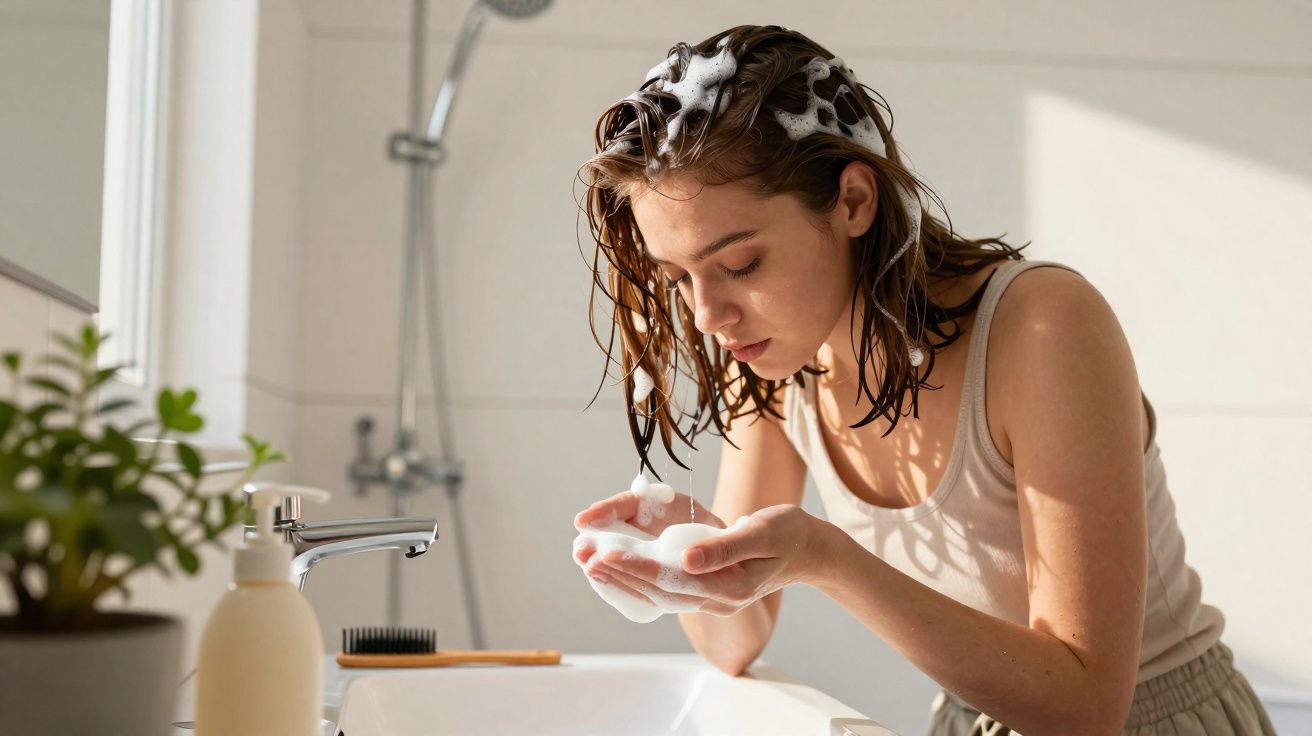
At the salon, your hair can come out bouncy and glossy. At home, that very same shampoo may leave it limp and lacklustre.
A hairdresser in Berlin says the gap often comes down to a surprisingly small shower habit: the first place your shampoo touches your head. If you’re squeezing a thick blob straight on to your crown, you could be upsetting your scalp without even noticing.
Why shampoo technique matters more than the brand
Most of us treat hair washing as a quick routine: soak, lather, rinse, finished. It’s easy to assume the bottle is doing all the work. In practice, how you apply shampoo can influence how your scalp behaves for days.
Shampoo is formulated to cleanse the scalp first and the hair lengths second. When you drop product directly on the highest point of your head, you create a concentrated “hotspot” of cleanser. That one patch gets repeatedly stripped, while other areas receive far less attention.
Applying shampoo straight on the top of your head can overload one area with cleanser, leaving other parts under-washed and more prone to irritation.
This uneven approach often triggers two issues at once: roots that turn greasy again too quickly and lengths that feel dry and frizzy, as though conditioner never quite fixes them.
What really happens when shampoo hits your crown first
The “oil rebound” effect on your scalp
Your scalp makes sebum, a natural oil that protects both skin and hair. If one zone-commonly the crown-is scrubbed more harshly and more often than the rest, the skin can respond defensively by producing extra oil.
That’s why you might feel oily at the top within 24 hours even when the rest of your hair still seems fine. Many people then compensate by using more shampoo, scrubbing harder, or washing every day-usually making the cycle worse.
Dry lengths and weaker ends
If you whip up foam at the top and drag it through everything, shampoo repeatedly washes over your lengths in a dense, sudsy stream. On hair that is already dry, bleached, or coloured, that can remove the little moisture that remains.
With time, you may notice:
- ends that feel straw-like and knot easily
- more split ends despite regular trims
- colour fading faster than the label suggests
- a rough surface that won’t lie flat, regardless of how much serum you use
Good hair washing is less about scrubbing foam everywhere and more about placing product exactly where it’s needed.
A salon habit for a healthier scalp and crown: lather in your hands, not from the bottle
Ask a hairdresser what they almost never do during a service: many won’t squeeze shampoo directly on to the scalp. In salons, the product is typically spread and diluted first, then guided across the scalp more evenly.
Step-by-step: a pro-style wash at home
This method mirrors what many professionals across Europe and the US advise:
- Fully saturate hair and scalp using warm (not hot) water.
- Dispense shampoo into your palms rather than on to your head.
- Rub hands together to distribute it and lightly foam it up.
- Place your hands first at the sides and back of the head (not straight on the crown).
- With fingertips, gently work across the entire scalp-including the top-without piling product in one spot.
- Rinse thoroughly and allow the lather to run through the lengths instead of scrubbing the ends.
In effect, you’re applying a lighter, more evenly spread foam rather than a concentrated blob on the crown. For many people with sensitive or flaky scalps, that single change reduces irritation.
How much shampoo is enough? (A small tweak that helps)
Another common mistake is using far more shampoo than you need. For most shoulder-length hair, a small amount is often sufficient-especially if you thoroughly wet your hair first and emulsify the shampoo between your hands. Using less product makes it easier to spread across the scalp evenly, which helps avoid over-cleansing one patch (usually the crown) while missing other areas.
The CWC method: conditioner–wash–conditioner
Hairdressers working with very dry, bleached, or curly hair often use the CWC method (short for conditioner–wash–conditioner). It’s designed to treat the scalp and lengths as separate zones with different needs.
| Step | What you do | Why it helps |
|---|---|---|
| First “C” – conditioner | Apply conditioner only to mid-lengths and ends on wet hair. | Protects fragile areas from harsher cleansing. |
| “W” – wash | Shampoo the scalp using the hand-lather method, avoiding blobs on the crown. | Cleans roots and scalp without over-drying lengths. |
| Second “C” – conditioner | Rinse, then apply conditioner again to the lengths and leave for a few minutes. | Restores moisture and smooths the cuticle. |
The CWC routine treats the scalp and the lengths as two different zones with different needs, rather than attacking everything with one blanket approach.
This approach can be particularly useful in winter, when cold winds and heated indoor air leave hair feeling brittle.
Why hairdressers often shampoo twice
A double shampoo can look like a salon upsell, but it often has a practical purpose.
The first wash loosens sweat, styling residue, pollution, and oil. The second wash then cleans more effectively with less “resistance”, usually requiring less product and spreading more evenly across the scalp.
If you shampoo twice at home, keep both rounds gentle-and still avoid applying fresh shampoo directly on the crown. Concentrate on the sides, back, and hairline, then guide the lather across the top.
Scalp health: the “soil” your hair grows from
It helps to treat the scalp as skin that happens to grow hair. If you wouldn’t aggressively scrub your face with concentrated cleanser in one spot every other day, your scalp is unlikely to love it either.
Signs your routine may be too harsh on the crown include:
- a tight, itchy feeling immediately after washing
- flakes mostly on the top and front
- redness or soreness when you touch the area
- roots that feel greasy while ends feel coarse
By changing where shampoo lands first, you reduce repeated friction and chemical stress on the same patch of skin.
Choosing products that support better technique
Even excellent technique can only go so far if the formula is extremely harsh. Many trichologists suggest gentler shampoos (often without strong sulphates) for frequent washing-particularly in places with hard water, which is common in parts of the UK.
On labels, look for terms such as “scalp balancing”, “moisturising”, or “for daily use”. Ingredients like aloe vera, glycerin, oat extract, and lighter plant oils are often kinder than heavy fragrance and aggressive detergents.
For very dry or curly hair, combining CWC with a richer conditioner and an occasional hair mask can restore softness without resorting to harder scrubbing on the crown.
Hard water and rinsing: a UK-relevant factor
If you live in a hard-water area, minerals can contribute to build-up, leaving hair looking dull and making the scalp feel less comfortable. Technique still matters, but so does rinsing: take extra time to rinse thoroughly, and consider an occasional clarifying wash if residue becomes noticeable (especially if you use dry shampoo or styling creams).
Real-life scenario: what changes when you stop “crowning” your shampoo
Picture two people with shoulder-length hair getting through a cold, windy month. Both wash every other day and use the same mid-range shampoo and conditioner.
- Person A applies shampoo directly on the crown, rubs vigorously, and pulls foam through the lengths.
- Person B uses the hand-lather method, massages the whole scalp evenly, and lets the rinse clean the lengths.
After four weeks, Person A is annoyed by a shiny-but-greasy crown and tangled ends, and ends up washing daily before important meetings. Person B often stretches to three days between washes, with less itchiness and fewer knots after brushing.
Altering where you apply shampoo can help you go longer between washes, soothe an irritable scalp, and reduce styling-related damage.
When your scalp or hair needs extra attention
If your scalp is very flaky, extremely oily, or you notice sudden shedding, technique alone won’t solve everything. A dermatologist can check for causes such as seborrhoeic dermatitis, psoriasis, or hormonal shifts that affect hair.
Even then, the advice often overlaps: use lukewarm water, don’t use nails, and don’t leave concentrated blobs of product sitting on one spot-especially on the crown.
For people who train daily, a middle ground can help. On heavy workout days, some opt for a quick rinse and a small amount of shampoo around the hairline, saving a full wash for every second or third day-still avoiding direct application to the top of the head.
Key terms to know before your next wash
Two phrases commonly appear in discussions about shampoo habits:
- Build-up: residue layers from styling products, dry shampoo, pollution, and hard water. This can leave hair feeling coated and dull and may block scalp pores.
- Cuticle: the outer layer of each hair strand, made of tiny overlapping scales. Rough handling and strong cleansers lift these scales, which makes hair frizzier and more abrasive to the touch.
Being gentler with your crown and more deliberate with shampoo doesn’t require luxury products or an elaborate routine. It begins with one simple change: foam in your hands first, spread it out, and let the top of your head be the last-not the first-place the shampoo touches.






Comments
No comments yet. Be the first to comment!
Leave a Comment