
The cycle finishes, the dishwasher beeps, and for a moment you get that small, domestic glow: task done, glasses clean, life mildly in hand. Then you open the door, the steam lifts… and there it is. Cloudy wine glasses. Lifeless tumblers. A thin, chalky veil where sparkle ought to be.
You rub one with your thumb, tilt it under the kitchen light and start the usual mental checklist: is the dishwasher ageing, has the detergent changed, or are you simply asking too much of 20 minutes of hot water?
Someone you know swears by an expensive rinse aid. Your neighbour bangs on about a “miracle” tablet. On social media, people are practically loading half the fruit and veg aisle into their machines.
And then there’s the simplest fix of all: a single yellow slice that quietly shifts the outcome.
Why your glasses turn cloudy in the first place
Before we get to lemon, it helps to name the culprit. That white film is most often limescale: mineral residue from hard water that settles on smooth surfaces during washing and, especially, drying.
It shows up far more harshly on glass than on plates. Because glass is transparent, every trace of calcium and magnesium is on display-every tiny droplet that dried where you didn’t want it to.
With each cycle your glassware survives, the haze can look as if it’s building, giving off more “tired pub glass” than “freshly laid table”.
Imagine a Saturday night dinner. You bring out your “proper” wine glasses-the ones that cost just enough to make you handle them with care. You nestle them into the top rack, add your usual tablet, close the door and select the eco programme.
Then, as someone starts pouring, you catch it: the glass doesn’t pick up candlelight the way it used to. There’s a faint misting, like a fingerprint you can’t quite polish away. You say nothing, but you notice it again when you put them back in the cupboard-an almost invisible fog that makes the whole kitchen feel slightly less crisp.
This film usually comes from a combination of factors: local water hardness, how much detergent you use, wash temperature, and how long dishes sit in warm, humid air after the cycle ends. When the water carries lots of minerals, each droplet that dries can leave a tiny mineral “stamp” behind.
Over time, those stamps layer up. In mild cases it’s mostly surface residue you can tackle. In worse cases, the glass can become etched and lose its original clarity permanently. That’s where a small, acidic ally can make a noticeable difference.
A quick UK reality check: hard water and your dishwasher settings
If you’re in a hard-water area (large parts of the South East and East of England, for example), it’s worth checking your dishwasher’s water-softener setting and keeping the salt topped up if your machine uses it. A correctly set softener reduces limescale at the source, which means fewer deposits for the lemon (or anything else) to fight later.
It also helps to keep on top of basic maintenance: rinse the filter, check the spray arms aren’t blocked, and avoid stacking glasses so tightly that water can’t circulate. Even the best “hack” can’t compensate for poor water flow.
The lemon slice trick for cloudy wine glasses: small gesture, big impact
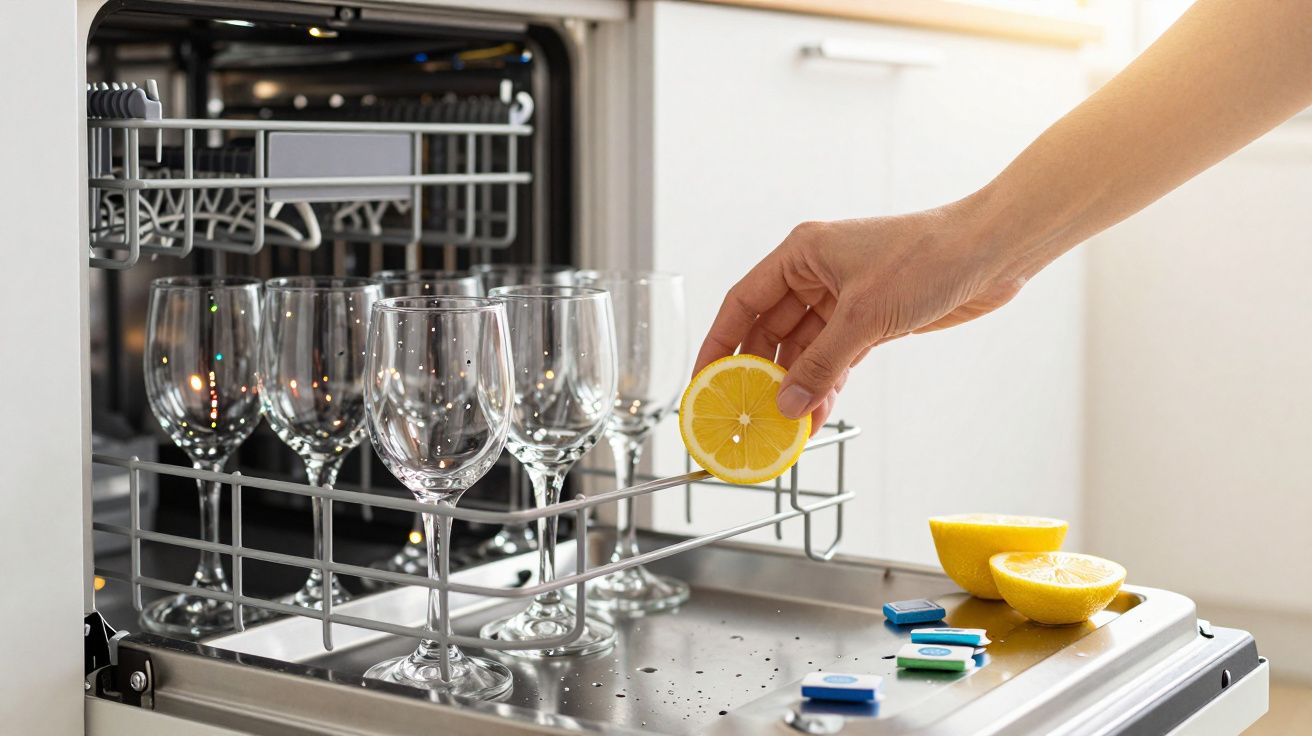
The method people keep sharing is almost suspiciously easy. Before you start the dishwasher, take a fresh lemon, cut one or two thick rounds, and place them in the cutlery basket or on the upper rack. Then run your programme exactly as you normally would-same detergent, same settings.
The lemon isn’t a replacement for detergent. It acts more like a natural helper. As it washes, it releases citric acid into the water, which can gently loosen existing limescale residue and make fresh deposits less likely to cling to your glassware.
Open the door afterwards and, suddenly, your glasses catch the light again. It feels like a magic trick, except it’s come from the fruit bowl rather than a bottle under the sink.
For many households, it begins by accident: someone has half a lemon left over after marinating chicken, doesn’t fancy wasting it, pops it into the dishwasher “for freshness”… and then notices the extra shine on the glasses.
From there it spreads the modern way-by word of mouth and short, addictive videos: a hand placing a lemon slice on the rack, a close-up of dull glass, then the reveal-clear, bright stems without any filter.
One person even tried it like a mini home trial for a month: same dishwasher, same detergent, same cycle. In the weeks with lemon, the wine glasses and jars stayed visibly clearer. In the weeks without it, the whitish veil started creeping back. Not laboratory-grade evidence, but hard to argue with when you’re looking straight at your own cupboard.
The chemistry is simple enough. Citric acid is a mild acid that reacts with the calcium and magnesium in limescale, helping break it down and keep it suspended in the water rather than glued to glass. Lemon peel oils can also add a light degreasing effect, plus the fresh citrus smell you notice when you open the door.
The point is that the lemon works alongside your dishwasher, not against it. You keep your routine; the slice quietly improves the finish.
How to use lemon in the dishwasher without causing problems
Keep it practical:
- Cut 1–2 slices about 1 cm thick from a fresh lemon.
- Pick out any obvious pips.
- Place the slices in the cutlery basket or flat on the top rack, positioned so they won’t interfere with the spray arms.
- Choose a normal cycle rather than an ultra-short one, so the lemon has time to do its job.
- When the cycle ends, bin or compost the used slice-don’t reuse it for another load, as it’s already done what it can.
One slice is typically enough for a standard load. Use two if your water is very hard or the limescale build-up is persistent.
A few easy pitfalls to avoid:
- Lemon won’t make an overloaded machine wash better. If the racks are crammed, glasses still knock together, water still can’t circulate, and deposits still form in the “dry pockets”.
- Don’t drop in whole lemons or big halves-they can wedge in awkward places or obstruct the spray arms. Thin-to-thick slices are safer and just as effective.
- Don’t leave old slices sitting in the machine for days between cycles. You’ll swap a clean, fresh note for a dried, slightly miserable bit of peel.
“Adding lemon to the dishwasher won’t make a failing machine perform like a new one,” says an appliance technician. “But in a working dishwasher with hard water, it can noticeably improve glass clarity for almost no money.”
- Where should the lemon go? In the cutlery basket or on the top rack, away from the spray arms.
- How often should you use it? Once or twice a week, or whenever you’re washing lots of glassware.
- What type of lemon is best? Any fresh yellow lemon; organic if you prefer; leave the rind on.
- What about limes? They contain citric acid too, but the slices are smaller and can slip through baskets.
- Can you stop using commercial rinse aid? You may be able to reduce it, but don’t expect lemon to handle every job rinse aid is designed for.
Beyond the trick: what this little slice really changes
A lemon slice won’t fix every household nuisance, but it does subtly upgrade the everyday routine. You cook, you eat, you clear up, you load the dishwasher… and then you add a small, almost sensory step that smells like summer and feels satisfyingly low-effort.
People who adopt it often say it’s hard to give up-not only because the glasses look better, but because it’s pleasing to get a smarter result from something natural and modest. One of those quiet habits that makes the kitchen feel looked after.
It can also prompt a bigger thought: how many older, simple solutions have we abandoned in favour of specialist products? How many peels, slices and leftovers could do one more useful job before they head for the bin?
Next time you spot that dull film returning to your glassware, you may glance at the fruit bowl differently-and perhaps pass the experiment on to someone else who’s privately irritated by their cloudy wine glasses.
Related kitchen tips you might want to try next
- Rubbing lemon on avocado to keep it green for hours
- Putting newspaper in vegetable drawers to absorb moisture and odours
- Boiling vinegar and water to remove limescale from kettles
- Leaving half a lemon in a warm oven to lift baked-on smells
- Using bicarbonate of soda to remove coffee stains from vacuum flasks
- A creamy pumpkin pasta sauce for an autumnal dinner
- Freezing bananas for quick, healthier desserts
- Rubbing lemon on plastic chopping boards to lift stains
Key points at a glance
| Key point | Detail | Value for the reader |
|---|---|---|
| Natural descaler | Lemon’s citric acid helps loosen limescale residue on glass | Brighter, shinier glasses without extra products |
| Simple routine | Put 1–2 lemon slices in the cutlery basket or on the top rack | Easy to adopt; no need to change dishwasher settings |
| Low-cost experiment | Uses leftover lemon you might otherwise throw away | Less waste, better everyday results |
FAQ
Question 1: Does lemon really replace rinse aid in the dishwasher?
Not entirely. Lemon can improve shine and reduce limescale marks, but rinse aid is designed to help drying and reduce water spotting. Many people find lemon lets them use less rinse aid, rather than none at all.Question 2: Can lemon damage rubber seals or metal parts in my dishwasher?
Used as a couple of slices now and then, it’s unlikely to cause harm-the acidity is mild and heavily diluted by the wash water. Constantly adding large amounts of lemon juice (or other strong acids) isn’t recommended.Question 3: Will my glasses and plates smell of lemon afterwards?
Any light citrus scent usually fades as items dry. Most people notice it when they open the door straight after the cycle, not while drinking from the glass.Question 4: Is it better to use lemon slices or bottled lemon juice?
Slices tend to work better in practice: they stay put, release acid gradually, and are easy to remove. Bottled juice can drain away early in the cycle and end up doing less.Question 5: What if my glasses are already permanently cloudy?
If the glass is etched, no simple trick will restore the original clarity. Lemon helps with surface limescale, not permanent structural damage. A quick check: if rubbing the glass with vinegar or lemon doesn’t change the cloudiness, etching is the likely cause.




Comments
No comments yet. Be the first to comment!
Leave a Comment