
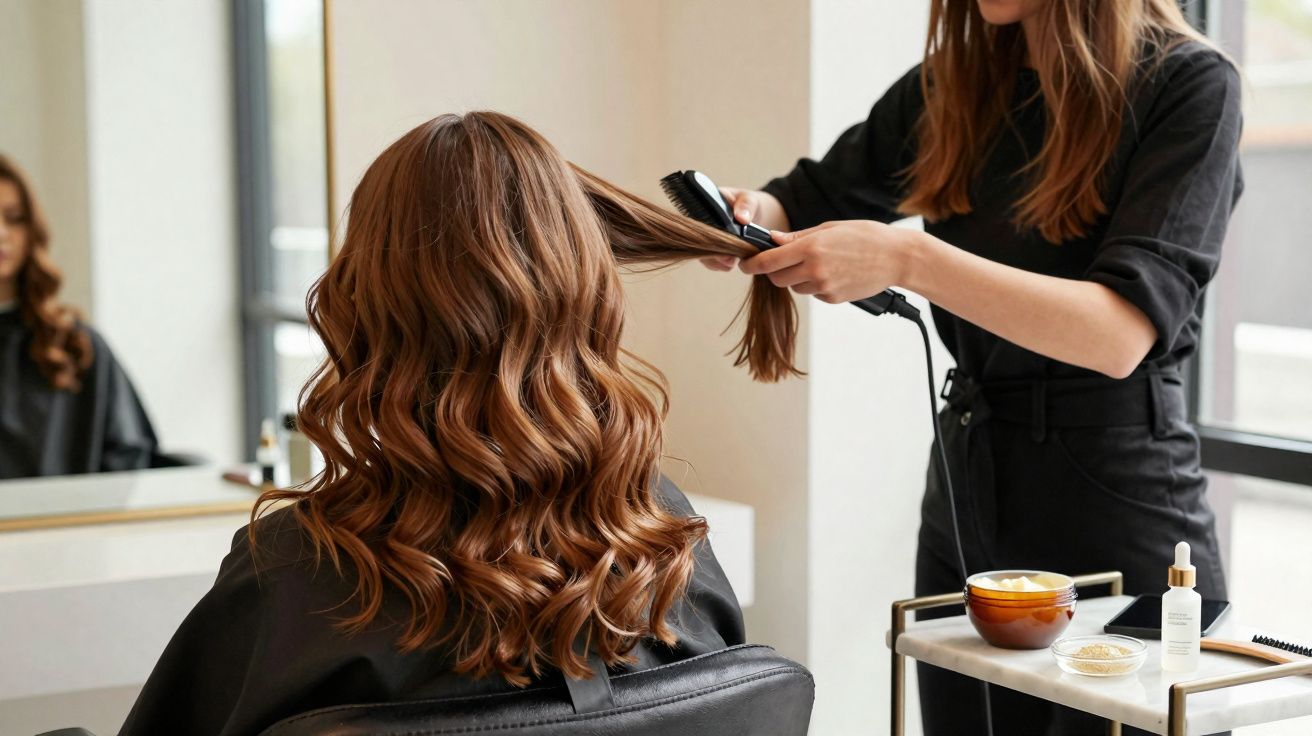
In salons from Paris to New York, a new kind of smoothing service is steadily taking the place of the pin-straight, chemical-laden looks that defined the last era of hair straightening.
Many stylists are now championing nanoplasty-a treatment positioned as a way to smooth, fortify and add shine, while avoiding the harsh chemicals that made the Brazilian blowout so divisive.
From Brazilian blowout to nanoplasty: what’s changing in smoothing services
For well over ten years, the Brazilian blowout was the default answer for anyone fed up with frizz, unruly curl patterns or the daily routine of heat straightening. The pitch was easy to understand: hair that stays poker-straight for months, with far less effort each morning.
The backlash was equally straightforward. Many products depended on formaldehyde or closely related ingredients that can give off fumes once a straightener is applied. That has repeatedly raised health concerns for clients and, in particular, the professionals doing the treatments day in, day out.
Nanoplasty is being introduced as a smoothing service that frames itself less as a chemical “shortcut” and more as a high-performance repair treatment that also happens to straighten.
Rather than fitting neatly into “chemical straightening”, nanoplasty is marketed as a blend of two ideas: part intensive conditioning ritual, part longer-term smoothing.
What nanoplasty actually does to the hair fibre
Most nanoplasty formulas combine amino acids, vitamins and collagen. These are familiar haircare ingredients, widely used to support the hair fibre, help with elasticity and create a smoother outer surface by coating raised, damaged cuticles.
Salon protocols typically state that the active mixture is intended to move past the cuticle and into the cortex-the inner structure of the hair shaft that influences both strength and shape. In other words, it aims to work on two fronts: easing the hair’s natural pattern while also reinforcing the strand.
The promise isn’t only straighter hair, but hair that feels silkier, looks glossier and snaps less-while staying smoother for around four to six months.
Compared with many traditional straightening systems, nanoplasty treatments sold across Europe and North America frequently highlight that they contain no formaldehyde or similar aggressive agents. That doesn’t automatically equal “100% safe” or “100% natural”, but it does signal a clear change in how smoothing services are presented and discussed.
Nanoplasty results: a more natural finish than ultra-straight hair
A major draw is the end result. Where older straightening services could leave hair stiff and ruler-straight, nanoplasty is usually described as retaining movement. Waves tend to be loosened and softened rather than pressed completely flat.
That appeals to people who dislike the dry, “straw-like” appearance sometimes associated with heavy straightening: fewer flyaways, reduced root puffiness, but still some bounce and shape through the lengths.
For many clients, this also translates into less day-to-day reliance on straighteners-tools that can be a significant contributor to dryness and breakage when used at high temperatures every morning.
Who nanoplasty is for (and who should think twice)
Stylists often steer nanoplasty towards people with:
- wavy or frizzy hair that expands in humid weather
- curls that are routinely straightened with heated tools
- long hair with dry, porous mid-lengths and ends
- hair that’s been stressed by repeated colouring or highlights
If you have very tight curls or coils, the outcome is more likely to be a noticeable loosening than a glass-like, mirror-straight finish. Some people choose it specifically to soften the overall texture while keeping a degree of curl definition.
If your hair is extremely fragile or has been heavily chemically processed, extra caution is still essential. Even with a less aggressive formula, the straightening phase typically uses temperatures above 200 °C, which can put additional strain on already weakened fibres.
Two practical considerations many salons discuss less
It’s also worth thinking about timing and comfort. If you’re prone to scalp sensitivity, ask whether a patch test is appropriate and whether the product is applied right up to the roots or kept slightly off the scalp. People with asthma, allergies or migraines triggered by strong smells may also want to check ventilation and how the salon manages fumes during heat sealing.
Finally, if you colour your hair, plan your appointment order carefully. While many clients do combine colour services and smoothing, your stylist should advise on spacing to avoid over-stressing the hair fibre and to reduce the risk of tone changes in freshly coloured lengths.
How a nanoplasty session works in the salon
Nanoplasty is not a quick add-on at the basin. In most salons, it’s booked as a multi-hour service.
| Step | What happens |
|---|---|
| 1. Clarifying wash | The hair is shampooed to remove oils, silicone and product build-up. Conditioner is not applied. |
| 2. Application | The nanoplasty formula is worked through section by section, from roots to ends, to ensure consistent coverage. |
| 3. Processing time | The product is left on for 40–60 minutes, depending on length, density and texture. |
| 4. Rinse and blow-dry | The hair is lightly rinsed and then blow-dried in preparation for heat sealing. |
| 5. Flat ironing | Each section is passed through straighteners repeatedly at roughly 220–230 °C to lock in the active ingredients. |
After the service, clients are commonly advised to avoid getting the hair wet, sweating heavily, or tying it back tightly for two to three days. This “setting” window is intended to let the treatment stabilise along the hair shaft.
The aftercare period can be the difference between results that fade closer to four months and results that last nearer six.
How long nanoplasty lasts-and how to maintain the results
Most salons quote longevity of about four to six months. The exact duration varies significantly depending on your hair type, how frequently you wash, and which products you use afterwards.
Shampoos high in sulphates can speed up fade-out. Strong clarifying shampoos, salt water, and frequent swimming in chlorinated pools can also shorten how long the smoothing effect remains noticeable.
To extend results, many stylists recommend switching to sulphate-free shampoos, using richer conditioners, and applying heat protection sprays if you still style with hot tools.
Nanoplasty vs Brazilian blowout vs hair botox
The modern salon menu contains several treatments that sound alike, and marketing language often makes the differences harder to spot. In simple terms:
- Brazilian blowout: a classic long-wear straightening service, historically associated in some markets with formaldehyde-based formulas.
- Hair botox: primarily a deep-conditioning approach that targets damaged cuticles for a smoother feel, with only mild straightening.
- Nanoplasty: sits in the middle-aiming for a clear smoothing effect while being positioned as more treatment-led and less chemical-heavy.
In reality, product names and ingredient lists can differ substantially by brand and by country. If you have allergies, asthma or a reactive scalp, it’s especially important to ask directly about ingredients, fumes and the heat level used.
What amino acids and collagen really contribute
Nanoplasty advertising often leans heavily on amino acids and collagen. They’re not miracle ingredients, but they do have understandable functions.
Amino acids are the building blocks of keratin, the main protein that makes up hair. When used in topical treatments, they can support hydration and pliability, which may help hair resist snapping under brushing, tension or heat styling.
Collagen largely works on the surface. It can form a coating that makes hair feel smoother and appear shinier, and it may lessen the roughness that contributes to frizz. It won’t “rebuild” hair from the ground up, but it can make damaged lengths look more even and glossy.
For many clients, the biggest shift isn’t the terminology-it’s simply hair that detangles easily, dries faster and demands less daily effort.
Potential risks and questions to ask your stylist
Even with a gentler image, nanoplasty remains a chemical service paired with very high heat. Anyone who is prone to scalp irritation, odour-triggered migraines, or allergic reactions to cosmetic ingredients should take extra care.
Before you book, consider asking:
- Does the product give off any fumes during ironing, and how is the space ventilated?
- Is the formula free from formaldehyde and related compounds?
- What minimum gap is recommended between colour services and nanoplasty?
- Roughly how many straightener passes will be done on each section?
- Which aftercare products are suitable, and what should be avoided?
Cost matters too. Because it can take several hours and requires specialist technique, nanoplasty often sits in the upper price range on salon menus-particularly for very long or very thick hair.
Real-life scenarios: who may benefit most from nanoplasty
If you have shoulder-length, naturally wavy hair that turns fluffy at the first sign of rain, nanoplasty can mean stepping out with air-dried hair that still looks neat. You may keep a gentle wave, just without the surrounding haze of flyaways.
A busy parent who previously spent about 30 minutes every morning straightening might find their routine shrinks to a quick brush, with only the occasional styling touch-up and a light spritz of heat protection.
By contrast, if you genuinely enjoy wearing your curls most days and only want the option of easier straightening now and then, a softer service such as hair botox may suit you better, as it focuses on repair without such a marked texture shift.
For anyone weighing up a smoothing treatment, nanoplasty broadens the choices: less about rigid, ultra-straight hair at any cost, and more about a negotiated level of frizz control, shine and styling time-while keeping an eye on the long-term condition of the hair fibre.


Comments
No comments yet. Be the first to comment!
Leave a Comment