
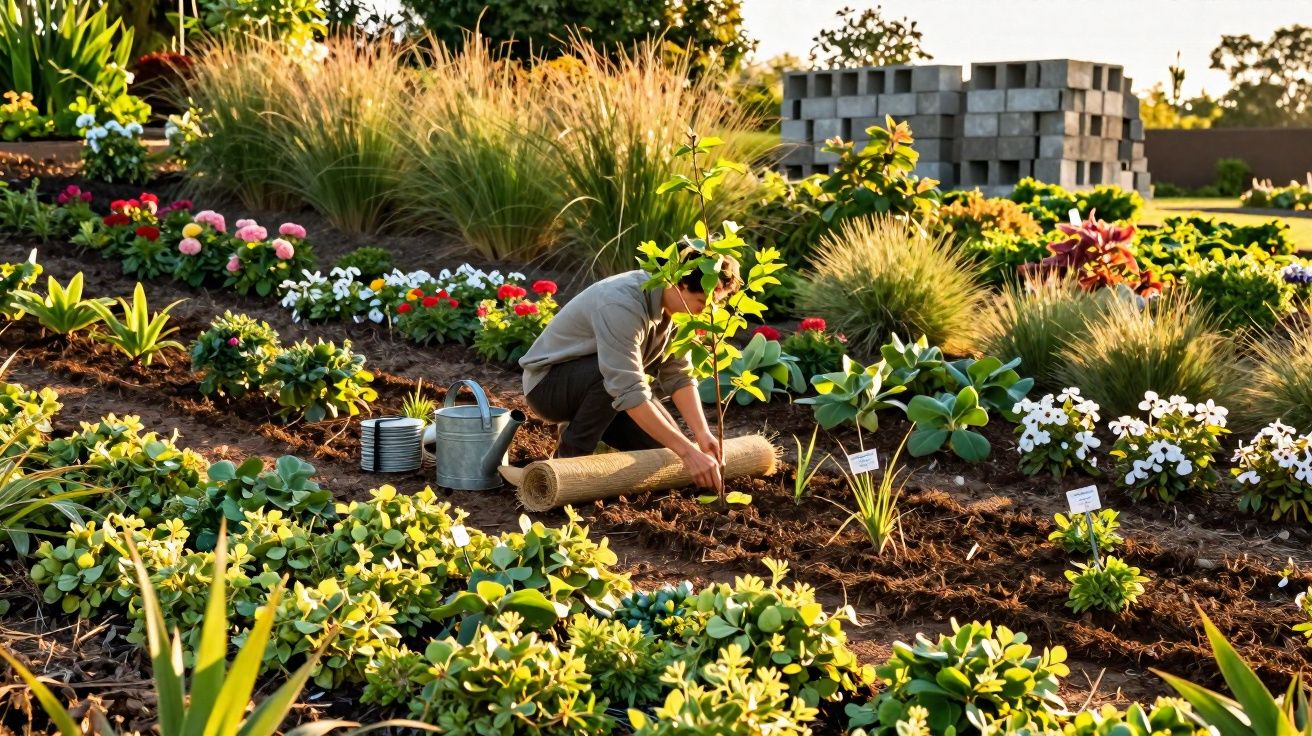
A bare mound of earth in the garden can turn into a trouble spot - or into a flowering showpiece that tames rainwater and keeps costs down.
Many homeowners get fed up with slipping banks, barren slope gravel and rainwater that rushes straight towards the patio. Instead of paying for expensive concrete retaining walls, more and more garden professionals are choosing a surprisingly simple answer: the right planting. With a well-thought-out planting plan, a slope can be stabilised for under €20 per m² (roughly £17 per m²) and visually transformed into a blooming cascade.
Why a planted slope is often a better choice than a concrete wall
At first glance, a slope can look like a pure structural engineering problem. People often reach for walls, concrete “L” retaining units, or solid concrete plinths. These typically come in at around €150–€300 per m² (about £130–£260 per m²) - and they don’t always feel particularly welcoming in a garden setting.
With carefully chosen slope plants, you can achieve comparable stability - for less than a tenth of the cost of a solid wall.
The principle behind this is often described as engineering biology: plants take on jobs that would otherwise require concrete and steel. Their roots bind and interlock the soil, their foliage breaks the force of rainfall, and their evapotranspiration helps improve the microclimate. The result is a living support system that strengthens year after year, rather than ageing and degrading.
Phytostabilisation: how roots hold a slope like a net
Landscape designers use the term phytostabilisation when plants are deliberately used for slope stabilisation. The key is choosing species with shallow, strongly branching root systems that stitch through the soil like a three-dimensional mesh.
Common choices include tough groundcovers and small shrubs such as:
- creeping Hypericum species (St John’s wort relatives)
- low-growing Cotoneaster (dwarf cotoneaster)
- Vinca minor (lesser periwinkle) for shadier areas
- creeping cranesbill varieties (Geranium)
There’s a second benefit as well: dense leaf cover softens the impact of raindrops. Instead of heavy downpours tearing open the surface and carving channels into the bank, water infiltrates more slowly. This reduces erosion and helps the soil stay moist for longer.
How professionals plant a garden slope: step by step to a stable planted bank
If you want a slope to hold long-term, it pays not to “just start planting”. Careful preparation avoids headaches later.
1. Prepare the slope and remove weeds properly
Start with thorough groundwork:
- Remove weeds with their roots, especially couch grass and docks.
- Dig out large stones, rubble and thick leftover roots.
- Roughen the surface lightly with a rake so water can soak in rather than run off.
Putting the time in here makes a big difference later, because deep-rooted perennial weeds are notoriously hard to remove once they’ve re-established on a bank.
2. Choose the right planting density
To create a stable cover that closes quickly, professionals plant densely - usually 4 to 5 plants per m².
Plants are set out in staggered rows (a “staggered” pattern) so you don’t end up with bare lines - you get a continuous carpet.
A good visual technique is to plant small clusters of 6 to 7 plants of the same species. This creates “blocks” of colour that later merge into natural-looking drifts.
3. Protect the slope with mulch and jute
Once planting is done, protect the soil immediately:
- Heavier mulch such as woodchips, or fresh chipped ramial wood (often sold as BRF-style chips), helps keep moisture in and is less likely to slip downhill.
- From around a 15% gradient, a jute or coir mat is very helpful. Lay it over the soil, pin it securely, then cut cross-shaped slits to push plants through.
Avoid plastic sheeting or tightly woven synthetic membranes. They smother soil life, can cause waterlogging, and often break down into microplastics after a few years.
Three planting zones for a true flowering cascade (garden slope planting)
To make sure the bank is not only stable but also attractive, professionals design in three tiers: top, middle and bottom. Each zone has its own conditions.
| Zone | Conditions | Suitable plants |
|---|---|---|
| Upper slope | dry, exposed to wind, heat | ornamental grasses, Physocarpus (ninebark), broom, Teucrium, ornamental spindle (Euonymus) |
| Middle slope | highest erosion risk, sunny, often steeper | Heuchera, Sedum, Erigeron, Gypsophila, clubmoss-like groundcovers, Hypericum |
| Lower slope | more moisture, richer soil | Alyssum, Campanula (bellflowers), violets, low Sedum and Erigeron varieties |
Between planted areas, placing larger stones or small boulders can help. They form mini-terraces, visually break up the gradient, and hold soil back at vulnerable points.
Extra stability without concrete: guide the water as well as the plants
Even the best planting performs better when surface water is managed. On slopes where runoff tends to race downhill, consider adding subtle features that slow and spread water - for example, small level “ledges” formed with stones, or shallow cross-slope depressions that interrupt flow. The aim is not to create a pond, but to reduce speed so water infiltrates instead of stripping soil.
Also think about where the water goes at the bottom of the bank. If it’s funnelling towards a patio, path or garage entrance, a narrow gravel strip or planted soakaway area can help capture splash and reduce muddiness, especially during summer storms.
When to plant: the best windows for stable banks
Two times of year work particularly well for slope planting:
- Mid-September to late November: the soil is still warm, rain supports establishment, and plants can form first roots before winter.
- March to April: a spring option that suits years with very wet or harsh winters; plants move straight into growth.
In both cases, avoid planting when the ground is waterlogged or frozen. During the first few weeks, regular watering in dry spells is worthwhile - especially on sunny south- or west-facing slopes.
Practical example: from a slipping problem bank to a stable flowering slope
A common scenario: a steep bank, roughly 30°, beside a garage driveway repeatedly washed soil onto the access during heavy rain. Rather than paying for a costly concrete wall, the choice was made to stabilise it using robust groundcovers.
What was done:
- Wide-area planting with periwinkle and creeping groundcovers.
- A jute mat across the entire bank, with cross-shaped cuts for each planting hole.
- A thick layer of woodchip mulch as extra protection.
After two growing seasons the slope was fully covered; rainwater soaked in rather than pouring over the edge. Total spend stayed under €20 per m² (around £17 per m²) - a fraction of what a professionally built concrete structure would have cost.
Where planting alone reaches its limits: when a structural engineer must decide
Despite its advantages, planting is not suitable for every extreme case. If a slope is very high, exceptionally steep, or supports load-bearing structures such as basement walls, bring in a qualified professional. In those situations, a hybrid approach can work well:
- low dry-stone walls combined with planted strips
- gabions (stone cages) that are then planted and greened over
- small terrace steps planted with perennials and shrubs
On very sandy soils or heavily compacted ground, a jute or coir mat is close to essential in the first year. It buys plants the time they need to build a strong root network before winter storms arrive.
Maintenance level, benefits and common mistakes
Many gardeners worry a planted slope will be high-maintenance. In reality, once the cover has closed, the workload usually drops:
- Weed pressure falls sharply under a continuous plant carpet.
- Watering is generally only needed after establishment, during prolonged dry spells.
- A light annual trim is enough for most species.
Beyond stability, planting brings more insects, improved soil structure and a more pleasant garden microclimate.
To avoid disappointment, watch out for three classic errors: planting too sparsely, choosing the wrong species (delicate rock-garden perennials instead of robust slope plants), and skipping mulch protection in the first year. The early phase is what decides whether the bank becomes a flowering cascade - or continues to erode.
How to choose suitable plants and combine them intelligently
A simple colour plan helps create a calm, intentional look. If you want mainly blue and white flowers, combine groundcover bellflowers with grey-leaved perennials and a few grasses towards the top. For a yellow-and-white scheme, lean on Alyssum, yellow groundcovers and pale ornamental grasses.
It also pays to balance growth speed: fast groundcovers deliver the first line of stabilisation, while slower, long-lived shrubs provide structure for years. This layered approach makes the slope not only more attractive, but more secure - because different root systems reinforce one another.






Comments
No comments yet. Be the first to comment!
Leave a Comment