
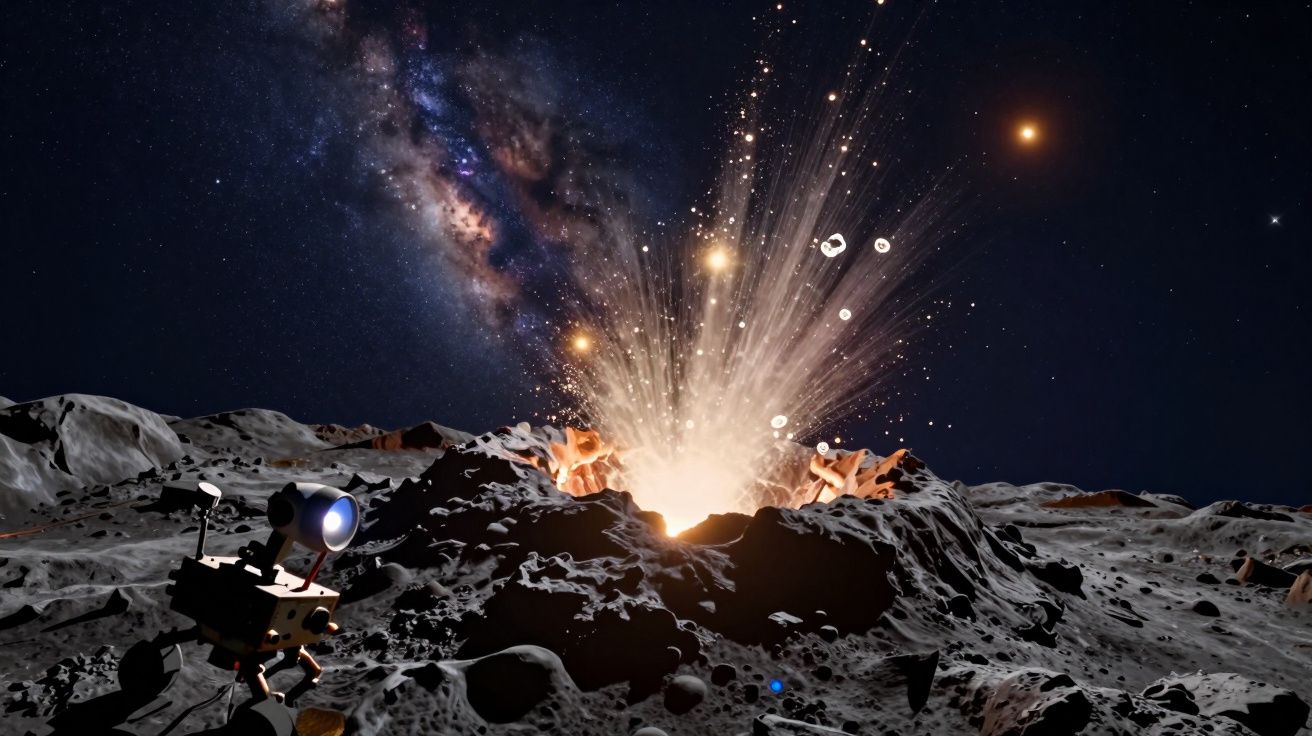
The interstellar comet 3I/Atlas - only the third object ever confirmed to have entered our Solar System from deep space - has produced its most startling development so far. As astronomers followed it close to the Sun, they reported evidence consistent with cryovolcanoes (in other words, ice volcanoes) erupting from its surface, in a pattern that looks remarkably similar to activity seen on icy worlds much nearer to Earth.
What is 3I/Atlas, exactly?
First detected in July 2025 by survey telescopes scanning the sky for short-lived, moving targets, 3I/Atlas earned its “3I” designation because it is the third confirmed interstellar visitor, following 1I/‘Oumuamua and 2I/Borisov. Its orbit is strongly hyperbolic, which is the tell-tale sign that it is not gravitationally bound to the Sun. In plain terms: it is passing through, not coming home.
When researchers integrated its orbit backwards in time, they concluded it probably drifted through the Milky Way for billions of years before it happened to cross our path. If that estimate is right, 3I/Atlas could be older than the Solar System (about 4.6 billion years old) - a deeply frozen remnant from another star system’s early, turbulent era of planet building.
3I/Atlas is both alien and familiar: a wanderer from another star whose behaviour echoes the icy leftovers on the outskirts of our own system.
Because it will not loop back like a typical long-period comet, astronomers treat every night of observation as precious: once it departs the Sun’s influence, it will fade and continue into interstellar space, leaving only measurements behind.
The surprise: cryovolcanoes (ice volcanoes) on an interstellar comet 3I/Atlas
Around the time 3I/Atlas swung through its closest approach to the Sun, a team led from Spain’s Institute of Space Sciences used the Joan Oró telescope at Montsec Observatory to monitor it in detail. They expected the usual cometary display: sunlight heating surface ice, producing relatively smooth jets of gas and dust.
What they found appeared more complex. Instead of only steady, radial outflow, the coma showed multiple curved, structured jets that seemed to switch on and off, resembling eruptions from discrete vents - closer to geysers than to uniform sublimation. When the team modelled the jet geometry and compared spectra from the material being expelled, a scenario emerged that looked strongly like cryovolcanism.
The observations are consistent with pockets of volatile ice and oxidising liquids trapped beneath the surface, rupturing upwards and producing explosive bursts of gas and dust.
In planetary science, cryovolcanoes are not “hot” volcanoes at all. They are eruptions of cold or semi-molten material (slurries, vapours, brines) driven by pressure build-up, phase changes, and chemical energy inside an icy body. Within our Solar System, cryovolcanoes have been proposed or identified on Pluto, Triton, and Ceres.
Why cryovolcanoes are so unexpected here
Seeing cryovolcano-like behaviour on 3I/Atlas surprised researchers because an interstellar comet could, in principle, contain almost any mixture of ice and rock, assembled around a different star under different conditions. Yet the activity looks similar to what is seen (or inferred) on icy objects in the outer Solar System, particularly trans-Neptunian bodies beyond Neptune.
The data indicate a surface rich in carbonaceous material, with water ice, carbon dioxide (CO₂) and other ices mixed through fine dust. As 3I/Atlas approached the Sun, more volatile species such as CO₂ would begin to sublimate (turning directly from solid to gas). That outgassing can enlarge fractures, drive material movement into deeper layers, and pressurise sealed pockets below the surface.
The team’s interpretation goes a step further: they suggest an oxidising liquid - likely brines containing oxygen-bearing compounds - could infiltrate the interior and react with grains of iron, nickel, and sulfides embedded in the matrix. Such reactions can generate heat and release gases, providing extra energy to trigger localised blow-outs through weak crustal zones. The result would be the kind of bent, episodic jets now observed in the coma.
The chemistry behind a frozen eruption
To probe this idea, the researchers did more than inspect images. They compared spectra from 3I/Atlas with laboratory measurements of carbonaceous chondrites - a class of meteorites that preserve primitive, carbon-rich material and organic compounds from early Solar System bodies that never completely melted and differentiated.
One comparison proved especially striking: a meteorite fragment thought to have originated from a trans-Neptunian object, later recovered during a NASA expedition in Antarctica. Its reflectance features and broad compositional signature were close to what the team inferred for 3I/Atlas.
Something that formed around another star appears to share chemistry with icy remnants at the edge of our own planetary system.
If that link holds up, it implies that planet-forming discs around different stars may build comets and small bodies from broadly similar raw materials: iron and nickel, sulfide compounds, carbon-rich dust, and a varied cocktail of ices. In other words, the outcome may be shaped as much by universal chemistry as by local history.
Why this matters for the story of life
Many models of the early Solar System suggest comets helped deliver water and complex organic molecules to the young Earth. Some of the precursors for biology may have arrived in vast numbers of icy impacts. If 3I/Atlas truly shares a comparable carbonaceous, metal-bearing composition, it strengthens the case that the building blocks for life could be widespread around other stars as well.
It also supports a larger possibility: planetary systems elsewhere might experience similar long-term “delivery” of water and prebiotic chemistry, especially if interstellar comets like 3I/Atlas are common and roam the galaxy in large numbers over immense timescales.
Key points at a glance
- Source region: likely formed in the outer disc of another star.
- Age: potentially older than the 4.6-billion-year-old Solar System.
- Composition: carbonaceous material, metals, sulfides, and mixed ices.
- Activity: multiple structured jets consistent with cryovolcanoes (ice volcanoes).
- Fate: a one-off passage; it will not return after escaping the Sun’s gravitational hold.
A quick comparison with other interstellar visitors
| Object | Type | Year of discovery | Notable feature |
|---|---|---|---|
| 1I/‘Oumuamua | Elongated body, unusual | 2017 | Non-gravitational acceleration with no obvious coma |
| 2I/Borisov | Comet-like | 2019 | Looked broadly similar to Solar System comets |
| 3I/Atlas | Interstellar comet | 2025 | Evidence of cryovolcanoes and carbonaceous, metal-rich composition |
‘Oumuamua famously raised more questions than it answered, with its cigar-like form and unexplained acceleration. 2I/Borisov appeared far more typical, resembling an ordinary long-period comet. 3I/Atlas now provides a third example - and, with its apparent cryovolcanic behaviour, shows that interstellar objects can be not only active, but also geologically intriguing.
Why astronomers feel the clock ticking
3I/Atlas passed perihelion - its closest point to the Sun - on 30 October. From here on, it recedes each week, dimming as it returns to the cold between the stars. Observers are racing to collect data before the coma thins and the jets weaken or shut down.
Worldwide facilities are tracking its brightness and tail structure. Some teams prioritise colour and spectroscopy to refine the inventory of ices and dust. Others focus on modelling jet dynamics to infer the nucleus’s internal layout.
This is effectively a one-shot experiment: once 3I/Atlas is gone, only the dataset will remain.
A practical challenge is that an interstellar comet’s visibility can change quickly with distance, solar illumination, and viewing geometry. That makes coordinated observing campaigns especially valuable, combining different instruments and wavelength ranges to build a complete picture before the object fades beyond reach.
How cryovolcanoes work on icy worlds
To interpret the behaviour of 3I/Atlas, scientists draw on decades of work on icy bodies in the outer Solar System. On Pluto, images from New Horizons show domes and flows resembling frozen lava, likely made from slushy water ice or nitrogen-rich material. On Enceladus, a moon of Saturn, jets of water vapour and ice grains vent from fractures, sustaining a persistent plume and contributing material to a faint ring.
Cryovolcanoes do not require extreme heat. They can operate wherever there is a contrast between a cold exterior and a slightly warmer or more pressurised interior, plus pathways such as fractures or conduits. On a small nucleus like 3I/Atlas, a combination of solar heating and internal chemical reactions could plausibly supply enough energy to initiate eruptions, particularly once volatile ices begin to sublimate and build pressure.
What this means for future missions and models
Interstellar comets such as 3I/Atlas are increasingly high priorities for future spacecraft concepts. A fast-response probe capable of interception could image the nucleus at close range and directly sample freshly ejected material, replacing educated guesswork about other star systems’ small bodies with hard measurements.
Until such missions exist, researchers depend on simulations that blend gravitational dynamics, thermal physics and chemistry. By adjusting parameters such as porosity, ice abundance, metal fraction and rotation rate, they attempt to reproduce the observed jets and brightness evolution. Each model run that matches the data reduces the plausible range of internal structures for 3I/Atlas.
Beyond the headline of “ice volcanoes in deep space”, the broader implication is about habitability across the galaxy. Cryovolcanic activity suggests transient fluid circulation, even if it is brief and local. That circulation can move organics, alter minerals and accelerate complex chemistry in pockets where conditions briefly become favourable.
For astrobiology, such chemistry can matter almost as much as oceans and atmospheres. It reinforces the emerging view that small icy bodies may act as distributed chemical reactors - scattered around countless stars - quietly processing the ingredients that, in the right place and time, can contribute to living systems.






Comments
No comments yet. Be the first to comment!
Leave a Comment