
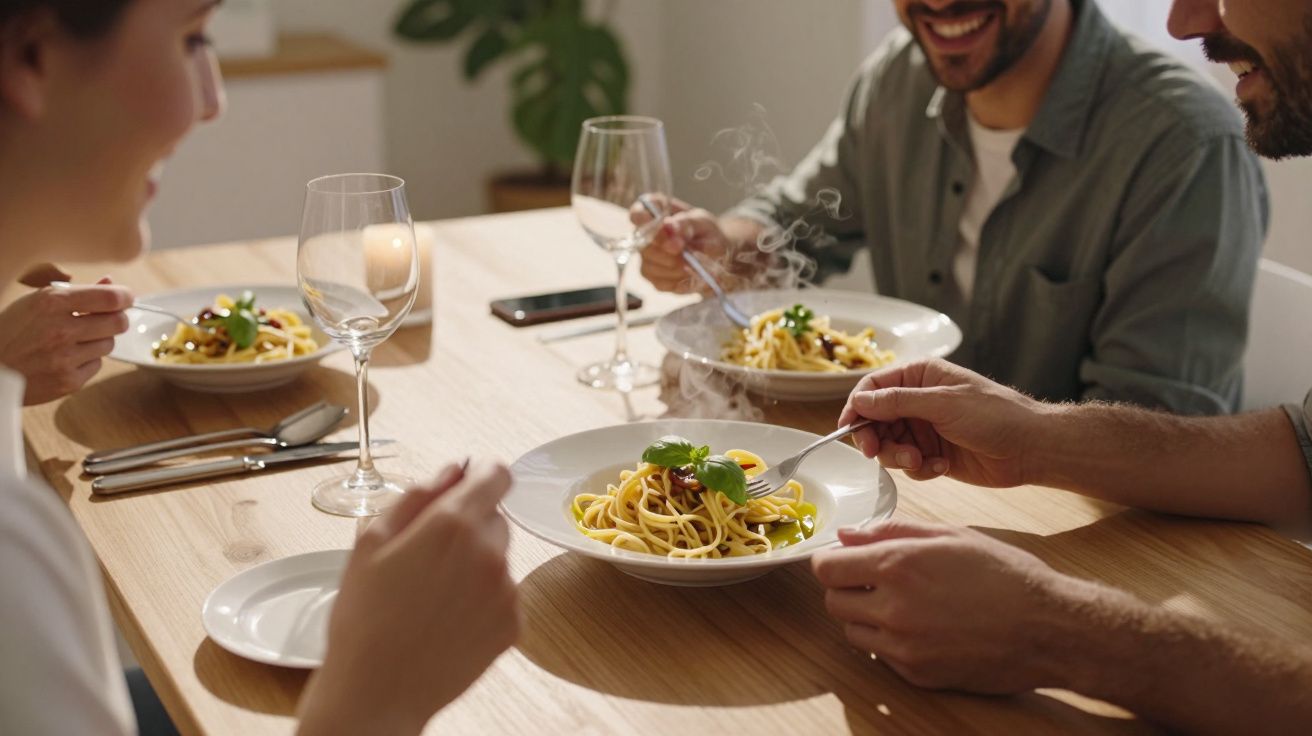
The fork stops partway to your lips.
It’s the same pasta, on the same plate, made from the same recipe you’ve cooked countless times. Last night, eaten in front of a TV series, it was… all right. Tonight, with friends packed around the table and laughing far too loudly, it suddenly tastes fuller, almost sweeter-as if someone quietly swapped in better ingredients.
You go in for another mouthful, but more slowly. The sauce seems to coat the pasta in a new way; the basil feels more vivid; the salt reads as bolder. Or maybe it’s the wine, the atmosphere, the stories bouncing around the room.
Opposite you, someone winces at a bite that’s far too spicy, and the whole table erupts. One shared grimace, one burst of laughter-and your brain subtly edits what your dinner tastes like.
The recipe hasn’t changed. You have.
Why the same dish doesn’t taste the same: social facilitation of eating and taste perception
Researchers have a name for this odd shift: social facilitation of eating. It sounds clinical, but it points to something intensely human-how an ordinary meal can feel almost cinematic when it’s eaten with other people.
When you eat by yourself, your attention tends to narrow onto the plate. You clock the texture, notice the minor mistakes, pick up on the slightly overcooked bit of chicken. In company, your focus spreads across the whole scene. Flavours mingle with voices, aromas tangle with stories, and your brain blends it into one noisy, satisfying experience.
Eating alone puts the spotlight on the food. Eating together puts the spotlight on the moment.
Studies in laboratories and everyday settings such as cafeterias show a consistent pattern. In groups, people don’t only eat more; they often report that the very same food tastes better-warmer, more comforting, somehow “more like a proper meal”.
One UK study tracked employees in a workplace canteen. The offering stayed the same and the menu remained predictably repetitive. Even so, people who sat at busy tables rated their lunch as tastier than colleagues who took a quick tray to a quiet corner.
A smaller, familiar example is the office birthday cake. It’s dry supermarket sponge, icing that’s too sweet, crumbs everywhere. Eaten alone at your desk, it would barely register. Shared at 3 pm while colleagues trade gossip about the boss, it suddenly becomes… actually quite nice.
The food didn’t improve. The context simply gave it a better storyline.
Beneath that storyline sits your brain’s reward circuitry. When you eat with others-particularly people you enjoy-your body tends to release more dopamine and oxytocin. Those chemicals don’t only heighten connection; they also dial up pleasure, which spills over into how tastes are perceived.
Your senses aren’t delivering pure, objective reality; they’re interpreting signals. If your brain is already in a socially safe, “this is good” state, it is more likely to lean into sweetness, richness and comfort. If you’re lonely, tense, or doomscrolling while you chew, your brain can tilt the experience towards dullness and dissatisfaction.
We like to think taste happens on the tongue. In truth, a large part of it happens in the mind-and the people around your table can influence it directly.
One more factor worth noticing is expectation. If you anticipate a brilliant evening, you often “taste” that optimism in advance; if you arrive anxious or self-conscious, even your favourite dish can feel strangely muted. The flavour is real, but the meaning your brain assigns to it changes the whole experience.
How to “hack” your taste when you eat alone or with others
If eating solo makes food feel flatter, there’s a surprisingly effective approach: give your brain the signals of a shared meal. It doesn’t need to be fake-just social enough to nudge perception in a different direction.
Set a proper place at a table rather than eating over the sink. Put your phone on flight mode and play a podcast with warm, natural conversation. Try eating at a consistent time, more like a diary appointment with yourself than a rushed refuelling stop.
For some people, a quick call with a friend while they eat changes the entire meal. Others build a tiny “dinner ritual”: a candle, a proper glass, a song they always play. It sounds trivial, but your brain reads it as a message: this matters.
When you eat with other people, your sense of taste can be tugged around in ways you barely notice. You may match the group, eat quicker, or miss subtle flavours because the conversation is too engaging.
At times you end up declaring, “That was amazing!” largely because everyone else did. Social pressure is another quiet guest at the table. You keep smiling through an over-salted risotto because the host looks both proud and slightly worried.
Let’s be honest: nobody manages this perfectly every day. Still, pausing occasionally-even mid-laughter-to truly register what’s on your fork can change the whole experience. Aim for one mindful bite per meal: a single moment where you feel the crunch, the heat and the aroma before it vanishes.
That’s how you stop the group from completely hijacking your senses. You remain present with people and present in your body.
Another helpful tweak is to use contrast on purpose. If you know a social meal will be noisy and fast, choose foods with clearer sensory cues-something with crunch, acidity, herbs or heat-so flavour has a better chance of cutting through the chatter.
“We don’t just share food, we share perception. The same dish becomes five different experiences around one table, and each of us edits the flavour with our mood, memories and relationships.”
To make this usable in real life, keep a small mental checklist-like an invisible note to yourself:
- Change your setting when you eat alone: table, lighting, sound.
- Keep at least one mindful bite during social meals.
- Notice what mood you were in before you started eating.
- Ask someone else what they’re actually tasting.
- Forgive yourself for comfort-food days that are more about feelings than flavour.
On a rough day, none of this will turn instant noodles into a Michelin star experience. What it can do is turn dinner back into a human moment rather than something you do in the background.
When taste becomes a mirror of your social life
Once you start noticing this, you’ll see it everywhere. The lonely supermarket sandwich eaten in a car park. The chaotic Sunday lunch where half the food is cold, yet your aunt’s roast potatoes become somehow legendary.
The difference isn’t the seasoning. It’s who was there-or who wasn’t. A quiet bowl of soup on a Tuesday can taste painfully bland because it’s also a reminder: tonight, it’s only you. Yet that very same soup, with rain tapping at the windows and a friend telling a story across the table, can suddenly taste “like home”.
Your taste buds are keeping a record of your relationships.
A single question can shift how you eat this week: what if food is less about flavour and more about the ways we avoid feeling alone-even when we’re physically by ourselves?
Some people keep a book that’s reserved for mealtimes only. Others send a photo of their plate to a friend each evening, a tiny ritual that bridges distance. The dish stays identical; the narrative around it changes-and so does the taste.
| Key point | Detail | Why it matters to you |
|---|---|---|
| Social context changes perception | The brain releases more dopamine and oxytocin when other people are present | Explains why shared meals often feel more delicious |
| Solo eating can be “enhanced” | Rituals, soundscapes and a bit of staging recreate social cues | Makes solitary meals feel less bleak and more comforting |
| One “mindful bite” can shift the whole meal | Taking a few seconds to notice texture, smell and flavour | Helps you enjoy food more, whether alone or with others |
FAQ
- Why does food taste better with friends than alone? When you’re with people you like, your brain tends to release more “feel-good” chemicals. That social pleasure bleeds into flavour, making the same dish seem richer, warmer and more comforting.
- Can loneliness really change how food tastes? Yes. If you feel lonely or low, reward signals can be dampened. Foods you usually enjoy may taste flat, overly salty, or simply “meh”, even if the recipe is identical.
- Is it normal to eat more in groups without noticing? Completely normal. Social facilitation of eating means we often eat more and faster around others-especially in relaxed situations-because we’re attending to conversation rather than internal fullness cues.
- How can I make solo meals feel less depressing? Build a small ritual: sit at a table, light a candle, play a friendly podcast, and plate your food properly. These cues tell your brain it’s a real meal, not an afterthought.
- Does mindful eating work if I’m with other people? It can. You don’t need to turn dinner into a silent retreat. Just take one or two mindful bites per meal-pause, taste fully-then return to the flow of conversation.





Comments
No comments yet. Be the first to comment!
Leave a Comment