
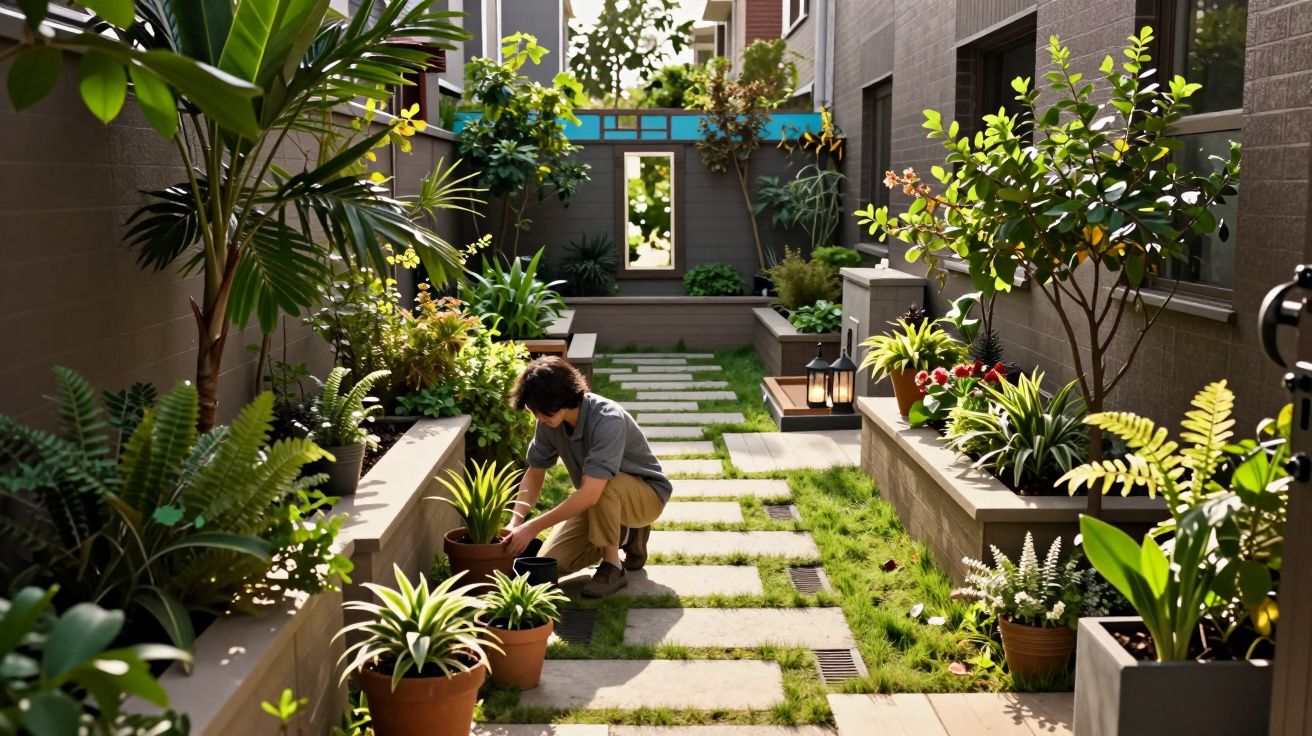
The first time it hits you, you’re standing in your little back garden with a mug of coffee, trying to work out why everything feels… two-dimensional. The beds are planted, the flowers are objectively lovely, the lawn is green enough. Yet the whole scene sits there like a picture sealed behind glass: no layers, no intrigue, nothing that draws you in or makes you want to wander.
Then you pop round to a friend’s place. Their garden is barely any larger than yours, but it feels like a different world. The path doesn’t run straight; it bends. A small tree tips into the view. The back fence somehow looks further away than it has any right to. You can still hear city noise in the distance, but the space reads like a private slice of countryside.
Same square metres. Completely different experience.
That’s the moment you realise a garden that feels generous isn’t accidental - it’s planned.
Why some small gardens feel bigger than they are
Step into any genuinely inviting small garden and something curious happens: your gaze doesn’t stop at the boundary. It moves. It follows a curve of paving, pauses on tall grasses, hops to a tree at the far end, then lands on a bench that’s tucked just out of full view.
That visual journey is designed. People who garden in compact urban plots are, in effect, set designers: they build layers, create overlaps, and control what you notice immediately versus what you discover later with a second cup of tea.
The footprint stays the same; the perceived space expands.
Picture the classic “before”. A neat rectangle of lawn, a thin border pressed against the fence, a few pots of geraniums, and the barbecue shoved into a corner. From the back door you can see everything in one glance - and because there’s nothing to uncover, your brain loses interest quickly.
Now imagine the same 40 m² garden split into three quiet zones: a small paved terrace close to the house, a mid-garden area with taller planting and a small tree, and, at the back, a slim bench partly screened by a trellis with climbing jasmine. Suddenly your eyes have to travel through the garden rather than simply scan it.
You haven’t gained a single square metre, but the space upgrades itself in your mind from “patch of outside” to “garden”.
What’s happening is close to optical sleight of hand. Before we consciously register “rose” or “hosta”, our eyes read height, diagonals, shadow, enclosure and openness. When everything sits at the same level and the same distance, the whole view collapses into a flat image.
Introduce layers - low, mid, high - and allow some views to be partly blocked while others are revealed, and the scene gains depth. Perspective kicks in: nearer elements feel larger, distant ones feel smaller, and your brain quietly concludes, there must be more here than I can see all at once.
That’s the calculation behind a small garden that feels surprisingly spacious.
Small garden design: playing architect in three dimensions
Begin with a simple shift in mindset: stop treating your garden like a flat plan and start thinking in sections, like an architect. On paper, sketch three bands from the house to the fence - near, middle, far - and decide what belongs in each one. Low planting at the front, medium-height shrubs or grasses in the middle, and something vertical towards the back.
In a tight space, height is your best friend. A single multi-stem small tree - such as an amelanchier or a Japanese maple - can make the far end feel more distant. A pergola or an arch pulls the eye upwards and forwards.
You’re effectively creating a green corridor, even if your garden is only about six metres long.
Many of us do the opposite because we’re anxious about making a small garden feel cramped: we push everything to the edges. Furniture is lined up against the wall, borders cling to the fence, and the middle is left empty. The irony is that a cleared centre can make a compact garden feel even smaller - like a vacant parking bay.
Try “floating” features instead. Place a small bistro table slightly off-centre. Create a soft island bed away from the boundary and fill it with airy grasses or perennials. Set stepping stones on a gentle diagonal instead of marching them straight from the back door to the shed. Those small moves force the eye to zigzag, which lengthens the visual journey.
That “how is this garden still going?” feeling you get in some spaces isn’t luck. It’s choreography.
Underneath it all is straightforward visual psychology: our brains respond strongly to depth cues such as overlap, diminishing size and partial obstruction. When one plant partly hides another, or when a path disappears behind a clump of shrubs, your mind assumes there’s “more” beyond. It doesn’t have to be a lot - it simply needs to be suggested.
That’s why a narrow side return can feel surprisingly spacious if it turns a corner, while a wider garden that’s fully visible in one glance can feel brutally short. A useful rule: don’t reveal everything from the doorway. Keep one feature hidden at first sight.
You’re not just planting; you’re controlling the pace at which the garden is revealed.
Depth, perspective and the illusion of space: practical tricks you can use
A hands-on place to start: choose your main viewpoint - the “money shot” - usually from the back door or the living-room window. Stand there, take a quick photo, and then (on the image) draw three horizontal bands: foreground, middle ground, background. Decide what will anchor each band.
- Foreground: pots, groundcovers, low herbs
- Middle ground: a path, a cluster of medium-height perennials, perhaps a small raised bed
- Background: a vertical accent - trellis, small tree, tall grasses, or even a fence painted to recede
Even this basic exercise pushes the design out of “flat carpet” thinking and into three dimensions.
A very common misstep is edging everything neatly around the perimeter. It seems sensible and “tidy”, especially when space is limited. The result, though, is often a green border framing a dead centre - like a picture mount with nothing in the middle.
Instead, aim for overlap. Let one shrub step forward from the back border. Allow a taller plant to lean slightly into the middle. Use repetition - the same grass planted in several places, or matching pots in different sizes - to carry the eye deeper into the garden.
And yes, you will misjudge things sometimes: a plant outgrows its spot, a pot feels too tight, a path doesn’t flow. That’s normal. Gardens aren’t finished in a day; they’re adjusted over time.
“Small gardens make people nervous because every error is on show,” a landscape designer in Lyon once told me. “But that’s exactly why they’re fun. One smart line, one tree in the right place, and you change the entire film in someone’s head.”
Quick wins for depth, perspective and the illusion of space
Use light and dark
Put paler foliage and lighter flowers nearer the house, and reserve darker, denser greens towards the back. Dark tones visually recede; light tones advance.Play with diagonals
Run a path or stepping stones on a slight diagonal rather than straight down the middle. A diagonal reads as longer than a straight line of identical length.Break the back fence
Soften hard boundaries with a trellis, a climber, or staggered planting. When the edge becomes less definite, your brain stops reading it as “the end”.Scale your furniture
Large corner sofas can overwhelm a tiny patio. Choose lighter, more visually open pieces so the eye (and people) can move through the space.Create a “borrowed view”
Frame something beyond your boundary - a distant tree, an attractive roofline, a skyline - through an arch or above a hedge. Even a glimpse pushes the mental horizon outwards.
Two often-missed tools: sound and lighting (small garden design that works after dark)
Depth isn’t only visual. In a compact garden, subtle sound can make the space feel calmer and more enveloping. A small water bowl with a gentle trickle, rustling ornamental grasses, or even a discreet wind chime placed at the far end can pull your attention deeper into the plot and mask nearby road noise.
Lighting also changes how big a garden feels. If all the light sits by the back door, the garden beyond disappears and the space feels short. Try placing a warm, low-level light on a feature near the back - a small tree trunk, a trellis, or a sculptural pot - so the boundary becomes part of the evening scene rather than a hard stop.
A garden that thinks bigger than its square metres
Once you start looking at your outdoor space through this lens, your priorities change. Instead of fixating on size, you begin noticing lines, pauses and shadows. A tricky corner becomes the perfect spot for a half-hidden chair. A dull fence turns into a background you can paint darker so planting stands out and the edge melts away.
The illusion of space doesn’t require rare plants or a costly redesign. It comes from a sequence of small, almost invisible choices made over time: shifting a bench, adding one taller shrub, curving a route that used to be straight, removing what blocks the view and introducing what guides it.
Little by little, a cramped garden stops apologising for itself and starts behaving like somewhere you want to stroll through. The measurements stay the same - but on a warm evening, when light falls along the path and your eye drifts towards a partly concealed corner, the numbers matter far less.
Further reading (as seen elsewhere)
- The world’s largest arms company has independently developed a new “parasite” submarine concept designed for multiple missions
- The Worm Moon 2026: March’s full moon and a total eclipse at the start of meteorological spring
- Black Friday 2025: the best live gaming deals on Switch 2, PS5 and PC, selected by our experts
- An unusually disruptive polar vortex event is developing fast this February, and experts say this year’s episode is exceptionally strong
- Psychology suggests people who tidy as they cook (rather than leaving it all until the end) often show these 8 distinctive traits
- US Coast Guard intercepts a tanker bound for China carrying Venezuelan oil
- “The most flattering cuts for salt-and-pepper hair”: a hairdresser shares tips for enhancing grey hair after 60
- An Arctic storm is brewing as the February forecast triggers a fierce debate: are stark climate warnings responsible insight, or fearmongering that divides the public?
Summary table
| Key point | Detail | Value for the reader |
|---|---|---|
| Think in layers | Split the view into foreground, middle ground and background, using different heights and textures | Creates immediate depth and a sense of progression in a small garden |
| Guide the eye | Use paths, diagonals, repeated plants and partial hiding to choreograph what’s noticed first | Makes the garden feel larger and more intriguing without adding square metres |
| Soften boundaries | Disguise the back fence with climbers, darker paint and vertical accents | Blurs where the garden ends, expanding perceived space |
FAQ
Question 1: How do I create depth if my garden is just a narrow strip?
Use the long shape to your advantage. Lay a stepping-stone path on a gentle diagonal, divide the space into two or three small “rooms” with an arch or trellis, and vary height as you go: low groundcovers, then medium perennials, then a small tree or tall grasses at the far end.Question 2: Won’t adding more plants make my small garden feel crowded?
It can if everything is the same height or bunched at the front. Aim for vertical layering and choose airy plants - grasses, open-structured shrubs and light perennials - that add volume without creating a solid wall.Question 3: Can colour really change the feeling of space?
Yes. Cooler colours (blues, purples, silvery foliage) tend to recede, so they can help stretch the back of the garden. Warmer, brighter shades feel closer, so keeping them nearer the house can improve perspective.Question 4: What’s the quickest change to create more perspective?
Paint the back fence a darker tone and place one taller element in front of it - a slender tree, a trellis, or an obelisk with a climber. The darker backdrop combined with a vertical accent pushes the boundary back visually.Question 5: Do I need a professional design to get this right?
Not necessarily. Start with a photo from your main viewpoint, mark out near/middle/far bands, and test one adjustment at a time. Live with each change for a couple of weeks. Space is experienced as much as it is drawn, and your comfort in the garden is the best measure of success.




Comments
No comments yet. Be the first to comment!
Leave a Comment