
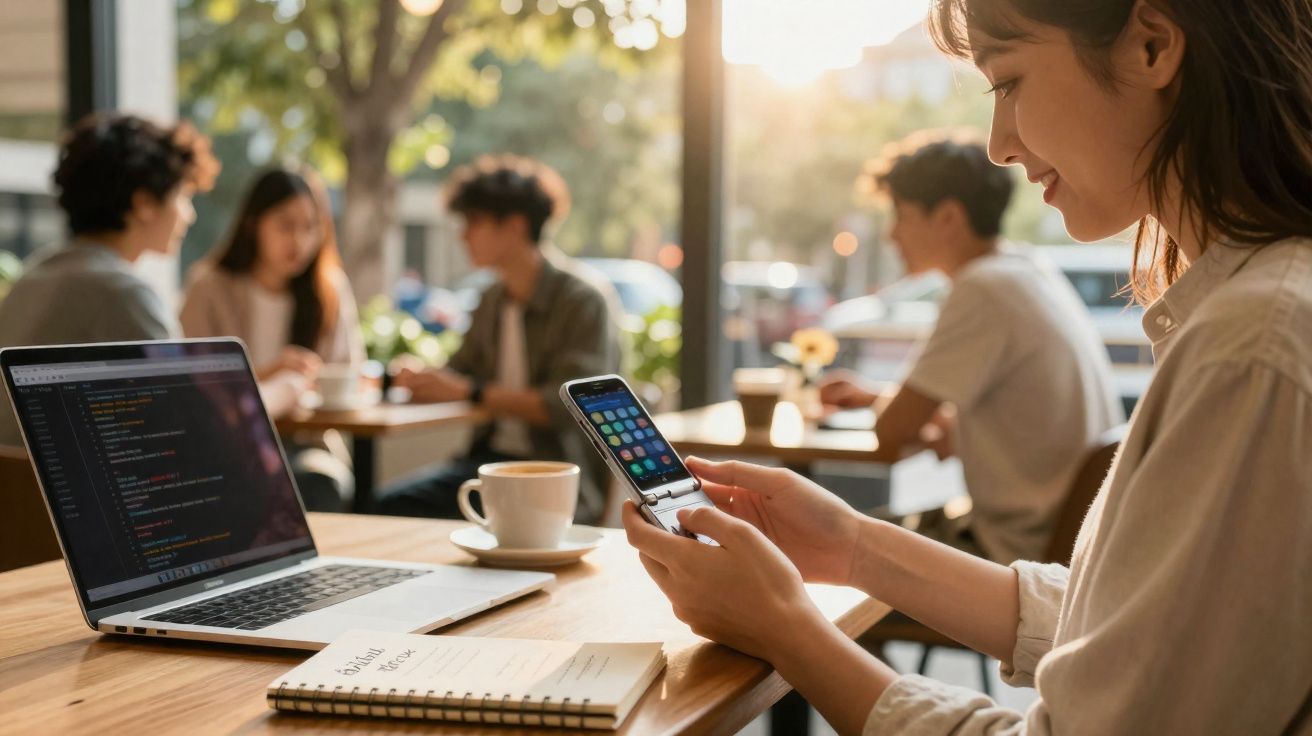
His mates are indoors, their faces warmed to honey by laptop glow; he’s the one outside, waiting for a call on a hinged handset that snaps shut with a reassuring click. His smartwatch stays blank. No alerts, no nudges. The city carries on regardless-buses exhale, coffee filters drip-and his shoulders loosen in a way he hasn’t felt since university. In tech we like to joke that we’re “building the future”, yet a few of us are deliberately stepping backwards into the past, and it’s not only for the irony.
The strange confession inside the dopamine factory
Put a handful of product managers in a pub around Old Street and ask what keeps them awake, and someone will eventually admit it’s their own screen time. Their day job is to craft nudges, tweak colours and haptics, and keep thumbs moving-then they catch themselves scrolling at 2 a.m. like a lab rat that knows perfectly well what the lever does. Most of us have had that bleak moment where the blue light hits your face before the kettle has even boiled, and you couldn’t say what you were hoping to find. The strangest layer is the embarrassment: the makers stuck inside what they made.
In stand-ups and retrospectives there’s a tidy vocabulary for it-attention loops, retention curves, daily active users. It sounds almost sterile until it leaks into your kitchen late at night and your partner says your name twice and you still don’t lift your head. At that point it isn’t a metric, it’s a feeling. Real life gets quietly sanded down at the edges, the phone wins the little argument, and you don’t even clock that it’s won.
Lots of people attempt the “digital detox”: a screen-free Sunday, Screen Time limits you can dismiss with a single tap. Be honest-hardly anyone keeps that up daily. So moving to a flip phone isn’t a clever tweak in settings; it’s more like rearranging the kitchen so you stop eating biscuits. If the device can’t do the thing, the thing can’t do you.
The moment the flip phone hinge clicks
Maya, who helps run a large e-commerce app, says her turning point came on a packed train when a stranger offered their seat to the phone in her hand rather than to Maya herself. It was meant playfully-classic London cheek-and still it stung. That evening she ordered a second-hand flip online: a cheerful little brick with physical keys and a torch bright enough to annoy her cat. The following morning she closed it and heard the hinge click, and it felt like shutting a door behind her.
Arun in Manchester, a back-end engineer who mostly thinks of phones as endpoints and logs, describes the constant ping as if somebody were whispering in his ear all day. He wasn’t chasing some rustic-purity aesthetic; he just wanted quiet. On the first weekend with a dumb phone, he found himself standing in the kitchen with empty hands, waiting for something to hook him. Nothing arrived. He wiped the hob, rang his dad, jogged through the drizzle, and later couldn’t get over how long the afternoon seemed.
The first week detox
The first week doesn’t play out like a neat montage with gentle music. It’s awkward and elastic, full of tiny humiliations. You forget a birthday because Facebook didn’t prompt you; you miss a meme; you turn up five minutes late because you couldn’t track the bus live. Then, gradually, the noise drops away-like silt settling in a glass-and the outline of your day comes into view.
How relationships change when the screen goes quiet
At home it’s not really about the gadget; it’s about the look you give across the table. One product designer told me her partner didn’t say anything on the first night-just carried on chatting as though conversation had always been like this. The odd surprise, she said, was what happened to her hands: they stopped hovering. Instead of reaching for a slab of glass, she reached for cutlery, a tea towel, a person.
Parents describe bedtime stories that aren’t interrupted by a buzz. Friends talk about pub conversations that start to stretch again, like an old jumper relaxing back into shape. Colleagues say meetings recovered an older rhythm once nobody felt that phantom tug of a reply waiting across ten other apps. A phone that stays shut can make it easier to talk.
Making it work without becoming a hermit
This isn’t a manifesto against maps, banking, or those useful train tickets that live in your pocket. Most of the tech workers I spoke to keep a smartphone in the flat, powered down or tucked in a drawer. They use it on purpose, like a power tool: bring it out for boarding passes, check-ins, and the kind of admin that would take ten times longer on a tiny T9 keypad. It’s not anti-tech; it’s pro-attention.
Little workarounds
They go back to printing directions and writing numbers in a notebook. They set up call-forwarding and stick with SMS for essentials. Some carry a compact camera, which-oddly-improves their photos because they take fewer. A few adopt a simple rule: if it can wait until evening, it waits.
The small office revolution
In small pockets of the industry, a low-key etiquette is taking hold. At one design studio in Bristol, there’s a basket by the door where people leave handheld devices before meetings; phones drop in like keys, and half an hour of real eye contact follows. Code reviews happen on laptops, then lids come down and everyone stands up. When a pocket doesn’t buzz, the pace shifts.
Other teams are accommodating flip life in practical ways: putting an actual phone number in Slack profiles, booking fewer “just checking in” calls, writing clearer briefs so work can breathe without constant pings. Someone joked that big tech spent a decade perfecting the infinite feed, and now the cool kids are rediscovering empty time. In some London offices, the most disruptive tech trend fits in a pocket and costs thirty quid.
The things you lose, the things you gain
There are real trade-offs. You won’t get the late-night “we’re nearby, come down” message, and you can’t spin up a shared black cab across three group chats in 20 seconds. Safety matters as well; one engineer moved back to a smartphone for late shifts after a scare walking home. And not everyone can afford-or be bothered-to juggle two devices, or has a job where being briefly unreachable is tolerated.
Even so, when the drip slows, something valuable returns. People talk about boredom as if it’s a room they forgot existed-spacious, echoing, slightly uncomfortable at first. After a few days it fills up with odd little projects: a sourdough attempt that flops, a wobbly chair you finally glue, a book you finish on a cold Saturday, the smell of toast while the radiator ticks. This isn’t self-improvement content; it’s your life expanding back into its corners.
Crossing Blackfriars Bridge with a flip phone, you notice the wind catching your collar and the wobble of bicycles, and there’s no rectangular lens turning the moment into evidence. One developer told me she feels less like she’s constantly producing herself. The vanity doesn’t vanish, the urge to show is still there, but it fades a little. The moment happens, then it’s gone-and that can feel like relief rather than loss.
Why it lands hardest in tech
When your day is spent optimising time-sprints, burndowns, blockouts-your private hours start to resemble another dashboard. A smartphone makes you measurable. A flip phone, oddly, makes you slightly illegible again: harder to track, harder to monetise, which is exhilarating if you’ve seen the spreadsheets. There’s a hint of mischief in that.
And they understand, better than most, how much work it takes to make scrolling irresistible. That knowledge becomes a kind of wary distance. No grand ideology-just the sense that you don’t want to be the product at 11 p.m. on the sofa in a hoodie, when your brain is at its thinnest.
There’s a domestic reality too: partners, flatmates, kids don’t care how elegant the algorithm was. They notice attention, full stop. One CTO told me his teenage son mocked the flip at first, then borrowed it for a camping trip and came back sunburnt and grinning, with a notebook full of jokes. Nobody uploaded those jokes to the cloud. They’re silly and priceless.
The rituals that replace the reflex
When the scroll disappears, replacement habits arrive almost on their own. People charge their flip phones in the hallway rather than beside the bed. Alarms turn back into actual alarms, tinny and insistent. Train journeys become for staring out of the window, overhearing snippets, and occasionally chatting to the stranger reading the same battered paperback you finished last year.
At lunch, without a camera you trust in your pocket, food stops being content. You eat it while it’s still hot. A design lead said she started carrying a tiny sketchbook again, drawing badly and feeling strangely liberated by it. The pages end up in a messy pile on her desk; a few have coffee rings that look like moons.
What partners notice, what friends remember
Ask the person opposite you and the feedback tends to be blunt. They don’t miss being photographed mid-sentence or cut off mid-story. They do miss fast jokes in the group chat, but they get a better version of you in return. Call it presence, call it kindness-it looks much the same.
Older friendships shift tone as well. A mate you haven’t seen in months gets a phone call instead of a DM, and your voice carries weight emojis can’t. It’s slower, clunkier, and somehow more adult. One developer said he found himself apologising more because he couldn’t smooth things over with GIFs-and those apologies landed better.
The myth of missing out, updated
FOMO doesn’t vanish. You miss an invite, hear about a gig after it sells out, learn the big story late. Then it passes. A new pattern forms: you get the story from an actual person rather than a feed, and you feel closer to whoever told it.
The strange side effect is a smaller life that feels bigger. When you’re not grazing a hundred headlines a day, you’re hungrier for the few you do read, and you sit with them. When social alerts stop slicing your hours into fragments, evenings become whole again. They lengthen-even on school nights.
What the flip can’t fix
Phones didn’t invent loneliness. They aren’t the root of every argument. A flip phone won’t repair a shaky marriage or make a job you hate suddenly humane. It can’t conjure a new friendship group by Friday.
What it can do is remove one loud variable. With less background pull, you hear the real issue sooner. Maybe it’s exhaustion, or a habit of interrupting, or the fact you keep saying “I’m listening” when you aren’t. That’s uncomfortable, and also oddly encouraging, because at least it’s something you can tackle.
Where this goes next
Will the flip phone trend scale? Probably not as a smooth curve. It looks more like an undercurrent: a private choice that a few people make, then a few others copy, the way office plants spread one succulent at a time. Some will drift back to smartphones; others will settle into a hybrid, two-phone routine.
Even so, there’s a cultural ripple: a feeling that progress was never meant to be one-way. The same people who shipped the endless scroll are now playing with boundaries-with friction, with intentional dead ends you can’t swipe through. The goal isn’t nostalgia; it’s agency.
Back on that wet Tuesday in Shoreditch, the software engineer slips his little flip into his pocket and heads back inside. The café smells of espresso and damp raincoats. Someone laughs too loudly; someone else drops a spoon onto the floor. He looks at his friends-actual faces, not avatars-and asks a question you can’t answer with a reaction. What comes next is a story, not a notification, and it may be the thing you’ve been missing without realising.



Comments
No comments yet. Be the first to comment!
Leave a Comment