
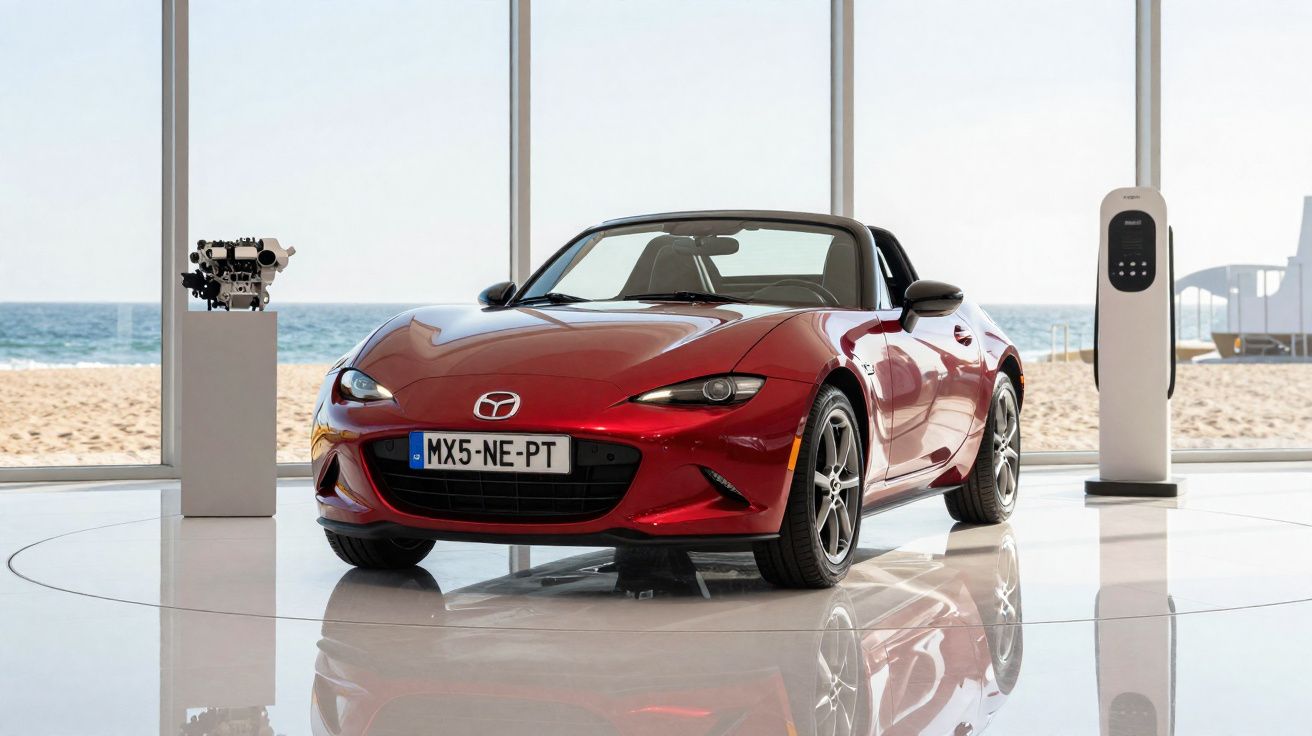
The next Mazda MX-5 is set to stick closely to the formula that has made it one of the world’s most loved roadsters: compact dimensions, low mass, and a naturally aspirated engine paired with a manual gearbox.
That sounds like unambiguously good news. For purists, it largely is - but in Portugal there’s a reason to be uneasy, and it has nothing to do with emissions. The real worry is taxation.
Reports suggest the upcoming Mazda MX-5 NE generation - the replacement for the ND generation introduced in 2015 - will arrive with a “mega engine”: the largest displacement ever fitted to this model.
Downsizing? Mazda’s engineers won’t be laughing
At a time when brands are sprinting towards electrification (some more enthusiastically than others), and when internal-combustion engines increasingly rely on turbochargers, electric assistance or sensor-led strategies to shape power delivery, Mazda is once again choosing the road less travelled.
Ryuichi Umeshita, the company’s technical director, has confirmed the next MX-5 will do without a turbo and instead use a new 2.5-litre naturally aspirated unit. Its name is Skyactiv-Z - and these are the first details we’ve heard about the engine.
According to Umeshita, “the power will be very good and fuel economy as well”. The key enabler is a new lambda (λ) combustion process, calibrated to keep consumption in check while meeting the upcoming Euro 7 rules.
In other words, it promises strong performance without added complexity - plus low fuel use… just not necessarily in Portugal. We’ll return to that, but first there’s another important point that needs setting out.
Mazda MX-5: light, light, light
Yes, displacement is going up - but weight is meant to stay firmly under control. Masashi Nakayama, general manager of Mazda’s design division, has stated that keeping the mass down remains a core target.
Mazda wants its roadster to remain under 4 metres long and to weigh around one tonne.
The next generation is expected to stay true to those principles. The trade-off is familiar: cabin space will still be tight. The priority remains lightness and agility rather than outright practicality - and we can live with that.
Portugal, where displacement costs more than pollution
Portuguese buyers face a particular headache: the country’s car taxation still leans on outdated criteria - for instance, the most eco-friendly Renault Clio on sale in Portugal is taxed at 10 times the level of the petrol version.
The culprit is engine size. So while the new MX-5 may be able to keep a competitive position in other markets, here its 2.5 litres could push it further into niche territory.
It’s the same tax logic that hurt the Toyota GR86, the cheapest model in Gazoo Racing’s line-up. In Portugal, its price ended up close to the GR Yaris because the GR86’s 2.4 litres attracted far more tax than the 1.6-litre three-cylinder unit. The outcome was predictable: the GR86 had a very muted commercial run here.
The Portuguese hope
Mazda acknowledges it is exploring a 100% electric MX-5, but mass remains an almost insurmountable obstacle. And, in truth, an EV isn’t really what most buyers want from a car of this type.
There is a third route. A mild-hybrid Mazda MX-5 hasn’t been ruled out, pairing a smaller engine with assistance from an electrical system. Anything more extensive than that, however, currently seems unlikely. The company’s intent is to keep the Miata light, straightforward and true to its character.
How long until it arrives?
Mazda says the first model to receive the new Skyactiv-Z won’t appear until 2027, fitted to an SUV - most likely the successor to the CX-5. The MX-5 should follow shortly afterwards, which means the current ND3 generation still has several years left on the road.
Until then, all that’s left is to wait - and to hope Portugal doesn’t turn another automotive icon into something fiscally unaffordable. The car that helped democratise roadsters may be on the verge of becoming even more expensive.






Comments
No comments yet. Be the first to comment!
Leave a Comment