
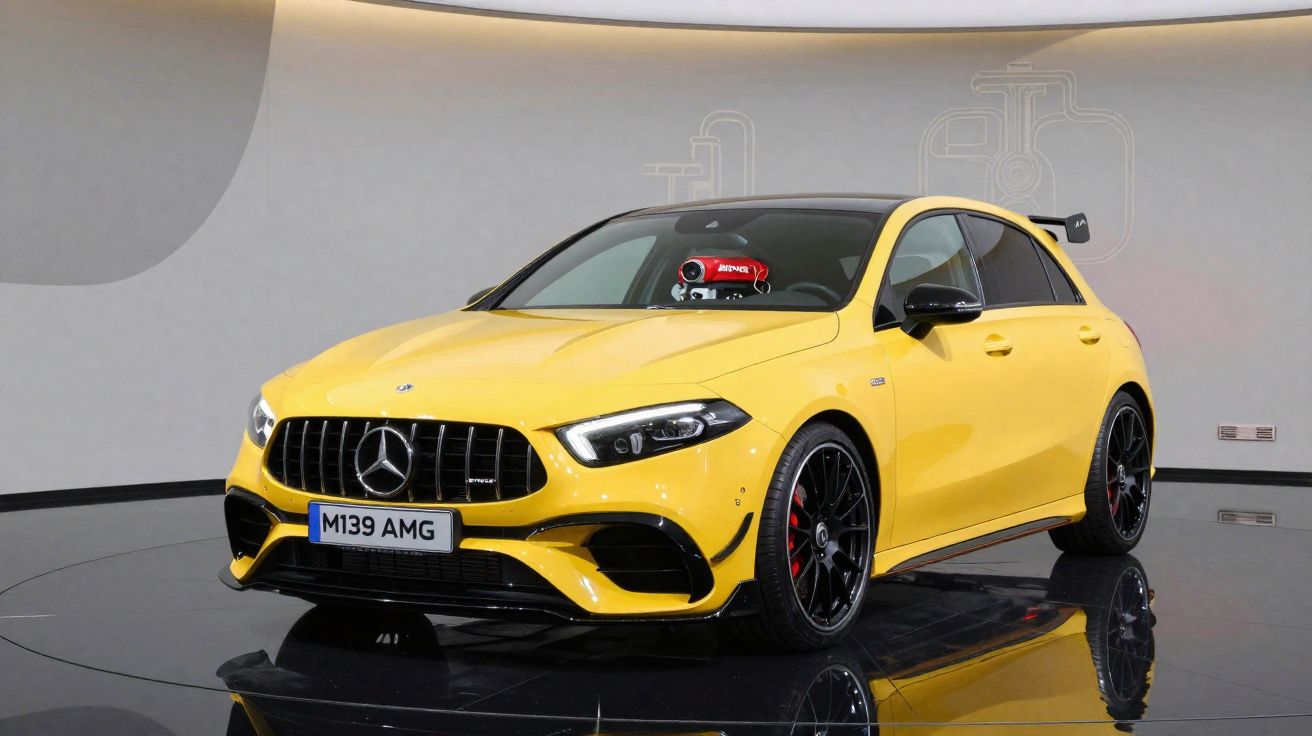
AMG: three letters forever linked to brawny V8s - yet it also wants to wear the crown among four-cylinder engines. The new M 139, due to power the upcoming A 45, is set to become the most powerful four-cylinder engine in the world, delivering a remarkable 421 hp in S specification.
That figure is all the more striking when you consider the new unit still displaces just 2.0 litres - in other words, a little over 210 hp per litre! You can call the German “power wars” futile, but the results remain undeniably fascinating.
M 139: genuinely all-new
Mercedes-AMG states that the M 139 is not simply an evolution of the previous M 133 that has powered the “45” range until now - according to AMG, only a few nuts and bolts carry over from the earlier unit.
The engine had to be redesigned from the ground up to meet the challenges posed by emissions regulations, the packaging demands of the vehicles it will be fitted to, and the desire to deliver more power while also reducing weight.
Among the new engine’s standout changes, the most eye-catching is AMG’s decision to rotate the engine 180º around its vertical axis. As a result, the turbocharger and exhaust manifolds are now positioned at the rear, close to the bulkhead separating the engine bay from the cabin. Naturally, the intake system has been moved to the front.
This layout brings several benefits: aerodynamically, it enables a more optimised front-end design; and in terms of airflow, it helps the engine not only take in more air, but also route it along a shorter, more direct path with fewer deviations - on both the intake and exhaust sides.
The AMG team did not want the M 139 to mimic the typical response of a Diesel, but rather that of a naturally aspirated engine
One turbo is enough
Also noteworthy is the use of a single turbocharger, despite the exceptionally high specific output. It is a twin-scroll unit running at 1.9 bar or 2.1 bar depending on version: 387 hp (A 45) and 421 hp (A 45 S), respectively.
As with the turbos used on the Affalterbach V8, this new turbo features bearings on the compressor and turbine shafts, cutting mechanical friction and ensuring it reaches its maximum speed of 169,000 rpm more quickly.
To sharpen low-speed response, the turbocharger housing contains separate, parallel passages for exhaust-gas flow, and the exhaust manifolds themselves use split runners. This allows the turbine to be fed by a dedicated, separated exhaust stream.
The M 139 further distinguishes itself with a new aluminium sump, a forged-steel crankshaft, and forged-aluminium pistons - all designed to cope with a new 7,200 rpm redline, with peak power arriving at 6,750 rpm - 750 rpm higher than in the M 133.
Distinctive throttle response
A major focus was placed on how quickly the engine responds, particularly through the shaping of the torque curve. The new engine’s maximum torque is now 500 Nm (480 Nm in the base version), available from 5,000 rpm to 5,200 rpm (4,750–5,000 rpm in the base version). That is an unusually high band for a turbo engine - the M 133 delivered its 475 Nm from as low as 2,250 rpm and held it through to 5,000 rpm.
This was a deliberate choice. AMG did not want the M 139 to replicate the typical “Diesel-like” response, but instead to feel like a naturally aspirated engine. In other words, as with a good NA unit, its character should encourage drivers to explore higher revs more often, with a freer-revving nature rather than relying on the mid-range.
Even so, AMG promises strong responsiveness at any engine speed, including at low revs.
Keeping power cool
With outputs this high - it is the most powerful production four-cylinder engine in the world - cooling becomes critical, both for the engine itself and for keeping compressed intake-air temperatures in the optimal range.
The toolkit includes redesigned water and oil circuits, separate cooling systems for the cylinder head and engine block, electric water pumps, and an additional radiator located in the wheel arch, supplementing the main front radiator.
To keep the transmission operating at the ideal temperature, its oil is cooled by the engine’s cooling circuit, and a heat exchanger is mounted directly on the transmission. The engine control unit has not been overlooked either: it is installed in the air-filter housing and cooled by the airflow.
Specifications
| Mercedes-AMG | M 139 |
|---|---|
| Architecture | Inline 4-cylinder |
| Displacement | 1991 cm³ |
| Bore x Stroke | 83 mm x 92.0 mm |
| Power | 310 kW (421 hp) at 6750 rpm (S) 285 kW (387 hp) at 6500 rpm (base) |
| Torque | 500 Nm between 5000 rpm and 5250 rpm (S) 480 Nm between 4750 rpm and 5000 rpm (base) |
| Maximum engine speed | 7200 rpm |
| Compression ratio | 9.0:1 |
| Turbocharger | Twin-scroll with ball bearings for compressor and turbine |
| Maximum turbocharger boost pressure | 2.1 bar (S) 1.9 bar (base) |
| Cylinder head | Two adjustable camshafts, 16 valves, CAMTRONIC (variable adjustment for exhaust valves) |
| Weight | 160.5 kg with fluids |
We will see the M 139 - the world’s most powerful production four-cylinder engine - arrive first in the Mercedes-AMG A 45 and A 45 S. Everything suggests that will be as soon as next month, before it then appears in the CLA and later in the GLA.
Like every other engine carrying the AMG stamp, each unit will be assembled by one person only. Mercedes-AMG has also announced that the assembly line for these engines has been optimised with new methods and tools, cutting production time per unit by around 20 to 25%. That enables output of 140 M 139 engines per day, spread across two shifts.





Comments
No comments yet. Be the first to comment!
Leave a Comment