
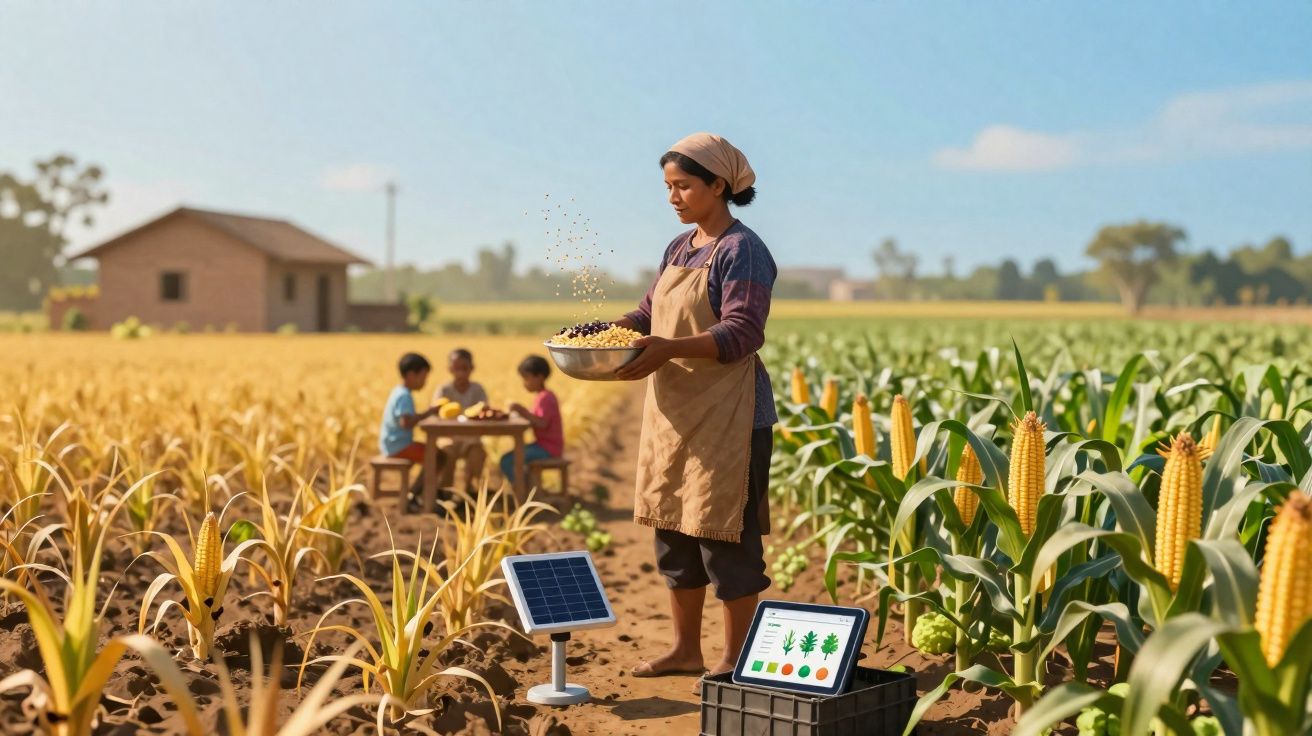
Global climate policy is stuck in a dilemma. Slowing global warming demands tough action - yet those very measures can push up food prices and deepen hunger. A new international analysis now suggests the picture is more complicated: the same climate mitigation strategies can also clean up the air, lift crop yields and soften part of the looming food crisis.
When climate policy leaves plates emptier
The international community wants to limit warming to 1.5 degrees as far as possible. Scenarios that take this target seriously lean heavily on two levers: bioenergy and afforestation. Both require land - and that land then becomes unavailable for producing food.
When farmland is converted into energy-crop plantations or planted with fast-growing trees, the area available for wheat, rice, maize and other staples declines. Competition for every hectare intensifies. At the same time, CO₂ pricing makes the entire food chain more expensive: fertiliser, diesel for tractors, electricity for irrigation, transport and processing - everything costs more.
An international research team modelled these impacts using six global agriculture and economy models. Their finding: a climate policy pathway aligned with 1.5 degrees could, by 2050, push around 56 million additional people into hunger - an increase in risk of about 17% compared with a scenario without tightened climate mitigation.
That is particularly sensitive because the baseline scenario is, in principle, encouraging. If economic development continues at a moderate pace and agricultural yields rise, the number of people at risk of hunger could fall by 2050 from roughly 720 million today to about 330 million. Stronger climate mitigation noticeably slows that progress.
"More climate action without countermeasures in agriculture could push millions more people into food insecurity - especially in poorer countries."
The unseen opponent: how ground-level ozone destroys harvests
The second part of the story is in the air, just a few metres above the ground, where so-called ground-level ozone forms. Unlike the protective ozone layer high in the atmosphere, this version harms plants and people.
Plants absorb ozone through tiny pores in their leaves. Once inside, it triggers chemical reactions that damage cells. The plant then has to spend energy on repair and defence rather than on growth and grain formation. Staple crops such as wheat, rice and maize are particularly vulnerable.
Ozone is produced from precursor gases such as methane and nitrogen oxides, emitted by agriculture, transport, industry and energy production. Ambitious climate policy targets exactly these emissions - and in doing so also reduces the formation of ground-level ozone.
As ozone exposure drops, plants quite literally “breathe” more easily. They grow better, set more grain and deliver higher yields. More supply on world markets puts downward pressure on prices, making calories more affordable for many people.
Cleaner air fills plates - but not completely
In their modelling, the researchers systematically accounted - for the first time - for how lower ozone levels affect agriculture. The result is striking: the benefit from cleaner air can offset around 15% of the additional hunger risk created by climate mitigation measures.
In concrete terms, around 8.4 million people who would otherwise slip into hunger by 2050 remain above the critical threshold thanks to improved harvests. So this is not only about abstract tonnes of CO₂, but about very real meals on very real plates.
"Less methane and nitrogen oxides mean less ozone - and in many regions that works like a free yield-boost programme for agriculture."
Earlier studies examining the link between climate policy and food security largely ignored ozone’s influence. That omission made the downsides of climate mitigation for nutrition look far bleaker than they are under more realistic assumptions.
Who gains most from better air quality under climate policy?
The gains are felt worldwide, but they are unevenly distributed. Two regions stand out: India and sub-Saharan Africa. Together, they account for more than half of the food-security benefit achieved through cleaner air.
- India: especially large effects, most notably for wheat.
- Sub-Saharan Africa: a clear but much smaller benefit.
- Rest of the world: increases that ease pressure, but rarely resolve the underlying problems.
In India, the reduction in ozone damage compensates for about 39% of the negative food impacts associated with stringent climate policy. The main reason is that large wheat-growing areas are located there, and wheat responds strongly to improved air quality.
In sub-Saharan Africa, the picture differs. Maize, millet and soya make up a large share of production. These crops also benefit from lower ozone, but less strongly. As a result, the air-quality effect offsets only around 8% of the negative impacts of climate policy in that region.
Climate policy alone will not defeat hunger
The study delivers a double message. Climate mitigation pursued without considering food systems increases hunger risk in many places. Climate mitigation that also improves air quality, by contrast, boosts yields and eases hardship - but it is nowhere near sufficient on its own.
The researchers therefore argue that food security must be built into climate strategies from the outset. Measures required include:
- targeted support for higher agricultural productivity, for example through improved seed and adapted farming methods,
- smarter allocation of land between bioenergy, forest and food production,
- reducing food losses across the entire supply chain, from harvest to supermarket.
A decisive factor is where, precisely, afforestation and energy crops take place. Planting forests on marginal, low-productivity land harms food availability far less than taking highly fertile soils out of food production. Many countries have so far paid little attention to this kind of fine-tuning.
How the models produce these figures
The analysis draws on six different global agriculture and trade models. These tools simulate how policies, prices, crop yields and consumption influence one another. They incorporate, among other inputs, population growth, economic data, known climate trends and technological developments.
What was new was the inclusion of atmospheric chemical reactions responsible for ozone. With that addition, yield losses or gains can be estimated in tonnes of grain per hectare - and then linked to price and income data.
These models are not an oracle. They provide ranges and probabilities rather than exact predictions. Even so, they show clear trends: without accompanying agricultural policy, climate mitigation pushes food prices noticeably upwards - and while cleaner air reduces that pressure, it does not eliminate it.
What this means for political decisions
For governments, the implication is a clear mandate. Climate policy must not be designed in isolation through the lens of emissions accounting alone. Each tonne of CO₂ avoided should be paired with a kind of “food check”: what does this measure do to arable land, crop yields and the prices of staple foods?
At the same time, opportunities open up. Strict methane rules in the oil and gas sector, livestock farming or at landfill sites improve not only the climate outlook but also the food situation. The same is true for cutting nitrogen oxides from transport and industry. Here, climate mitigation, clean-air policy and food security can be aligned rather than set against one another.
For many people in India or sub-Saharan Africa, this may sound like dry modelling. In practice, it helps determine whether, in 2050, their families will have enough bread, rice or maize porridge. That is exactly why the question of how climate policy can fill - or empty - plates is moving ever closer to the centre of the global debate.






Comments
No comments yet. Be the first to comment!
Leave a Comment