
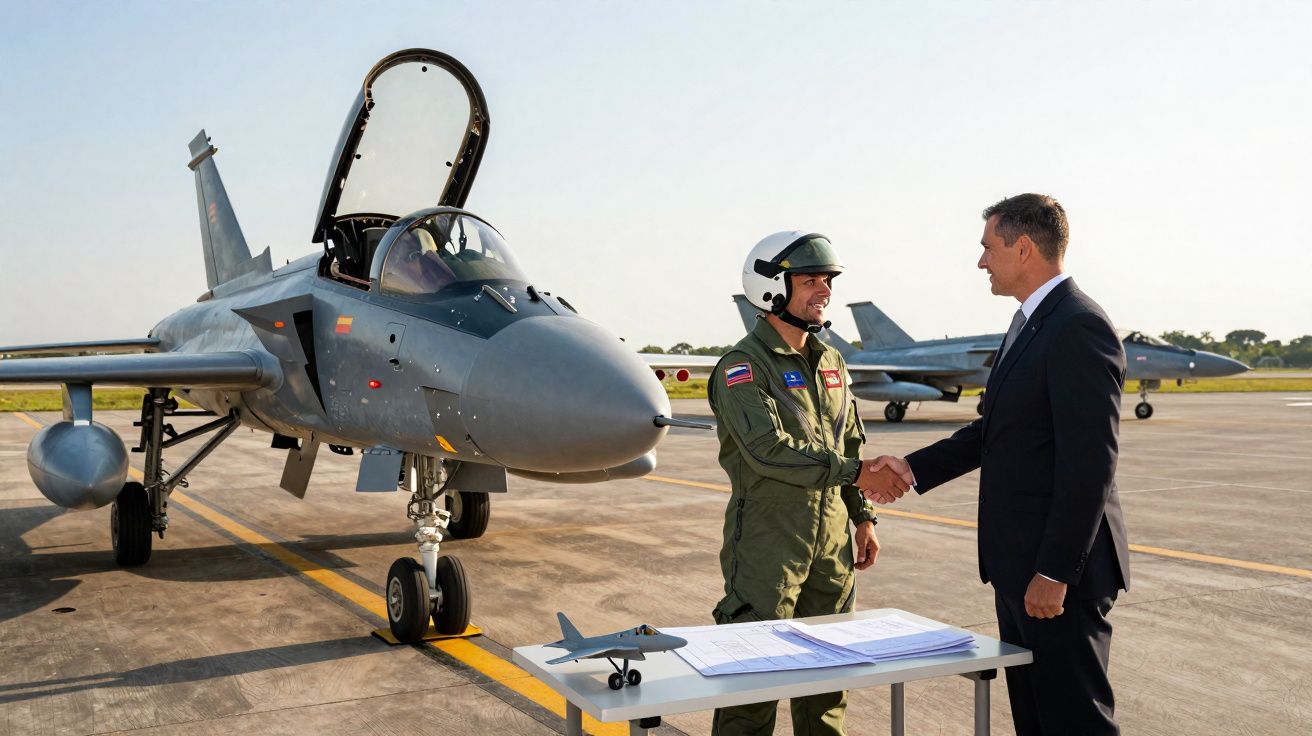
Colombia’s Comptroller General’s Office has confirmed it has authorised the contract signed in November 2025 between the Ministry of National Defence and Swedish manufacturer Saab to purchase 17 Gripen fighter jets for the Colombian Aerospace Force (FAC). After examining the technical, financial and legal studies underpinning the selection, the oversight body stated it found no irregularities or observations that could call the process into question, certifying the operation’s transparency and legality.
Review of documentation and classified Gripen programme information
In its official communication, the Comptroller General reported that it checked the full set of contract documentation, including the technical annexes, the financing plan, and the industrial and social cooperation commitments (offsets). The audit was carried out at FAC facilities, where information classified under the Gripen programme is stored and protected by confidentiality clauses that prevent public release of technical and financial details. Even so, the watchdog said it applied its constitutional and legal powers in full, with access to all information required to validate the process.
Offer assessment: costs, timetable and support package
The report concluded that Saab’s proposal best served the country’s interests, considering the overall price, the delivery timetable and the breadth of logistical support included. The contract-worth €3.135 billion (approximately USD 3.42 billion)-covers delivery of 17 new aircraft equipped with state-of-the-art weaponry, technical and operational training, and a comprehensive maintenance system. It also sets out a phased payment plan, with 40% between 2026 and 2031 and the remaining 60% between 2028 and 2032, supported by future budget allocations approved up to a maximum ceiling equivalent to the full contract value, estimated at around USD 3.4 billion.
FAC technical evaluation of the Gripen E/F against competitors
During the assessment phase, the FAC used a demanding technical methodology built on nine variables and 157 sub-variables addressing operational performance, avionics, sensors, weaponry, sustainment costs, infrastructure and technology transfer. Of the proposals reviewed, only Saab and France’s Dassault supplied enough information to allow a thorough like-for-like comparison, with Saab achieving the top score. Technical analyses pointed to the Gripen E/F’s lower cost per flight hour, its capacity to operate from short runways, and the simplicity of integrating it with existing infrastructure as decisive elements in the final choice.
Industrial and social offsets linked to the Saab deal
The agreement also contains an industrial and social offset programme: 85% is to be channelled into projects under the Ministry of Trade, Industry, and Tourism, while the remaining 15% is intended to bolster the national aerospace industry and enhance the Aerospace Force’s technical capabilities. The Comptroller General indicated these offsets do not change the contract’s total value, but are a central component for the country’s technological and strategic development.
Background to the November 2025 purchase and Kfir replacement
The Comptroller General’s approval follows an extended evaluation and negotiation process that culminated in November 2025, when the Colombian government and Saab formalised the acquisition of the new Gripen E/F fighters to replace the Israeli-origin IAI Kfir fleet. Although there were early controversies surrounding the unit price and limited clarity on the aircraft’s final configuration, the procurement is viewed as a landmark for Colombia’s air defence-bringing into service one of the region’s most advanced combat aircraft and reinforcing the country’s strategic military posture.
Images used for illustrative purposes.
You may also be interested in: The Colombian Aerospace Force Is Getting Closer to Receiving Its Two New S-70 Firehawk Firefighting Helicopters





Comments
No comments yet. Be the first to comment!
Leave a Comment