
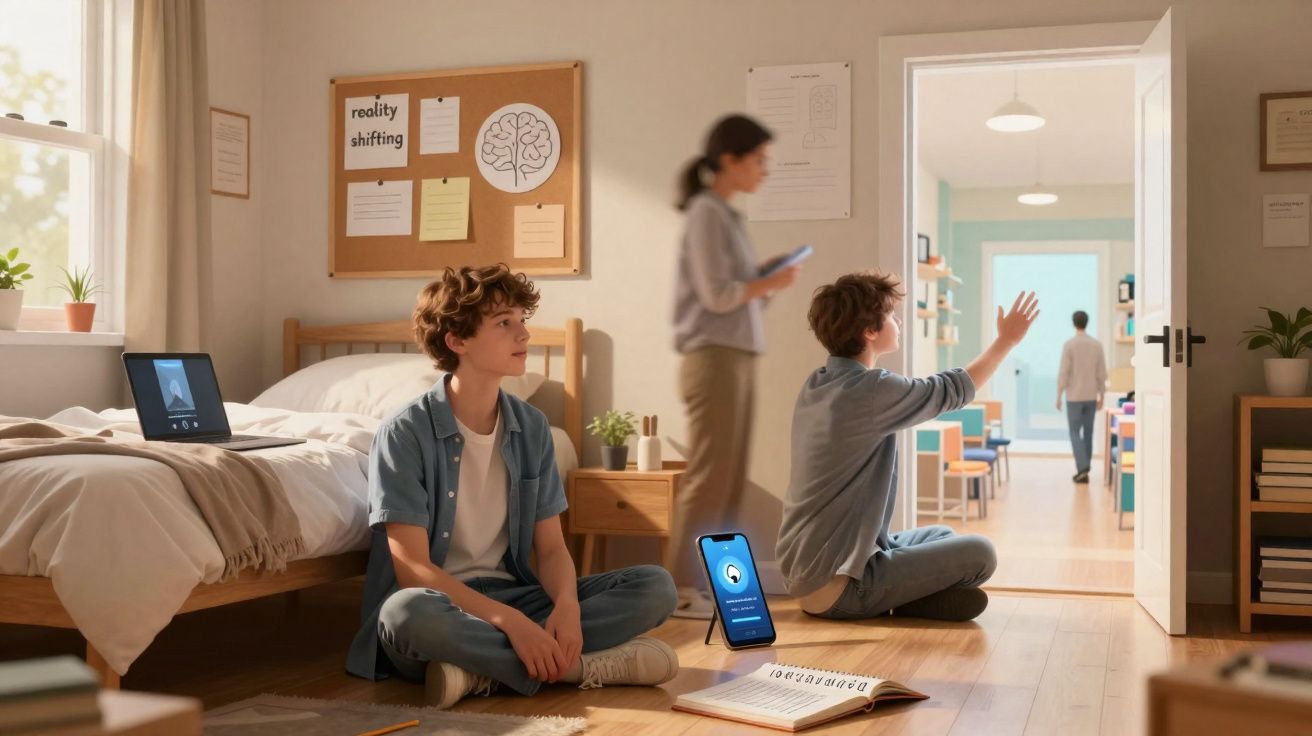
For many parents, it can resemble ordinary daydreaming. Online, however, the behaviour is framed as something far more deliberate and intense, widely referred to on social media as “shifting”.
What teenagers mean by “shifting” into a desired reality
Across TikTok, Reddit and Discord, shifting is typically presented as an intentional step away from day-to-day life and into a vividly constructed “desired reality”. Rather than letting the mind wander, teenagers often plan a setting in advance-frequently inspired by pop culture-and then attempt to mentally “jump” into it.
One young person might design a full Hogwarts schedule, map out a dorm room, and decide who their friends are. Someone else may draft a version of life in a different body, with different parents, or in a relationship with a character from a television series. During a shifting attempt, they may describe themselves as genuinely “there”: moving through hallways, listening to voices, and picking up or holding objects.
Shifting, as teens describe it, is not just zoning out. It feels like stepping into a custom-built, story‑driven reality that they can revisit.
Control is central to how shifting is explained in guides and tutorials. The emphasis is that you do not simply “fall” into a fantasy; instead, you practise switching from current reality to the desired one, commonly while lying in bed with eyes shut, following a specific routine. Many claim they can choose when the session begins and when they return.
Why shifting spread so quickly during and after the pandemic
Lockdowns provided ideal conditions for inward-focused coping. During the Covid-19 pandemic, multiple studies noted rises in alcohol use and other coping behaviours among adults. For teenagers, digital forms of escape expanded sharply-gaming, binge-watching, fan fiction and, for some, shifting.
With long stretches indoors, schooling disrupted, and background anxiety running high, everyday life could feel either dull or too much. Against that backdrop, a world where you write the script and set the rules could seem especially compelling.
- Pressure at school could be rewritten as a storyline of magical tests and house points.
- Tension at home might be reimagined as “found family” bonds in a fantasy castle or among a spaceship crew.
- Worries about an uncertain future could be replaced by a universe where the future is already settled and safe.
Social platforms accelerated the trend. Tutorials, “methods”, personal success posts and POV videos circulated rapidly. Some creators describe “shifts” as almost impossible to distinguish from being awake, which has understandably prompted questions from both parents and clinicians.
Is shifting simply guided imagery, or something else?
From the perspective of neuroscience, shifting often resembles a highly structured mix of mental imagery, absorption and suggestion. People have always used imagination to influence feelings and behaviour-whether that is children playing make-believe or athletes mentally rehearsing a routine.
Evidence suggests that when someone pictures a scene in rich detail, brain areas associated with perception, emotion and movement may activate in ways that parallel real experience. People with strong absorption can lose awareness of their surroundings while reading a novel or watching a film. Shifters appear to draw on this same ability, but package it with a label, an online community and a repeated ritual.
The brain does not neatly separate “real” and “imagined” at the level of raw sensory activity. What changes is context, judgement and voluntary control.
Accounts of shifting can also resemble established psychological phenomena:
| Phenomenon | What happens | Possible link to shifting |
|---|---|---|
| Lucid dreaming | The sleeper becomes aware they are dreaming and may influence what happens. | Many shifting “methods” look similar to lucid dream induction, often around the point of falling asleep. |
| Hypnotic trance | Attention narrows, awareness of the environment drops, and imagery can become powerful. | Shifting routines that use scripts, counting and autosuggestion echo common hypnotic techniques. |
| Maladaptive daydreaming | Daydreaming becomes intensely immersive and starts to disrupt everyday functioning. | For some heavy shifters, repeated sessions could begin to resemble this pattern, particularly if it becomes compulsive. |
That said, not every teenager who shifts fits a diagnosis. Many report staying on top of schoolwork, seeing friends, and treating shifting more like a pastime-similar to role-playing games. In those cases, it may feel like an interactive story they run internally.
Suspending disbelief: where concerns tend to begin
Shifters often describe the goal of “fully believing” in the desired reality while they are experiencing it. They try to push away the idea that it is imagined, much as a reader can forget the physical book during a gripping scene. That intentional suspension of disbelief is part of what makes the experience feel so vivid and emotionally satisfying.
This is frequently the point that unsettles adults. Some parents worry that repeated deep immersion could soften the boundary between imagination and reality-particularly for teenagers who are already vulnerable due to isolation, bullying or trauma.
Clinicians don’t panic at imagination itself; they pay attention when imagined worlds become the only place where a young person feels safe, valued or in control.
At present, hard evidence is limited. Shifting is largely a new name for long-standing mental abilities, and rigorous clinical research is only beginning. What professionals more commonly recognise is a familiar dynamic: when young people feel powerless in daily life, they may invest heavily in spaces where they control everything-whether that is a game server, a fandom, or an intensely private inner world.
What science can say about shifting today
Neurology and psychology can describe parts of what may be happening, even if they cannot yet quantify every risk. When teenagers talk about a “controlled mental trip”, several known processes are plausible contributors:
- Predictive processing: the brain continually constructs a model of reality and updates it using incoming information; in shifting, attention is redirected away from external input and towards an internally generated model.
- Absorption traits: some people naturally sink further into stories, music or imagery, which can make shifting feel more accessible.
- Reward circuits: the quick relief from stress or loneliness may reinforce the behaviour, building a feedback loop.
- Sleep transition states: many approaches rely on relaxation at bedtime, when vivid imagery and hallucination-like sensations can be typical.
None of these mechanisms automatically imply psychosis or “losing touch”. Specialist concern usually centres not on vivid imagination itself, but on the broader context-depression, anxiety, self-harm, or neglect. In those situations, shifting could conceal deeper distress rather than resolve it.
Recognising when shifting is becoming a problem
Most parents do not need diagnostic language to notice when something has shifted from harmless to harmful. Several warning signs may warrant speaking to a health professional:
- Shifting takes over the day, while schoolwork, sleep or friendships fall apart.
- The teenager insists the imagined world is literally real and better in every respect.
- They become intensely irritable or panicked if they are prevented from “shifting”.
- There are indicators of self-neglect, self-harm or severe mood changes.
If these features are present, clinicians typically ask not only about shifting, but also about bullying, family stress, neurodevelopmental conditions and trauma. The aim is rarely to outlaw fantasy; it is to broaden coping strategies and restore involvement in real-world routines and relationships.
How to discuss shifting with a teenager
In many households, the immediate reaction is to ridicule it or ban it. That approach tends to backfire. Teenagers who shift often already feel dismissed, and hostility is likely to drive the practice into secrecy rather than reduce it.
Curiosity usually opens more doors than confrontation. Asking what the “other world” offers can reveal what feels missing in daily life.
Useful questions that can deepen the conversation include:
- “What do you like most about that reality?”
- “Are there things there that you wish you had here?”
- “How do you feel when you come back?”
- “Is it ever hard to stop when you want to?”
These prompts can naturally open into broader discussions-friendship dynamics, identity and gender questions, academic pressure, or body image-without immediately treating shifting as pathology. Where needed, a therapist who understands youth digital culture can help interpret the terminology and the routines.
Related practices around shifting: from role‑play to mental rehearsal
Shifting sits within a wider range of activities in which people explore alternative versions of themselves. Tabletop role‑playing games, live-action role-play, fan fiction and cosplay similarly invite participants to inhabit different identities and narratives.
In cognitive-behavioural therapy and sports psychology, guided imagery is commonly used to rehearse behaviour change or performance. The same imaginative capacity that supports shifting can, when directed towards practical aims, strengthen resilience-such as practising social skills, preparing for exams, or working up to a feared situation.
Some therapists even adapt approaches from fandoms that teenagers already enjoy. For example, picturing how a favourite character might navigate a difficult conversation-and then translating that “script” into real life-can make exposure work feel less abstract and more engaging.
Risks, benefits and what might come next
When used occasionally, shifting may function as emotional first aid: rapid relief, a safe space to explore identity, and a boost for creativity. Writers and game designers often describe comparable inner experiences while inventing worlds and characters.
Difficulties can emerge when the mental escape replaces real-world change. If confidence only exists as a witch in a castle or a warrior on a starship, a teenager might postpone actions that could improve life at school, at home or socially. In that way, avoidance can quietly strengthen helplessness.
Research will probably concentrate on three broad questions: how widespread shifting actually is, which psychological traits predict deeper involvement, and what support is most effective when someone becomes stuck. For now, the most practical stance is to avoid treating it as either a miraculous skill or a sure sign of madness.
Parents and professionals are left with a familiar balancing act: valuing the rich inner life that helps many young people get through difficult years, while protecting those for whom an imagined “desired reality” is starting to feel like the only tolerable option. That tension may grow as digital fandoms, virtual reality and AI-driven storytelling make inner worlds even easier to design and share.






Comments
No comments yet. Be the first to comment!
Leave a Comment