
Dust can return before you have even put the vacuum cleaner back, and it loves to settle along the easily ignored strip where the wall meets the floor.
Baseboards almost never feature on anyone’s “proper” cleaning rota, but they give the game away the moment visitors arrive. All it takes is a glance down and you spot it: that flat, grey band tracing the room. It is a small detail that quietly reflects your indoor air, daily routines and even how you heat the place.
Why baseboards collect dust so quickly
Baseboards sit at the crossroads of airflow, foot traffic and gravity. As you walk around, fine particles are nudged and rolled across the floor. Radiators warm the air so it rises, cooler air drops, and that constant circulation carries lint, pet hair and general dust until it hits the first upright surface in its path - your baseboards.
The busiest rooms show it first. Hallways, lounges and children’s bedrooms get repeated movement all day, and that motion lifts fibres and debris from carpets, soft furnishings, cardboard packaging and clothing. Those bits hang in the air briefly, then settle into the familiar grey “halo” around the perimeter of the room.
The material matters too. Many baseboards are made from:
- lacquered wood
- PVC or plastic
- MDF or composite boards with synthetic coatings
These finishes can hold static electricity. That static acts like a mild magnet, attracting whatever drifts close. In a dry, centrally heated home - especially through winter - the static effect tends to increase. If you have pets, shedding adds a constant stream of fur and fluff, making the baseboards an ideal catch point.
Baseboards don’t just “get dirty”; they behave like low, static-charged shelves where dust naturally settles every day.
What baseboard dust tells you about the air inside your home
A persistent dust line at floor level is a clue about what is floating around your rooms each day. That fine build-up is not random; it commonly comes from textiles, mattresses, paper fibres, outdoor pollution tracked indoors, and residues from cooking. If your baseboards get dirty again very quickly even after treatment, it can be a sign that other factors are worth a look.
A few straightforward habits can reduce what ends up collecting along those lower edges:
- place a doormat and leave shoes by the door to reduce grit and street dust
- launder throws, curtains and pet bedding often, as they continually shed fibres
- vacuum slowly and, if you can, use a HEPA filter to cut down on recirculated particles
- aerate rooms briefly but regularly, particularly after cooking or using sprays
Keeping baseboards cleaner is not only about appearances. Less dust settling near the floor can be relevant for toddlers, pets and allergy sufferers, because their breathing zone is often closer to ground level.
The simple antistatic trick cleaning experts swear by for baseboards
Rather than wiping more and more often, many professionals aim to stop dust sticking in the first place. The approach is surprisingly basic: apply a very light antistatic layer so particles are less inclined to cling when they touch the surface.
Two everyday products are repeatedly recommended in professional tips: vegetable glycerin and fabric softener. Both are diluted with water and wiped on using a microfiber cloth, leaving a subtle finish that is almost invisible.
How glycerin works on dusty baseboards
Vegetable glycerin is a clear, slightly syrup-like liquid found in cosmetics and some food products. For cleaning purposes, it creates a gentle conditioning film. When you spread it very thinly, it helps level out microscopic unevenness on painted or coated surfaces. Dust can still land there, but it tends to release more readily when you walk past, sweep or vacuum close by.
It is a good option for anyone who prefers fragrance-free products or reacts to perfume. It will not yellow paint and, when used sparingly, it does not leave an oily appearance. The crucial points are dilution and using less than you think you need. A few drops in water - with the cloth wrung out well - can cover a whole room.
Why fabric softener can help against dust
Fabric softener, familiar from the laundry, contains antistatic ingredients designed to reduce cling on clothes. On baseboards, the same type of agents can reduce static build-up and lightly condition the finish.
When used correctly, a small amount diluted in roughly half a litre of water leaves a thin protective veil and, as a bonus, a faint “fresh laundry” smell along walls and corridors. In homes with dogs or cats, it can help hair gather at floor level where it is easier to pick up, rather than sticking partway up the wall.
A barely visible antistatic film often cuts baseboard dusting frequency by half, without changing the rest of your cleaning routine.
Step-by-step routine that actually saves time
To get the most from the method, treat it as quick upkeep rather than a full scrub. After the first run-through, the job typically takes around 15 to 20 minutes for an average flat.
1. Remove existing dust without hurting your back
Begin with dry dusting. Using a broom or a floor mop fitted with a microfiber head lets you stay standing, which is kinder to your knees and back. Sweep horizontally along the baseboards, starting at one corner and circling the room.
If you can see older marks or splashes, follow up with a slightly damp microfiber cloth or pad. Do not over-wet the area, particularly with wooden or MDF boards, because moisture can seep into joins and cause swelling.
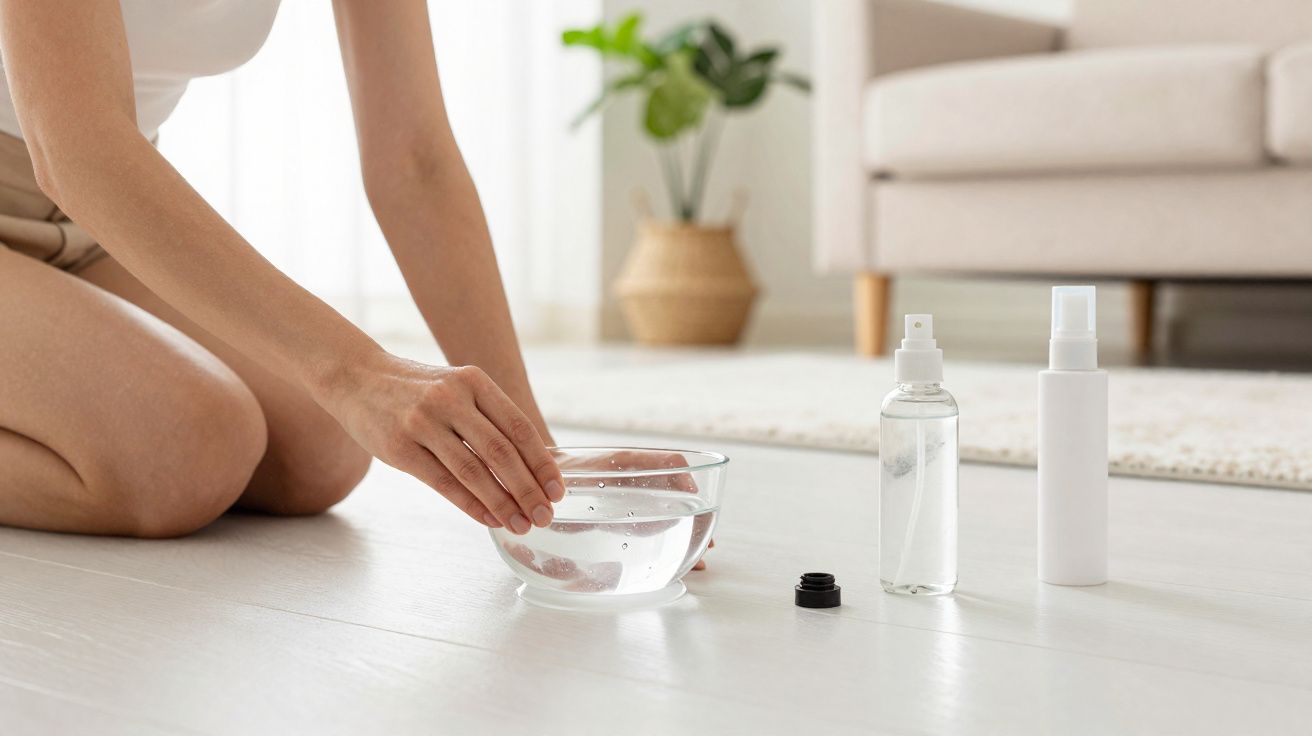
2. Prepare the antistatic solution
When the baseboards are clean and fully dry, mix the solution. Common mixes are:
| Product | Quantity | Water | Best for |
|---|---|---|---|
| Vegetable glycerin | 5–10 drops | 500 ml | Fragrance-sensitive households |
| Fabric softener | 1 small capful | 500 ml | Homes with pets and heavy dust |
Dip a clean microfiber cloth into the mixture, then wring it out firmly. It should feel only barely damp. Using too much liquid can leave streaking or residue, particularly on glossy paintwork.
3. Apply a thin, even coat
Fold the cloth into a neat pad and run it gently along the baseboards. Move in straight strokes, overlapping slightly so you cover narrow bits near door frames or behind furniture. There is no need to scrub; the aim is an even layer, not abrasion.
Two light passes are usually sufficient. The finish should feel smooth rather than tacky. If you still see shine or damp patches after a few minutes, you have likely applied too much - buff it quickly with a dry cloth.
A good guideline: after treatment, baseboards should look like freshly wiped paint, not like they’ve been polished with oil.
How often should you repeat this trick?
How long it lasts depends on your household. In a small flat with little footfall and no pets, many people find baseboards stay noticeably cleaner for three to four weeks. Bigger families, open-plan spaces and carpets tend to generate more airborne fibres and can shorten the gap between treatments.
As a rough guide:
- quiet homes, no pets: repeat every 4–6 weeks
- one or two pets: every 3–4 weeks
- multiple pets or heavy traffic: every 2–3 weeks
As the surface becomes easier to manage, you can often maintain it with a quick dry dust between treatments. That removes loose particles before they bond into the thicker grey line that usually forces a full clean.
Extra care, risks and alternatives
Glycerin and fabric softener are not ideal for every finish. If your baseboards are raw wood, waxed, or coated with very high-gloss designer paint, test a small hidden patch first. Some premium coatings can react to conditioning agents, becoming blotchy or losing their even sheen with repeated use.
If you are trying to minimise chemical products, another option is to wipe with a slightly damp microfiber cloth and then finish with a dry, static-charged cloth. It does not leave a long-lasting film, but it can still reduce dust compared with untreated surfaces.
If you have asthma or strong sensitivity to fragrance, you may prefer fragrance-free glycerin or an antistatic spray intended for electronics and screens. Used sparingly, these rely on the same principle: less static, less dust, and less time spent scrubbing at floor level.






Comments
No comments yet. Be the first to comment!
Leave a Comment