
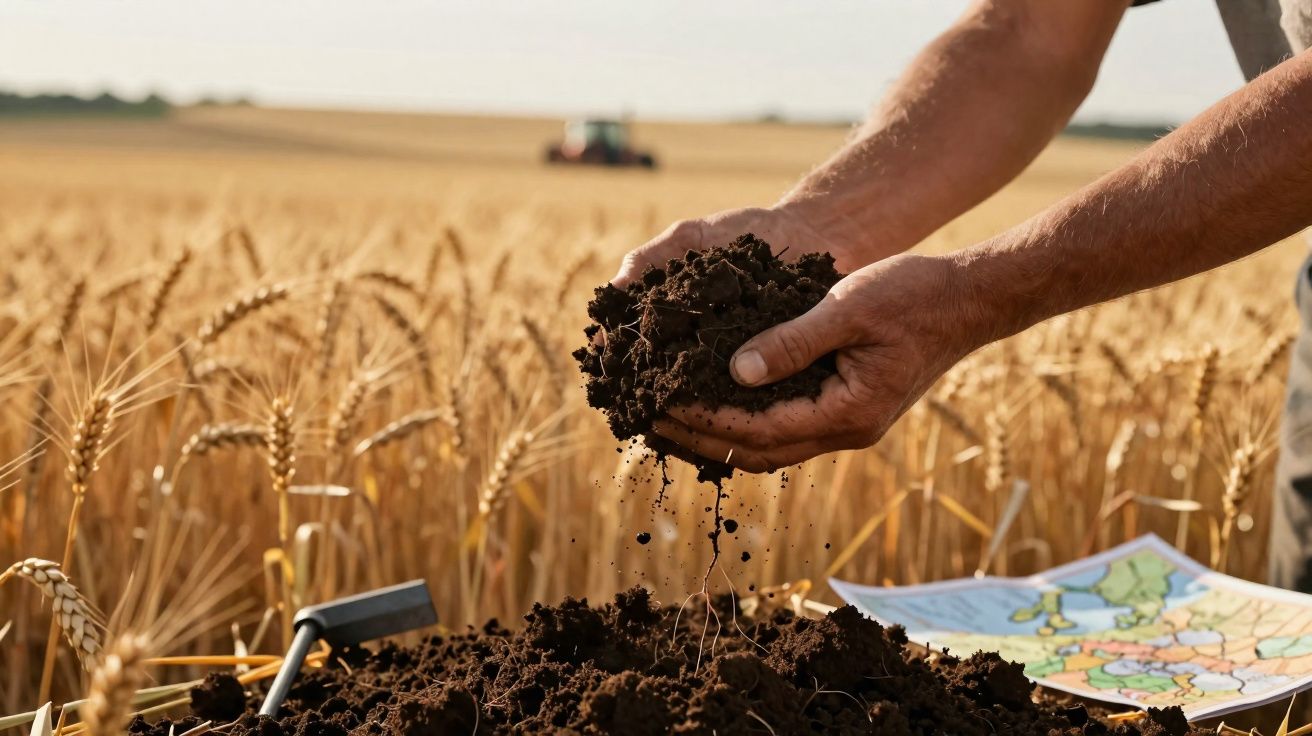
On a clear spring morning outside Poltava in central Ukraine, a farmer rests on his spade and grins. Under his boots the earth is startlingly dark, like finely ground coffee blended with charcoal. He lifts a small handful; it breaks apart easily and leaves an inky black mark across his palm. Overhead, birds wheel across a broad, level skyline, and far away grain silos glint like steel lighthouses.
He places a single wheat seed into the furrow, brushes just enough soil over it, and gives a small shrug. “Here, the soil does most of the work,” he says. A moment later he adds, almost under his breath: “That’s why people fight for it.”
What you’re looking at is chernozem - agriculture’s black gold - and its influence reaches well beyond this quiet field, shifting power in places that seem a world away.
Chernozem: the continent’s deep black skin
From orbit, the well-known “black earth belt” reads like a dark streak running across Eastern Europe and Central Asia, beginning in eastern Romania, passing through Ukraine and Russia, and continuing into Kazakhstan. Up close, though, the feel is closer to velvet than scar tissue.
In many areas, chernozem forms a dark, fertile layer that can extend to 1 metre in depth, packed with humus and organic material. Farmers like to joke that if you drop your keys into it, you may never see them again. When rain arrives, the ground soaks it up hungrily and then keeps hold of the moisture like a sponge. On a bright, dry day it carries a faintly sweet scent - wet timber and old leaves. This is not inert dirt; it’s a living system.
Cross the steppe in late June and it becomes obvious why geologists and generals speak about this terrain in the same breath. Wheat fields move in long golden waves, broken only by the occasional village, a battered tractor, or a sagging power line.
Ukraine, holding roughly a third of the planet’s chernozem, has built its image as one of the world’s great breadbaskets on this dark base. Russia and Kazakhstan, with enormous black-earth reserves of their own, load train after train with grain bound for Black Sea ports and distant buyers. When yields are strong here, bread prices tend to fall in Cairo, Lagos and Dhaka; when harvests fail or exports are obstructed, the effects spread quickly.
The reason chernozem is exceptional is less magic than deep time. Over thousands of years, steppe grasses grew, died and broke down in a temperate climate. Grazing herds disturbed and mixed the surface. Microorganisms thrived, multiplied and processed the remains. Gradually, layer upon layer of organic material accumulated, transforming the top metre into a dense store of nutrients.
That upper layer can contain as much as 15% organic carbon - far higher than most cultivated soils. It nourishes crops generously and keeps water available well after the weather forecast has turned dry. Put simply: farmers in these regions can often produce more with less fertiliser and less irrigation than many peers elsewhere. Roots push down readily through the soft structure, helping plants stay anchored against wind and rough weather - as if each growing season begins with a built-in advantage.
Black gold, green weapons
For farmers such as Oleksandr, who manages a mid-sized wheat operation in southern Ukraine, chernozem’s value is both straightforward and harsh. Straightforward, because fertile ground usually means strong output; harsh, because strong output attracts attention from far beyond any local boundary.
When fighting reached his area in 2022, he concealed his tractor inside a barn, tucked behind stacks of hay bales. The fields themselves stayed where they were. Tanks rolled through, pressing muddy ruts into the same black soil. Shell holes collected rainwater, then filled with wild grass. He carried on sowing whenever there was an opening because, as he put it, “if we stop, others will take this place and this soil, and they won’t leave.” His life - and what his children might inherit - is quite literally embedded in that metre of darkness.
Many people know the feeling: a map on the news abruptly stops being abstract and starts to look like a vulnerable, inhabited place. When Russian forces moved into parts of eastern and southern Ukraine, commentators quickly highlighted oil and gas, ports and pipelines. Yet among agronomists and commodity traders, another map passed quietly from hand to hand: the chernozem map.
It is hard not to notice how often black earth regions overlap with places that draw investment, pressure and, at times, occupation. Grain storage sites become strategic points. Black Sea export lanes turn into leverage during international talks. A single metre of soil sounds modest; across a continent, that layer can influence alliances, food prices and even election outcomes thousands of kilometres away.
Viewed geopolitically, chernozem functions as both a buffer and a tool within global food systems. States rich in black soil can ship immense volumes of wheat, maize, barley and sunflower oil - converting harvests into hard currency, negotiating weight and quiet influence in food-importing regions.
But the same reliance can rebound. When war blocks ports or disrupts rail lines, millions of tonnes of grain may sit stranded in silos. The world is then forced to relearn a simple reality: food security is only as steady as a handful of crucial corridors and a handful of crucial soils. Chernozem is not just a natural resource. It’s an invisible actor in international politics, linking a farmer’s palm to a supermarket shelf through a fragile chain.
What can we learn from chernozem black earth?
Most people do not live on the Ukrainian steppe or the wide plains of Russia. For many of us, the soil we meet is on an allotment, a balcony, or a small community bed - and it is more likely to be tired and depleted than mythically black. Even so, that dark metre of chernozem carries a lesson worth taking home.
Black soil’s “secret” is gradual gain: organic matter returning to the ground season after season. You can imitate a small version of that process almost anywhere. Compost kitchen peelings. When you pull crops, leave some roots behind. Shred fallen leaves and add them back rather than binning them. Sow cover crops so the surface is protected through winter. These modest, repeated actions quietly raise organic content - and one day you realise the earth breaks apart differently between your fingers.
What trips people up is the hope of instant “chernozem in a bag”. That’s where frustration begins: you buy an expensive fertiliser, apply it, and wait for a miracle. For a year or two, plants may respond - and then the ground beneath can feel even less alive than before.
True black earth did not appear within a single year, and it certainly wasn’t created by quick fixes. If we’re being truthful: hardly anyone manages this perfectly, day after day. Life is busy, compost can smell, and cover crops can look untidy. That is fine. The goal is not perfection; it is to treat soil as something to build and safeguard, rather than something to exhaust. Even a pot on a balcony can develop its own miniature “black layer” if you manage it in that spirit.
Researchers who focus on chernozem often sound less like technicians and more like storytellers. They speak about patience, memory and the way land “remembers” our decisions. One Ukrainian agronomist captured the idea in a line that stayed with me:
“You can own land on paper, but the soil only works for you if it trusts you.”
To bring that approach into everyday practice, it helps to keep a simple checklist in mind:
- Feed the soil, not just the plant.
- Keep the ground covered whenever you can.
- Put organic matter back instead of removing everything.
- Steer clear of heavy, repeated cultivation that damages soil structure.
- Think in seasons and years, not only in single harvests.
These routines will not turn a back garden into the Ukrainian steppe. Over time, however, they can move your soil a small step nearer to that living, black sponge beneath the world’s breadbaskets.
The silent power beneath our feet
Once you begin paying attention to soil, you start seeing it everywhere: the compacted grey strip beside a car park, the thin dusty layer in a city green space, the rich dark bands on a freshly turned field shown on television. Chernozem is simply the most dramatic form of something we all rely on and rarely discuss.
There is a quiet irony at work. The same black earth that feeds vast populations also attracts armies, sanctions and drawn-out negotiations. A metre of soil assembled grain by grain over millennia can be wrecked in a single season of careless farming - or burned and torn apart in a few nights of shelling. Once that sinks in, mountains of grain at a port look less like “commodities” and more like compressed history.
Perhaps the uneasy question behind the fascination with black earth is what we are doing with our own thin, life-supporting layers. Are we treating them as disposable - something to strip-mine and abandon - or as a slow inheritance we should pass on intact?
You do not need to live in Ukraine, Russia or Kazakhstan to be tied to chernozem. Each time you eat bread, pasta or a bowl of cereal, some distant field on some patch of soil has done silent work on your behalf. Agriculture’s black gold is more than a regional curiosity; it is a reminder that much of modern comfort rests on something as delicate as a crumb of earth - a discussion worth having more often, at kitchen tables and policy tables alike.
| Key point | Detail | Value for the reader |
|---|---|---|
| Depth of chernozem | Black soil layers may extend to 1 metre deep and are rich in organic material | Explains why these areas function as such influential breadbaskets |
| Geopolitical weight | Chernozem in Ukraine, Russia and Kazakhstan supports major grain exports | Shows how faraway soils can shape food prices and global stability |
| Everyday lessons | Build organic matter slowly and protect soil structure at any scale | Provides practical ideas for gardens, farms and local food systems |
FAQ:
- Question 1 What is chernozem soil, exactly?
- Question 2 Why is Ukraine so often described as a global “breadbasket”?
- Question 3 Can other countries “make” chernozem using modern methods?
- Question 4 In what way does conflict in black earth regions change global food prices?
- Question 5 What can ordinary gardeners borrow from chernozem regions?



Comments
No comments yet. Be the first to comment!
Leave a Comment