
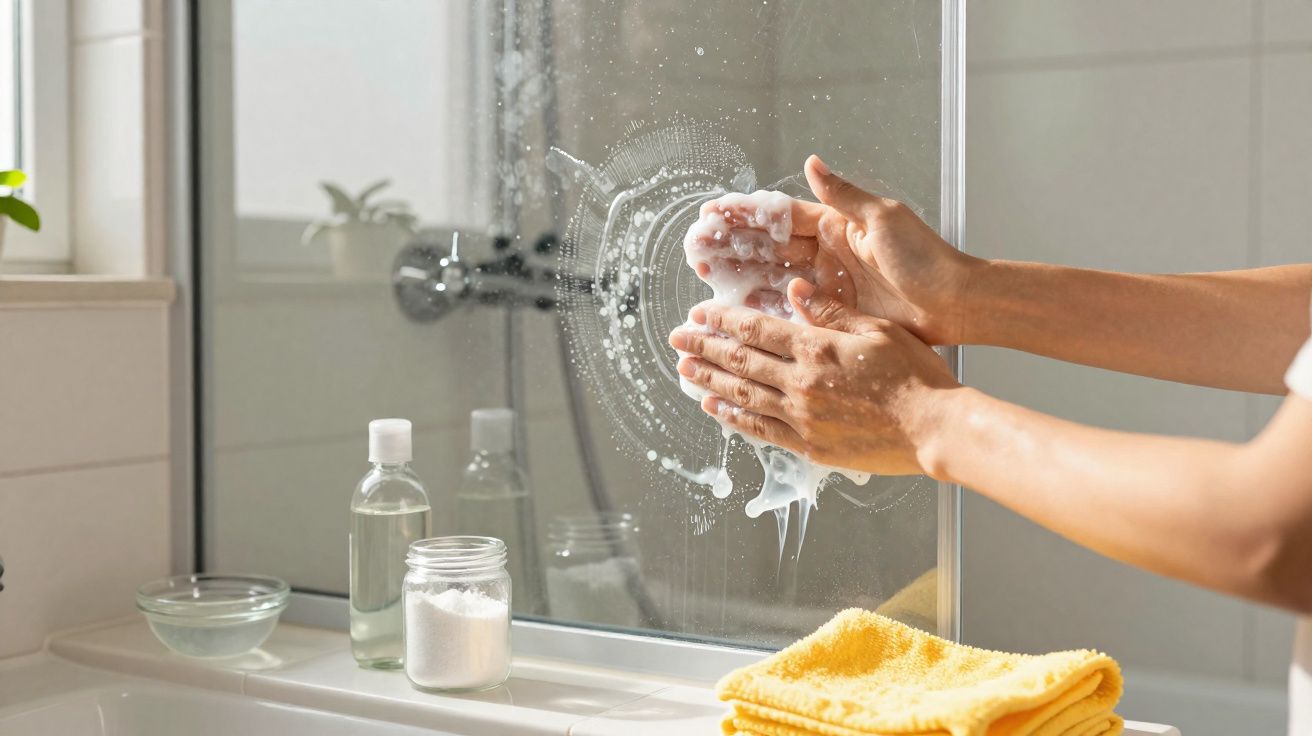
Many households know the same scenario: white specks, dulled glass, a constant stream of new sprays from the chemist - and yet the shower screen still looks greyed over. A straightforward DIY approach circulating on social media claims to tackle exactly this: a homemade gel cleaner made from three ingredients that most people already have in the kitchen cupboard.
Why shower glass turns cloudy so quickly
If you live in an area with hard water, you will notice it in the shower sooner or later. During showering, minerals dissolved in warm water - such as calcium and magnesium carbonates - settle onto the glass. Once the water dries, the familiar white marks and a hazy film are left behind.
Over time, that film gradually becomes a proper crust. More soap, shampoo and shower gel then stick to it, layer by layer. Eventually the glass does not just look dull, it can seem genuinely worn: tiny dots, yellowish patches, and a texture that no longer feels smooth.
"The longer limescale is left, the more strongly it bonds to the glass surface - and then even powerful cleaners only help to a limited extent."
Out of frustration, many people reach for cream cleaners, abrasive sponges or steel wool. It can appear to work at first, but it leaves fine scratches behind. In those microscopic grooves, limescale grabs on even faster the next time - and the glass permanently loses its shine.
Gentle acids instead of scrubbing: the thinking behind the gel
Rather than relying on force, this DIY method uses a different principle: mild acids plus plenty of contact time. Limescale is chemically sensitive to acids. If you give them long enough to work, deposits can be broken down without harming the glass.
Standard liquid cleaners quickly run down vertical surfaces. That is exactly where the gel idea helps: a thickened cleaner clings to the shower screen, stays put on problem areas, and can get on with the job.
DIY anti-limescale gel cleaner: the 3 ingredients most people already have
To make the homemade anti-limescale gel cleaner, you only need three items:
- Household vinegar (clear, around 8% acidity) - helps dissolve mineral build-up
- Citric acid (powder) - boosts the effect and targets limescale in spots
- Cornflour (cornstarch) - creates the gel-like texture
In household use, vinegar and citric acid are considered so-called weak acids. In concentrated form they are not harmless, but they are typically far less aggressive than many industrial products containing strong acids or chlorine. The starch turns the mixture into a gel that behaves like an expensive specialist cleaner - just at a much lower cost.
How to mix the anti-limescale gel cleaner
The process is more like a quick bit of cooking and takes about ten minutes:
- Set out a glass jar or a heatproof measuring jug.
- Stir 1 tablespoon of cornflour into 300 millilitres of cold water until there are no visible lumps.
- Pour the mixture into a small pan and warm it over a low heat, stirring, until it thickens into a slightly viscous, translucent gel.
- Remove the pan from the hob and let it cool briefly.
- Stir in 1 tablespoon of citric acid.
- Add around 100 millilitres of clear household vinegar and mix thoroughly.
- Leave to cool, then decant into an empty, clean bottle or an old dispenser.
The cost is roughly 50 cents - often noticeably less depending on the brands you choose. The quantity is usually enough for several cleaning sessions.
"With half a euro in material costs, you replace several bottles of specialist cleaner from the supermarket shelf in one go."
Using it properly: how to get the shower screen clear again
To let the gel do what it does best, the order of steps matters. If you take a few minutes to do it methodically, you will usually see a clear before-and-after difference.
Step 1: Remove surface grime
Start by quickly rinsing the glass with warm water. The aim is to remove residues from shampoo, soap or dust so the gel can sit directly on the limescale. A soft cloth is enough here - do not use a brush at this stage.
Step 2: Apply the gel
Put on gloves. Using a spoon, a brush, or straight from the bottle, spread the gel onto the dry or only slightly damp glass. Coat heavily affected areas - often around the splash zone beneath the shower head - particularly generously.
The key point: do not scrub hard. Instead, “lay” it on as a layer. The gel should cling to the surface rather than immediately sliding down.
Step 3: Make the most of the dwell time
Depending on how severe the deposits are, leave the gel to work for 15 to 30 minutes. For very stubborn crusting, an hour can make sense.
"The real ‘magic’ happens during the dwell time - not while scrubbing."
During this period, the acid reacts with the limescale, loosening it and softening the build-up. If you like, you can check partway through and add more gel where any patches have dried out.
Step 4: Clean gently and rinse
Once the time is up, wipe the surface carefully with a soft, non-scratch sponge or a microfibre cloth. In many cases the deposits will now lift away without much force.
Then rinse everything with plenty of water until no gel residue remains. Finally, use a lint-free cloth or a squeegee to pull off the water so fresh droplets do not dry on the newly cleaned surface.
What to watch for with different materials
Not every shower screen is made from standard toughened glass. Depending on the material, small adjustments are sensible:
- Standard glass: Generally uncomplicated. The gel can usually be used undiluted.
- Coated glass with an anti-limescale layer: Test first in an inconspicuous corner and, if needed, dilute with a little water. Follow the manufacturer’s guidance.
- Plastic or acrylic: The surface is more sensitive. Mix the gel a little thinner and apply via soft cloths.
- Tile grout: Possible for short periods, but do not leave it on too long so the grout material is not attacked.
- Stone such as marble or granite: Do not use acids, as they can dull the surface.
Keeping the shower screen clear for the long term
Once you have done the heavy initial clean, two simple habits can save a lot of effort.
Everyday routine
After showering, use a squeegee to remove water from the glass and tiles. It rarely takes more than a minute, but it significantly reduces how much limescale can form. Alternatively, a quick wipe with a microfibre cloth also helps.
Every few weeks, you can then schedule a “treatment” with the gel. With very hard water, once a month can be reasonable; in soft-water areas, longer intervals are often enough.
Mistakes many people make without realising
Common missteps that make shower glass look older than it needs to:
- Cream cleaner on glass
- Scouring pads or the abrasive side of a washing-up sponge
- Cleaning only “when it’s really bad”, instead of following a regular care routine
- Combining strong chemicals, for example vinegar with chlorine-based products
Mixing different agents can produce toxic fumes. For that reason, only use one cleaner at a time and ventilate thoroughly afterwards.
How limescale, vinegar and citric acid work together
This household trick is based on straightforward chemistry. Limescale is mainly calcium carbonate. When it meets acid, soluble salts, water and carbon dioxide are formed. This applies to both vinegar and citric acid.
Citric acid has the advantage of being a crystalline powder that stores well for a long time and is easy to measure out. Vinegar also brings a clearly recognisable “cleaning” smell that many people associate with freshness - even if not everyone enjoys the scent.
When a DIY gel reaches its limits
With glass that has been neglected for years, deposits can penetrate the surface so deeply that even acidic gels cannot remove them completely. In that case, the glass may look more etched than merely scaled.
In situations like this, the method often at least reduces the worst of the haze - but it may never become 100% clear again. If you are unsure whether a coating is damaged or if toughened glass shows cracks, it is wise to involve professionals; particularly with expensive shower enclosures, a proper assessment can be worthwhile.
Even with these limits, the gel-like cleaner shows how much can be achieved with simple means. With three pantry ingredients, a bit of patience and the right steps, the shower screen often looks surprisingly fresh again - without an aggressive chemical odour in the bathroom.



Comments
No comments yet. Be the first to comment!
Leave a Comment