
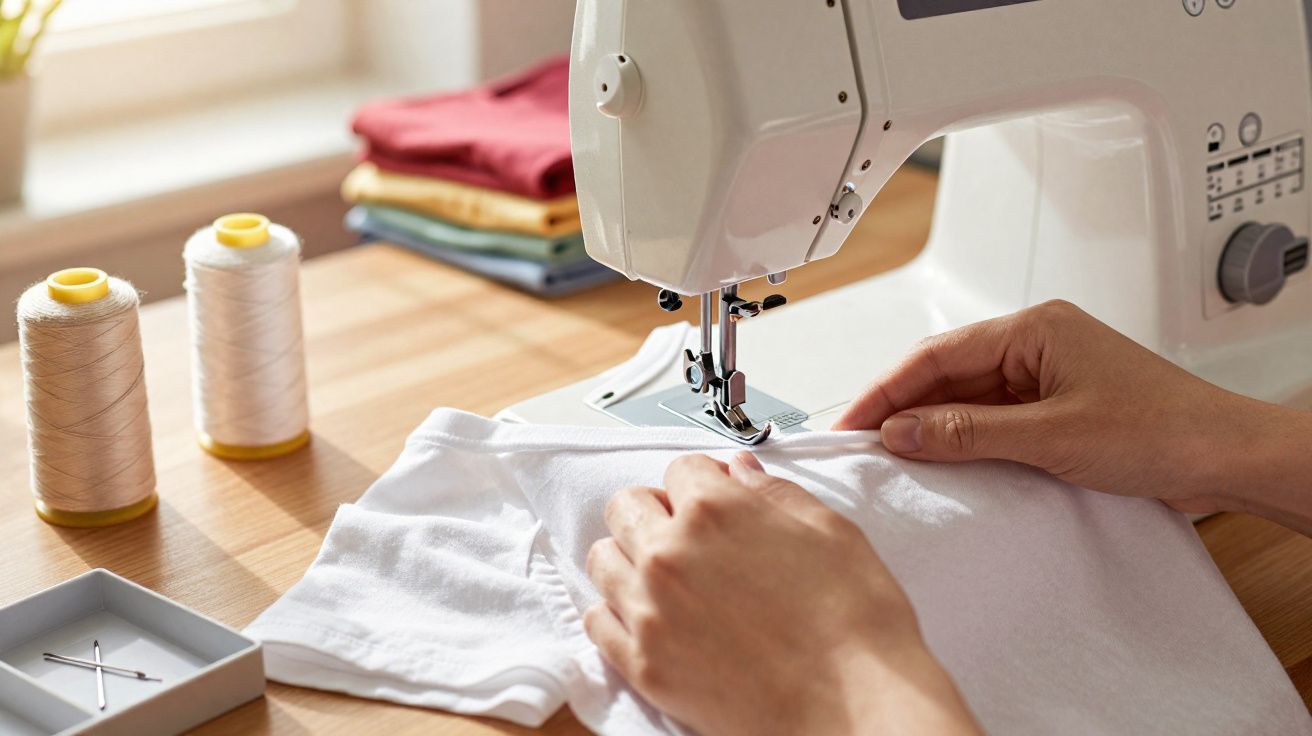
If you have ever shortened a jersey or stretch T‑shirt, you will know the familiar frustration: it looks tidy straight off the machine, then after a try‑on the hem ripples-or the thread snaps the first time you pull it over your head. The gap between homemade and shop-bought results is rarely about skill; it is usually down to one underused feature that is already built into most domestic sewing machines.
Why T‑shirt hems so often go wrong at home
Open your wardrobe and you will spot the pattern straight away: T‑shirts from the high street nearly always share the same finish at the hem. On the outside, you see two neat, parallel rows of stitching; on the inside, there is a soft, slightly stretchy join. That factory-style hem survives hundreds of washes without splitting or going baggy.
At home, the result is often very different because many people default to a basic straight stitch:
- The hem feels rigid and does not stretch comfortably.
- When you put the garment on, you can hear the thread crack-or it snaps completely.
- The jersey fabric ripples and the edge can curl outwards.
This is not because anyone is “bad at sewing”; it is a technique issue. A single straight stitch has very little give, yet stretch fabrics such as jersey need a seam that can move.
“The key is less about talent and more about using the right machine feature: a second needle that almost all domestic machines already include.”
The overlooked feature: sewing with a twin needle
What industry often achieves with a dedicated coverstitch machine can be replicated at home surprisingly well with a twin needle. Many machines from brands such as Singer, Brother, or Pfaff support this from the outset-yet plenty of owners never take advantage of it.
How the twin needle works inside the stitch
When you sew with a twin needle, you run two top threads, while underneath you still use a single bobbin. On the outside you get two parallel lines of stitching, typically spaced about 2 to 4 millimetres apart. On the inside, the bobbin thread links those lines in a zigzag.
That construction delivers several benefits at once:
- The seam stretches with the fabric instead of snapping.
- The hem sits flatter and is less likely to roll.
- The look is very close to ready-to-wear T‑shirts.
On cotton jersey, the stretch of the hem seam compared with a plain straight stitch can easily increase by a third or more. You feel the difference most on fitted tops: the stitching follows your movement rather than fighting it.
Where the extra attachment is hiding
Many people assume their machine is “too basic” for these kinds of results. In most cases, that is simply wrong. The second spool pin is often tucked away:
- in the machine’s accessory compartment,
- under the top-thread cover,
- or as a loose plug-in rod in the original packaging.
If the manual has long since disappeared, it is worth rummaging through the accessory tray. If you find a slim, short plastic or metal rod that slots into the top of the machine, it is usually the extra spool holder. With that small piece, an “ordinary” machine can produce remarkably clean hems.
Step by step: a perfect T‑shirt hem with a twin needle
Once you have located the spool pin, you only need the correct needle and a few suitable settings. With a little preparation, the hem can look impressively professional.
Choosing the right needles and settings
For jersey T‑shirts, a twin needle in size 80 or 90 works well. Choose a 2.5 or 4 millimetre needle spacing depending on the finish you want.
- Fit the twin needle: Remove the standard needle, insert the twin needle with the flat side facing the back, and tighten securely.
- Add two thread spools: Use the main spool pin and the additional spool pin.
- Thread the top threads: Guide both threads together along the normal threading path, then separate them at the end and pass each one through its own needle eye.
- Select the stitch: Set a straight stitch; do not use zigzag or decorative stitches.
- Reduce upper tension slightly: Instead of around setting 4, move closer to 3 to help prevent “tunnelling” between the two stitch lines.
A quick test on a scrap of the same fabric is essential. Do not pull the fabric-let the machine feed it. You will quickly see whether the tension and stitch length are right.
“Only when the test run on a scrap works without rippling, cracking noises, or thread breakage should the actual T‑shirt go under the presser foot.”
Typical problem: a stretchy cotton T‑shirt
It is a common scenario: a fitted cotton T‑shirt with elastane just needs shortening slightly. With a simple straight stitch, the hem rarely lasts. The first time you put it on, individual stitches can pop and the edge may stand away from the body.
With a twin needle, the outcome changes. On the outside you see two clean rows; on the inside an elastic zigzag ties them together. The seam stretches with the fabric, without that tell-tale cracking sound. This approach is particularly worthwhile for sportier cuts or children’s clothes.
For very fine or extremely stretchy fabrics, one extra trick often helps: swap the bobbin thread for woolly nylon or a mousse-style thread. It fills the inside zigzag more softly and reduces the risk of rippling even further. This principle has been standard in the sportswear industry for years.
When an invisible hem is the better choice
Alongside the twin-needle option, many sewing machines also offer another specialist for neat edges: the invisible hem stitch. In the stitch menu it is often shown with symbols that resemble a “B” or “V”-a line of straight stitches with occasional small side “bites”.
This technique usually uses a dedicated foot with a centre guide. The fabric is folded so the needle only just catches the outer layer. From the outside, almost nothing shows-only tiny vertical dots that are barely noticeable from a short distance.
| Situation | Recommended technique |
|---|---|
| Stretchy jersey, T‑shirts, sports tops | Twin needle for a stretchy, visible double row |
| Smart trousers, skirts, suits | Invisible hem stitch for an almost invisible edge |
| Thick denim or very stiff fabrics | Classic straight stitch, reinforced if needed |
For jersey, the twin needle remains the clear first choice. Fabrics with no elastane-such as cotton-linen blends or traditional suiting-often benefit more from an invisible hem, where the external appearance matters more than stretch.
Practical tips that prevent common mistakes
Long before the first line of stitching, preparation determines how the hem will look:
- Neaten the raw edge cleanly before folding up the hem.
- Press the hem without stretching the fabric.
- Match the needle to the fabric weight: needles that are too thick can leave visible holes, while needles that are too fine bend more easily.
- On jersey, use a jersey needle or a stretch twin needle to help avoid ladders and skipped stitches.
If your hems tend to ripple, you can also slightly reduce presser-foot pressure (if your machine allows it). A marginally longer stitch length (for example 3 rather than 2.5) can help the fabric feed more smoothly as well.
Why it pays to look beyond the obvious on your machine
Many domestic machines can do far more than they first appear. A small, easily overlooked rod in the accessory tray can be the key to consistently neat T‑shirt hems. With one twin needle and a modest tweak to thread tension, you can narrow the gap to industrial finishing by a noticeable amount.
Once you are comfortable with the method, you will not only shorten tops-you will also tackle sleeve hems, sports vests, or children’s leggings with confidence. With prices rising and sustainability becoming more important, the appeal is clear: instead of buying new T‑shirts, you can adjust or repair favourite pieces to a far more professional standard.
Terms such as twin needle, woolly nylon, or invisible hem can sound overly technical to beginners. In practice, they are simply small helpers that make everyday sewing easier. After you try this hidden feature for stretchy hems, it quickly becomes the default-and you may wonder why it sat unused in the accessory compartment for so long.




Comments
No comments yet. Be the first to comment!
Leave a Comment