
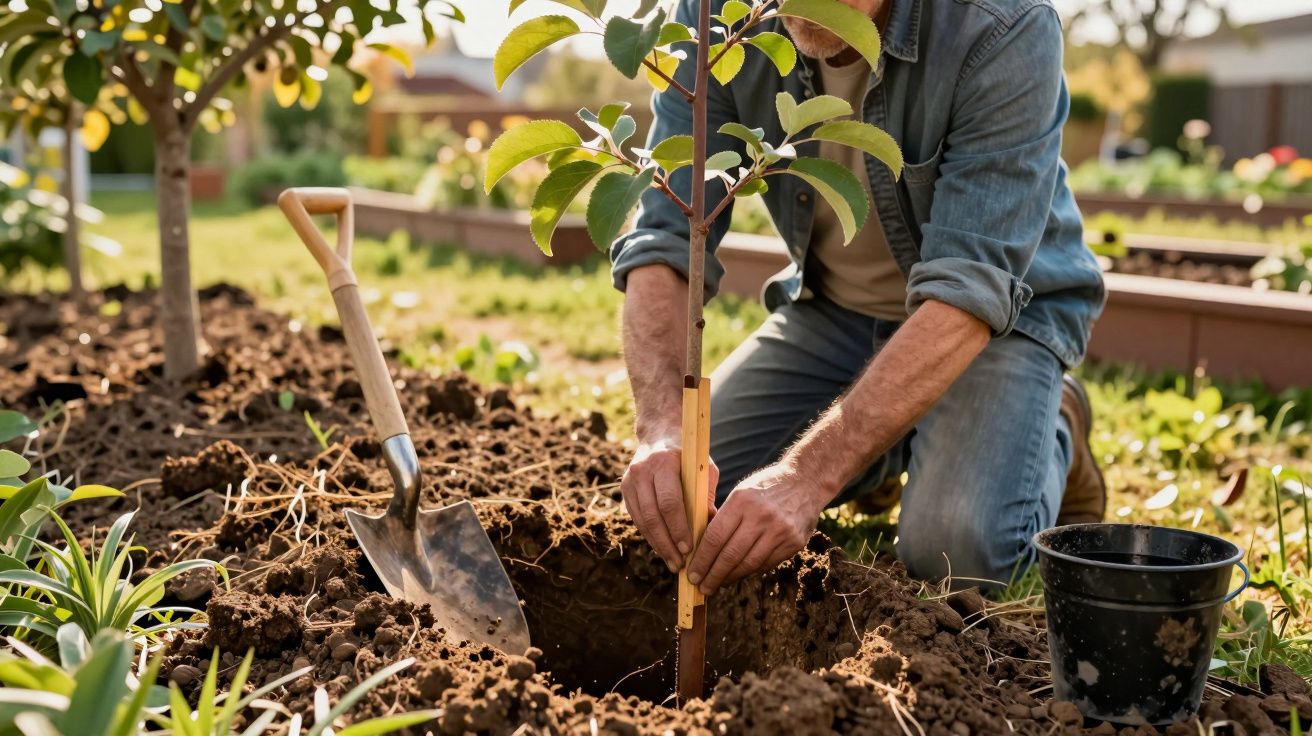
Planting an apple, cherry or apricot tree in March or April often comes with a simple hope: scented blossom in spring and your own fruit later on. Yet in many gardens the opposite happens - the tree sulks, barely produces new shoots, doesn’t flower, and no one can see the reason. In a surprising number of cases the problem isn’t the tree at all, but a few critical centimetres of planting height.
The most common planting trap: fruit trees set too deep
Well-intentioned… and disastrously done
A widespread belief is that a tree should sit as deep and as firmly as possible. So the hole is dug generously, the base of the trunk is banked up with soil, and everything is pressed down hard. It sounds sensible - but for fruit trees it can be a serious mistake.
If you cover the trunk base and the graft union with soil, you are quite literally starving your fruit tree of air.
When that sensitive area is buried, oxygen exchange around the trunk base drops sharply. Moisture lingers, the tree stays constantly damp, and the plant is forced to cope with conditions it simply isn’t designed for at that point on the stem.
Why damp soil against the trunk is so risky
Bark on the trunk behaves very differently from root tissue. Roots can tolerate consistently moist soil - they’re built for it. Trunk bark, by contrast, reacts badly to constant wetness.
If soil sits against the trunk for long periods, several things tend to follow:
- the bark softens, becomes waterlogged and swells
- hidden wood damage develops below the soil line
- fungi and rot organisms gain easy entry
- the transport vessels for water and nutrients are damaged or destroyed
From above ground the tree may look “fine” at first. Underground, however, the trunk can rot little by little. The shoots above the damaged area receive less and less sap until growth becomes weak - or the tree dies back entirely.
The key point on fruit trees: locating the graft union and root collar
How to spot the sensitive zones on a young fruit tree
Most nursery fruit trees are grafted. In other words, a hardy rootstock (the root system) is joined to a productive scion (the fruiting variety). The join is usually visible on the trunk once you know what you’re looking for.
Two points matter most:
- Root collar (trunk base): the transition from root to trunk - where root tissue ends and true trunk tissue begins.
- Graft union: a few centimetres above, often a small swelling, scar, knob or slight kink - the point where the variety was grafted on.
That “scar” is what forms the fruitful crown later. It must never end up below the soil surface.
Why the graft union must stay above soil level
The graft union is the core of your fruit tree - bury it and the tree can lose the very qualities you chose it for.
If the graft union is planted too low, the upper part of the tree may try to produce its own roots. That can sound like a bonus, but it usually removes the advantages provided by the rootstock - such as better frost tolerance, improved disease resistance, and controlled, weaker growth for smaller gardens.
This process is often described as own-rooting: the scion starts to “free itself” from the rootstock. Common consequences include:
- the tree often becomes more vigorous and harder to manage
- flowering is noticeably delayed
- yields can drop
- susceptibility to disease can increase
Instead of investing energy into flower buds and fruit, the tree diverts resources into coping with stress - and the promising start you expected never really arrives.
How to plant fruit trees correctly in March (graft union, root collar and height)
The golden rule for planting height
Here’s the practical rule that matters most:
After planting, the graft union should sit 5–10 cm above the finished soil level.
The root collar should be at, or just slightly above, the surrounding soil surface - and it must not be buried.
Keep the trunk base clear and the graft union plainly visible - that’s how fruit trees establish strongly.
With the sensitive area kept dry, exposed to air and a little sunshine, the trunk base is far less likely to be attacked by constant damp. The tree can then put its spring energy into new growth and blossom rather than survival.
A simple method to prevent the tree “sinking” later
Freshly loosened soil contains a lot of air and will settle noticeably over the following weeks. If you don’t allow for this, a correctly positioned tree can end up too low after the ground drops.
A reliable approach:
- Build a small, firm mound of soil in the base of the planting hole.
- Spread the roots out like a fan over the mound.
- Lay a straight stick or spade handle across the hole to mark the future soil level.
- While backfilling, keep the graft union 5–10 cm above that line.
- Tread the soil in gently for stability - but don’t compact it until it’s rock-hard.
This way, even after settlement, the tree remains at the right height for the coming years.
Extra planting points that prevent problems later (aftercare without burying the trunk)
A few closely related practices can make the difference between a tree that establishes quickly and one that struggles:
- Staking: In windy sites, stake the tree so it doesn’t rock in the hole, which can tear fine roots. Tie the trunk with a flexible tree tie and check it during the first year.
- Mulching: Mulch helps retain moisture and suppress weeds, but keep mulch a clear gap away from the trunk base. A mulch “volcano” piled against the stem creates the same damp, rot-prone conditions as soil banked up to the trunk.
These steps support establishment while still keeping the root collar and graft union dry and well ventilated.
How to recognise a “buried alive” fruit tree
Warning signs in year one and year two
Fruit trees planted with the root collar too low rarely fail overnight. More often, the symptoms creep in - especially in spring and early summer:
- short, weak new shoots
- small leaves with a yellowish cast
- flower buds that dry out before opening
- very slow, almost paused-looking growth for long periods
If the second year brings another poor flush and still no blossom, inspect the very bottom of the trunk. It’s common to find the graft union sitting just under the soil surface or packed tight with soil.
Rescue plan: uncover the trunk base
If the damage hasn’t progressed too far, exposing the base can save a fruit tree that was planted too deep.
With care, you can often improve the situation:
- Use your hands or a small hand trowel to remove soil from around the trunk.
- Shape a shallow dish so the root collar and graft union are visible and free.
- Avoid tearing fine roots and don’t scratch the bark.
- Move the watering ring further out so water doesn’t run directly onto the trunk.
Many trees respond by producing stronger growth and healthier leaf colour the following spring. Even so, reaching the first full flowering phase may still take another one to two years - patience is often rewarded.
Checklist: helping fruit trees establish healthily
Quick checks while backfilling the planting hole
A few basic rules prevent most planting failures. Use this checklist during planting:
- Position the graft union clearly above the future soil line.
- Don’t press soil directly against the trunk - the bark must remain exposed.
- Form the watering basin slightly away from the trunk so water doesn’t pool against the wood.
- Firm the soil only enough to stabilise the tree while keeping air spaces in the ground.
- In the first few weeks, re-check whether the tree has sunk as the soil settles.
Following these points lays the groundwork for a vigorous root system and a resilient crown.
What “root collar” and “graft union” actually mean
A quick look at fruit-tree “anatomy”
The root collar is the meeting point between root and trunk - the boundary between underground and above-ground tissues. This zone is particularly sensitive to constant moisture, frost damage and bark injuries.
The graft union is created by joining a chosen variety (for example, a richly flavoured apple) to a rootstock that copes well with local soil conditions, climate pressures and diseases. Without grafting, many modern fruit varieties would be far less reliable in a home garden.
That’s why the position of the graft union relative to the soil surface matters so much. If you accidentally bury it, you can strip the tree of the very characteristics you paid for.
Practical examples for different sites
Slopes, heavy soils and container planting
On a slope, water tends to drain away more readily, so the risk of waterlogging is lower. Even there, the same rule applies: keep the trunk base clear and the graft union above the soil surface. In very heavy clay soils, it’s often worth adding drainage material or at least mixing in sharp sand and compost so excess water can move away faster.
If you grow fruit trees in containers - for instance columnar forms or trees on weak rootstocks - you need to be even more precise. Pots waterlog quickly. A generous drainage layer (such as crocks or coarse drainage material), a high-quality, structure-stable compost mix, and strict attention to planting height all help. Even if the surface sinks over time, don’t top up compost over the root collar.
In the end, success or failure isn’t determined only by the variety. It often comes down to keeping an eye on those few, decisive centimetres on the trunk. Get them right and spring won’t bring bare branches - it will bring blossom, followed later by baskets of home-grown fruit.



Comments
No comments yet. Be the first to comment!
Leave a Comment