
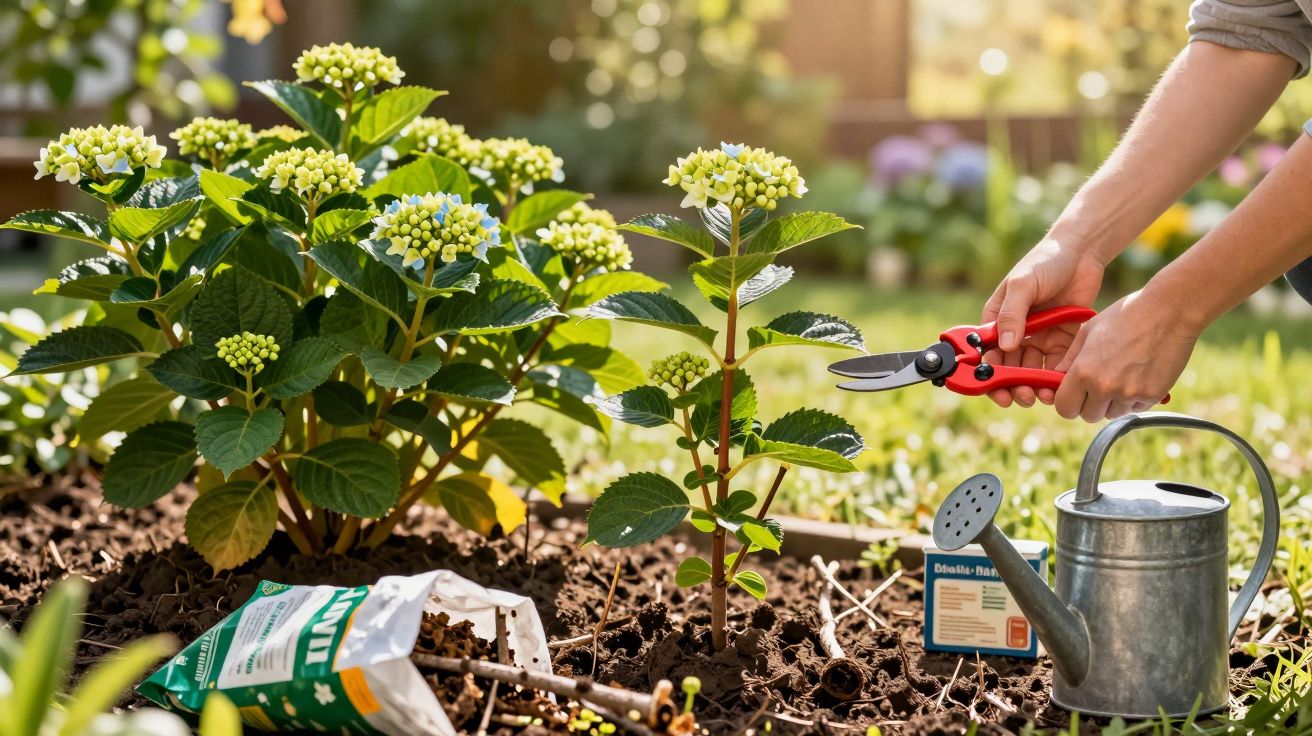
Spring is an ideal moment to turn lacklustre hydrangeas back into show-stoppers.
If you plan a few targeted jobs now, you can effectively “wake” your hydrangeas up. The key is choosing the right pruning window, using the correct technique for your hydrangea type, and giving a little extra attention to the soil around the roots. Done well, tired-looking shrubs can return to dense, brightly coloured flower heads - not just for one summer, but year after year.
Why hydrangeas suddenly produce very few flowers
Many gardeners recognise the pattern: a sturdy shrub with rich green foliage, yet hardly any blooms. It’s easy to blame a “bad summer”, too much rain, or the soil. In reality, the cause is often more straightforward - pruning at the wrong time (late winter or autumn), insufficient nutrients, or stress caused by frost or drought.
Hydrangeas largely decide between late winter and early spring how generously they will flower in summer.
During this period, buds form and mature. If you cut too hard - or at the wrong moment - you may remove a large proportion of the season’s flower buds without realising it. The encouraging news is that a clear, consistent plan for pruning and aftercare can restore strong flowering step by step.
The right time: when to prune hydrangeas in spring
In many parts of the UK, the best window is typically late February to early March. By then, the worst cold snaps are usually easing, and buds are visibly swelling, but not yet opening.
- Avoid pruning too early if hard overnight frosts are still likely.
- Don’t delay pruning into autumn - it can leave plants more vulnerable to winter cold.
- Before cutting, assess both the buds and the condition of the wood.
A quick inspection of the stems tells you a lot: plump buds on firm, brown stems usually indicate good timing. Soft, blackened, or badly frost-damaged growth should be removed cleanly.
Crucial difference: which wood does my hydrangea type flower on?
This is often the deciding factor. Hydrangeas do not all respond to pruning in the same way, and flowering depends on whether buds are carried on last year’s wood or this year’s growth.
| Hydrangea group | Where flowers form | Pruning approach |
|---|---|---|
| Bigleaf hydrangea (Hydrangea macrophylla), lacecap hydrangea, mountain hydrangea, oakleaf hydrangea, climbing hydrangea | Mostly on last year’s wood | Light thinning only: remove old flower heads, take out a small number of old stems at the base |
| Panicle hydrangea (Hydrangea paniculata) | On this year’s growth | Can be cut back firmly: shorten shoots substantially |
| Smooth hydrangea such as ‘Annabelle’ (Hydrangea arborescens) | Also on young growth | Hard cut-back possible: reduce to just above ground level |
If you’re not certain which type you have, it’s safer to remove less rather than more. For older shrubs, a summer photo can help you work out where flowers formed, making it easier to prune correctly the following spring.
Three simple pruning rules for reliably flowering hydrangeas
1) Bigleaf and lacecap hydrangeas: prune gently to protect flower buds
These popular hydrangeas set most of their flower buds the previous year. A severe spring cut often removes nearly all potential blooms. A careful, minimal approach is usually enough:
- Snip off spent flower heads, cutting just above a strong pair of buds.
- Remove thin, weak, dead, or crossing stems back to the base.
- Each year, take out one to three of the oldest, woody stems at ground level to gradually rejuvenate the shrub.
This slow renewal improves light and airflow through the plant and, over time, tends to increase flowering rather than reduce it.
2) Panicle hydrangeas: cut back confidently for strong new growth
Panicle hydrangeas flower on fresh growth, so they tolerate - and often benefit from - a bolder prune.
Shorten all shoots by roughly one third to one half, cutting just above a bud pair that faces outwards. This helps build a sturdy framework that can support large flower panicles through the summer.
The fewer buds you leave per stem, the larger and more dramatic the individual flower clusters tend to be.
If you prefer more flowers overall (though slightly smaller), leave more buds and prune less hard.
3) ‘Annabelle’ and similar: a near-ground cut-back is usually fine
With smooth hydrangeas such as ‘Annabelle’, bravery is often rewarded. Because they bloom reliably on the new shoots, you can cut them back to around 20 cm above ground level. This encourages thick, robust stems that hold the heavy, rounded flower heads more securely.
That said, in very exposed or windy gardens it can be sensible to leave the plant a little taller, as extra branching can provide added support.
After pruning: soil care, feeding, and protection
Pruning is only half the job. What you do next strongly influences plant vigour and flower production.
Clear the base and replenish nutrients
Start by removing anything diseased from around the root area. Old leaves with mould, spots, or obvious damage, along with fallen flower debris, should go in the general waste or council food and garden waste collection - not the compost heap if you suspect fungal problems.
Then apply a thin layer of well-rotted compost or a dedicated hydrangea feed. These typically supply adequate potassium and only moderate nitrogen, supporting healthy growth without pushing overly soft, sappy shoots.
Mulch to retain moisture and support flowering
After feeding, add a loose mulch layer such as bark chips, leaf mould, or shredded twiggy material. This helps in several ways:
- Moisture stays in the soil for longer.
- Temperature swings are less extreme.
- Weed germination is reduced, so hydrangeas face less competition.
Mulching is especially helpful for younger plants, whose roots have not yet reached deeper moisture reserves.
Water properly and watch for late frosts
Hydrangeas thrive in evenly moist soil, but they dislike waterlogging. After pruning and feeding, give a thorough watering, particularly if winter has been unusually dry.
Clear nights in March and April can still bring late frosts that damage swelling buds. A light layer of horticultural fleece can protect the largest buds and fresh shoots. Frost damage may not be obvious immediately - it often shows weeks later when shoots blacken or dry out.
Practical hydrangea tips for long-term strength (and better flowering)
Hydrangeas are often labelled “fussy”, but in truth they respond predictably to a handful of common care issues. Keep these basics in mind:
- Position: Partial shade suits many hydrangeas; harsh midday sun can stress them, especially in dry spells.
- Soil: Loose, humus-rich soil that’s slightly acidic is ideal. In very chalky areas, many gardeners get best results in large containers.
- Watering: In hot weather, water less often but deeply, rather than offering frequent small amounts.
- Monitoring: Through spring and summer, check for pests such as aphids and for leaf-spot symptoms, and act early.
Colour changes - for example, pink shifting towards blue - depend heavily on soil pH and aluminium availability. There are products designed to influence this, but repeatedly changing direction can unsettle plants. Better results usually come from choosing a colour goal and adjusting conditions steadily over time.
Two often-missed factors: clean tools and water quality
One extra habit that makes a noticeable difference is tool hygiene. Before moving between plants (and especially if you’ve cut out suspect, blackened stems), wipe or disinfect secateurs to reduce the risk of spreading disease.
Also consider water quality, particularly in hard-water regions. Regular watering with very hard tap water can gradually push soil pH upwards, which some hydrangeas dislike and which may reduce the intensity of blue tones. Collecting rainwater for container hydrangeas can be a simple, effective improvement.
What many people underestimate: patience plus a consistent plan
Hydrangeas are long-lived shrubs. A poor pruning decision or a tough frost rarely ruins the plant permanently - it more commonly spoils a single season’s display. If you respond methodically the following year, the shrub usually rebounds and returns to full flowering.
The guiding principle is straightforward: check in late winter, prune wisely in spring, keep soil and moisture steady - then let hydrangeas do what they were bred to do in summer: carry bold, generous blooms in white, pink, blue, or violet that make the garden feel transformed.





Comments
No comments yet. Be the first to comment!
Leave a Comment