
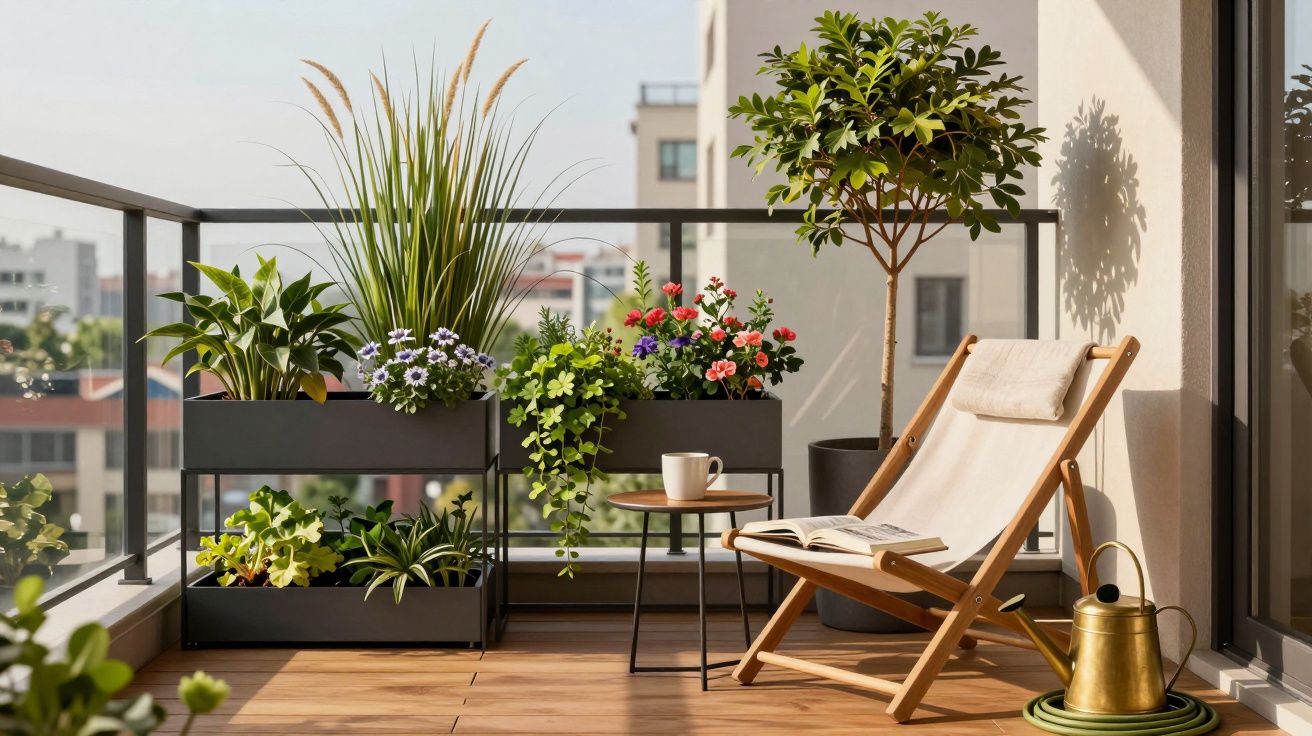
If you used to “do up” your balcony, you probably lined a few flowerpots along the railing and squeezed in a chair. For many people, that no longer feels enough. Outdoor space is being pulled closer to the living area and treated as a mini lounge, an al fresco dining spot, or even a home office outside. That shift is exactly why a new planting idea is taking off-one that visually retires the old scatter of pots.
Why classic flowerpots suddenly look dated
In recent years, balconies and terraces have evolved dramatically. Rather than acting as a simple parking place for plants, they’re increasingly styled as fully fledged rooms. With outdoor rugs, fairy lights, lounge sofas and compact side tables, plenty of households now treat the balcony as a second sitting room.
In that kind of setting, a random collection of pots on the floor can quickly feel busy and untidy. Different shapes, heights, colours and materials make your eye jump around, and the floor looks cluttered-even when you haven’t actually got many plants.
The new balcony look for 2026 is guided more by interior design than by traditional garden décor.
That’s why the 2026 approach follows one clear rule: plants shouldn’t be dotted around at ground level. Instead, they’re positioned with intention-structured, raised up, and placed like furniture.
Plants on legs: the 2026 balcony trend for mini raised beds and raised planters
At the heart of this shift are long, often rectangular planters on stands-think mini raised beds in a sleek format. The frames are commonly black metal or pale wood, supported on slim legs, and they read like stylish outdoor sideboards rather than basic containers.
Used well, they deliver several benefits at once:
- The floor stays largely clear, so the space appears bigger.
- Greenery is lifted up, making it more noticeable.
- The planters create clean lines instead of a jumble of individual pots.
- The balcony looks tidier and more contemporary.
Because the planting sits higher, leaves and blooms land around seated or eye level. When you’re relaxing outside, you’re no longer staring at bare walls or railings-you’re looking into a compact, well-planned band of greenery, almost like a floating bed.
Playing with height: how to make a modern, lively balcony with layered planting
A key principle of the trend is using levels on purpose. Rather than lining everything up at one height, you build a small “landscape” made from different tiers.
How the height mix works
Typically, three layers are combined:
- Near the floor: shallow crates, small stools topped with herbs, or low ornamental plants.
- Mid height: planters on frames that sit roughly at table height.
- Eye level: hanging baskets, wall shelves, or vertical trellises for climbers.
With this stepped layout, the balcony doesn’t just look greener-it feels more three-dimensional. Plants start doing the job of room dividers without adding heaviness.
Instead of glass or timber partitions, you get “green walls” that provide privacy while still letting light and air through.
This makes it easy, for example, to visually separate a dining corner from a small lounge zone on one terrace-without adding any extra screens.
From balcony to living space: plants as a design element
So why is the idea gaining so much traction in 2026? One reason is the way people now view their homes-especially in cities, where every square metre counts. Outdoor space is increasingly seen as a valuable extra room that many want to use year-round.
In that context, plants take on a different role. They’re no longer “just decoration”: they organise the layout and help shape the space. The containers themselves are chosen like furnishings-coordinated with the table, chairs and textiles.
Two style directions are especially popular:
- Modern-minimalist: black or white metal frames, crisp lines, fewer plants but with real impact.
- Scandi-cosy: timber frames, light upholstery, natural fibres, paired with lots of greenery and warm lighting.
Metal scores for durability and gives an urban edge. Timber adds warmth and a homelier feel that echoes indoor rooms. The two also mix well-for example, a black metal stand beside a wooden chair.
How to put the trend into practice (without rebuilding everything)
If you want to refresh your balcony for 2026, you don’t need a full redesign. A handful of targeted changes is often enough:
| Step | Action |
|---|---|
| 1 | Replace one or two old pots with long raised planters. |
| 2 | Plan for multiple heights: floor level, on a stand, and hanging. |
| 3 | Stick to a maximum of two materials (e.g. metal and wood). |
| 4 | Add lighting: fairy lights and small solar spotlights. |
| 5 | Arrange plants so seating is framed by greenery. |
On small balconies, the advantage is especially obvious. By lifting plants upwards, you free up floor space for a compact table, a lounger or a comfortable armchair.
One extra practical point worth building into your plan is drainage and surface protection. Raised planters still need a clear route for excess water-especially after heavy rain-so consider saucers or slim drip trays that won’t stain decking tiles. If your balcony has a delicate finish, a waterproof mat under the stand can prevent marks while still keeping the airy, raised look.
Which plants suit this new way of planting
Not every plant performs equally well in raised containers or narrow planter shelves. The most in-demand choices are those that look good in groups and are happy to trail a little:
- Trailing geraniums or petunias for bold colour
- Herbs such as rosemary, thyme and basil for fragrant kitchen corners
- Grasses for movement and a modern, calm feel
- Succulents and compact perennials for low-maintenance groupings
- Climbers such as ivy or clematis trained up slim trellises
If weight is a concern-particularly on older balconies-it’s sensible to avoid oversized containers packed with lots of compost. In many cases, several smaller, lighter planters are the safer choice.
Risks, care and practical tips
Raised planters come with a few points to watch. Because they often hold less compost than large tubs, they can dry out faster. In summer, it helps to consider:
- a watering system or built-in water reservoir,
- lighter-coloured containers on very sunny balconies,
- a mulch layer of bark mulch or gravel to hold moisture in.
Balconies exposed to wind need sturdy frames. To prevent tipping, the feet should be wide enough to give stability. In very exposed spots, slim ratchet straps or fixing the stand to a wall can add extra security.
Seasonal care also matters more when containers are smaller. In colder months, roots can chill faster above ground, so moving tender plants closer to the wall, wrapping pots with fleece, or choosing more cold-tolerant varieties can help keep the display looking good beyond summer.
Combinations that work particularly well in 2026
The trend gets even more effective when it’s paired with other elements. A few examples that regularly appear in current styling concepts:
- A narrow planter stand behind a bench, acting like a green backrest.
- A tall metal shelving unit of herbs positioned next to a barbecue or outdoor kitchen.
- Hanging plants above a small bistro table, creating a natural canopy.
- A mix of a tall planter box and an outdoor rug that visually defines a “room”.
If you prefer a subtler start, begin with a single raised container and see how it changes the feel of the space. Even one slim planting “board” can direct the eye and make a balcony look noticeably more premium.
At its core, the trend is simple: plants move off the floor and into the same design layer as furniture, shelving and lighting. Use that idea on your balcony and you’ll not only gain usable space-you’ll end up with an outdoor area that genuinely feels like an extension of your home.



Comments
No comments yet. Be the first to comment!
Leave a Comment