
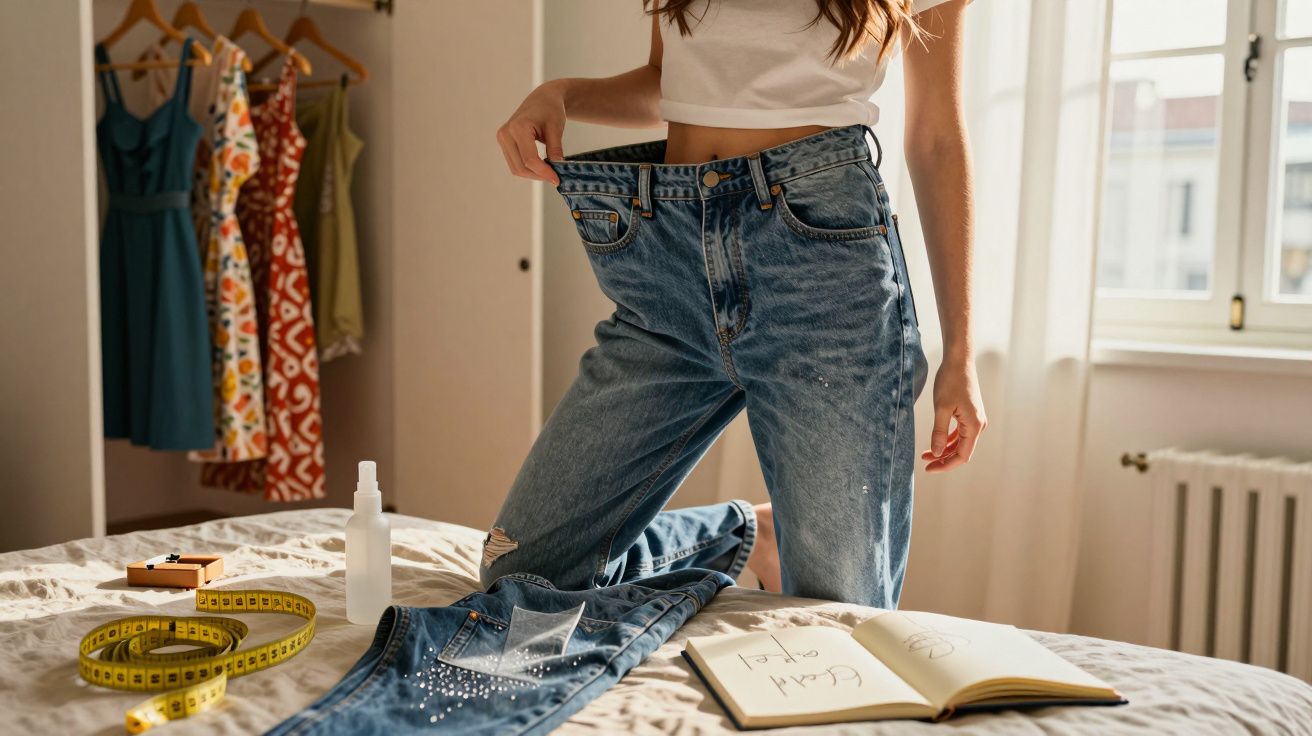
Many vintage enthusiasts know the feeling: in a shop or online, that old designer piece looks flawless-then at home you can barely fasten the button. It is deeply frustrating, because authentic pieces from the 1960s, 1970s or 1980s are not something you can simply replace. This is exactly where a few straightforward, surprisingly effective methods come in: you can adjust overly tight vintage clothing by up to one size-without destroying it.
Why vintage clothing often comes up smaller today
The first real revelation is that sizing has shifted dramatically. What was sold as a size 40 in the 1970s often corresponds more closely to a slim 36 now. Body measurements considered “standard” were different back then, and many garments were designed with a closer fit in mind.
On top of that, there is what dressmakers call ease allowance. In the past, plenty of garments were cut to sit very close to the body-sometimes almost like shapewear. That concentrates strain around the side seams and the waistband. If you force a piece over your hips, the fabric can tear or stretch out permanently in the wrong places.
Your body is not the problem-the old size charts are. Once you understand that, vintage sizing becomes far less stressful.
The good news is that high-quality older fabrics often respond extremely well to moisture, warmth and carefully applied tension. With the right approach, you can noticeably expand a tight waistband.
What “one size bigger” really means in centimetres
Many fashion professionals do not think in dress sizes-they think in measurements. Gaining one size at the waist or hips typically means roughly 4 cm extra in circumference.
- about 4 cm more circumference = roughly one size
- usually split across both sides: around 2 cm left and 2 cm right
- on skirts and dresses, the two side seams are often the best starting points
Once you understand these numbers, claims like “three sizes bigger in ten minutes” are instantly revealed as unrealistic. Gentle methods usually deliver anything from a few millimetres up to just under 3 cm. Anything clearly beyond that generally requires proper alterations to the cut and seams.
The five-minute trick: how to stretch vintage jeans safely (especially 100% cotton denim)
This quick method works best on jeans made from 100% cotton denim-either with no stretch at all or only a minimal stretch content. Cotton fibres swell slightly in lukewarm water and can adapt under controlled tension.
Step-by-step guide for jeans that are too tight
- Dampen with lukewarm water: Using a spray bottle, thoroughly wet the waistband and upper hip area until the denim is clearly damp but not dripping.
- Put them on: Fasten the jeans while standing. If necessary, do them up lying down first, then stand up.
- Move for 3–5 minutes: Stay active so the tension spreads evenly across hips and seat:
- gentle squats
- lunges forwards and to the side
- side-to-side torso twists to distribute strain around the hips and bum
- gentle squats
- Let them air-dry: Keep them on and allow them to dry naturally-avoid the tumble dryer, which can shrink them back.
- Measure: Measure the waistband before and after. With firm cotton denim, up to 3 cm of extra room is realistic.
This works because cotton fibres are more flexible when wet and can lengthen slightly under controlled tension in a way that holds.
If you cannot bear wearing wet clothing, use an alternative: stretch the damp waistband over a broad wooden coat hanger or another sturdy object that provides strong resistance. As it dries, the tension remains in place and the waistband widens more precisely.
If the jeans still pinch: when to reach for needle and thread
If fibre-stretching does not give you enough room, the next step is altering the cut. A classic fix is to unpick the back waistband and insert a small fabric panel-or a section of wide elastic-at the centre back. Done neatly, the change is almost invisible, especially on dark washes.
The key point: disturb the original fabric as little as possible so the alteration can be reversed later. If you are working with a valuable collector’s piece, it is worth going to a professional tailor with experience handling older garments.
Quick fixes for tight vintage skirts and dresses
With dresses and skirts, the tight spot is often at the side-around the hips or waist. In that case, a small insert at the side seam can help. In tailoring terms, this is a gusset, often shaped like a triangle.
How the side-seam gusset trick works on vintage skirts and dresses
- Identify the pressure point: Try the garment on and mark where it pulls most-usually at the waist or upper hips.
- Open the seam: Carefully unpick the relevant side seam for 5–7 cm.
- Cut the gusset: From a fabric that matches as closely as possible (or deliberately contrasts as a design feature), cut a piece around 6 × 8 cm and fold it lengthways once to form a triangle.
- Insert: Place the point of the triangle downwards into the V-shaped opening and stitch it in firmly on both sides.
- Repeat: Do the same on the other side so the silhouette stays balanced.
With two neatly placed triangles, the strain is distributed far better, and the circumference can ideally increase by the “magic” 4 cm. The garment’s line stays true-only the freedom of movement improves noticeably.
Especially with pencil skirts, a barely visible side-seam gusset can be the difference between “unwearable” and “favourite piece”.
How to avoid damaging older fabrics
Many older textiles are more delicate than modern mass-market clothing. Before you do anything, a quick check is worthwhile:
- Does the fabric look brittle or shiny along crease lines? If so, apply tension very cautiously.
- Is the waistband already stretched out or heavily reworked with multiple old stitch lines? Avoid adding extra strain.
- Are there visible tears or thinning at the seam? Reinforce first, then attempt stretching.
If you are unsure, test the method on a less-loved garment with a similar fabric blend. That gives you a feel for how much a fibre will give when exposed to moisture and movement.
Why it is worth the effort (and why vintage clothing deserves it)
Vintage pieces often deliver a level of quality that many fast-fashion chains rarely match now: denser weaves, careful finishing and cuts that outlast trends. Putting in a little effort to adjust the fit pays off. Rather than buying the next pair of jeans that is merely “fine”, you rescue a characterful one-off with real presence.
There is also a sustainability bonus. Every saved skirt and every altered pair of jeans reduces the need for new textile production, which consumes significant water, energy and chemicals. Wearing what already exists for longer noticeably shrinks your personal fashion footprint-without sacrificing style.
A practical note before you start: clean, condition and document
Before stretching or sewing, make sure the garment is clean (or at least freshly aired) so dirt does not get ground into the fibres during handling. If the fabric feels dry or stiff, gentle steaming from a short distance can help relax it-particularly on cotton and wool blends. It is also worth taking quick photos of seams, darts and waistband construction before you unpick anything; that makes it much easier to restore the original finish later.
Many fans eventually develop a simple routine: try on the “new old” find, identify tension zones, use the fibre trick for denim, and plan gussets for skirts and dresses. That is how a slightly-too-tight discovery becomes a personal favourite with a story-and the right fit.





Comments
No comments yet. Be the first to comment!
Leave a Comment