
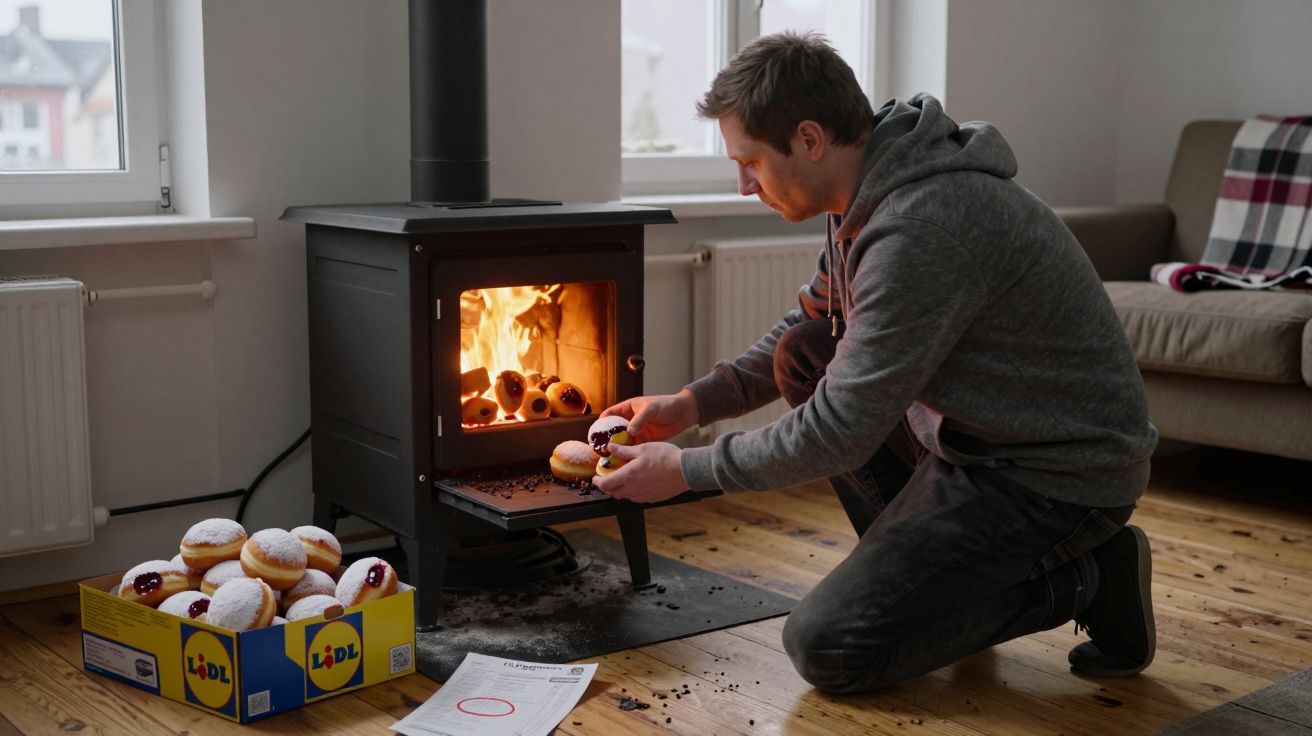
In Poland, one experiment is prompting equal parts disbelief and fascination: a well-known YouTuber isn’t feeding his stove with logs, but with kilogram after kilogram of greasy Berliner doughnuts from a discount supermarket. What starts as an absurd stunt ends up exposing the brutal knock-on effects of rising energy prices-and forces an uncomfortable question: since when did burning food become cheaper than buying proper heating fuel?
How Marek Hoffmann (AdBuster) ended up with the Berliner idea
The person behind the test is Marek Hoffmann. Online, he’s better known by his channel name AdBuster, where he typically reviews adverts, dismantles products and runs viral experiments. This time, though, he hits a nerve that goes far beyond entertainment: heating at discount prices.
The spark came from browsing a leaflet and checking supermarket shelves shortly before Fat Thursday, a traditional feast day in Poland. Around that time, classic Berliner doughnuts-hugely popular in Poland-are often heavily marked down. They appear piled high in the aisles, sometimes with steep discounts, because they need shifting fast.
That’s when Hoffmann poses a straightforward, provocative question: if those mountains of pastries are being sold for next to nothing anyway, could you simply burn them? And could they even work out cheaper than wood pellets?
A kilogram of discounted pastries costs him less than a kilogram of pellets-while offering a similar amount of energy.
133 Lidl Berliners in a stove: the numbers are hard to ignore
For the experiment, Hoffmann drives to Lidl and fills up a trolley. He ends up with 133 doughnuts, weighing about 10 kg in total. The full bill comes to €2.85, which works out at roughly €0.02 per Berliner.
He takes the haul back to his workshop, where he has a heavy cast-iron stove. Instead of logs or pellets, he loads the firebox with doughnuts. It sounds like pure internet nonsense-until you look at the sums, which are uncomfortably serious.
- Weight: about 10 kg of Berliners
- Total price: €2.85
- Quantity: 133
- Cost per piece: about €0.02
- Comparison: wood pellets cost more per kilogram than these discounted baked goods
Hoffmann then compares his costs with current pellet prices in Poland. For the same 10 kg of heating pellets, he would have paid noticeably more. That’s the combustible part of his point: in his example, clearance-priced food undercuts a fuel that is specifically produced and sold for heating.
Why fried Berliners burn so well
The obvious question is whether pastries can genuinely heat a space at all. Counterintuitively, the answer is yes. Berliners are made from dough, contain plenty of fat, and are loaded with sugar-exactly the sort of combination that can release a lot of energy when burned.
Using data Hoffmann cites, 1 kg of these fatty pastries comes in at around 18.5 megajoules (MJ) of energy. By comparison, typical wood briquettes are about 18.27 MJ per kg. The difference is small, but in this case the pastries come out slightly ahead.
In a stove, fat and sugar behave almost like an extremely dry, concentrated fuel-the energy is packed into every calorie.
In practice, the effect is obvious. Once the first Berliner catches, the temperature in the cast-iron unit climbs quickly. Hoffmann records several hundred degrees Celsius. Even more striking, the burn continues for almost five hours without constant topping-up. Oil in the dough, sugar, and the dry portion of the pastry all contribute.
What the real-world stove test looked like
Hoffmann films the process step by step. He packs the Berliners into the stove, lights them, and lets it run. His observations include:
- The Berliners ignite fairly quickly once they’ve dried out properly.
- The stove reaches high temperatures and holds them for a long time.
- Combustion continues for several hours without a dramatic drop in output.
- The fat produces an intense flame, comparable to very resinous wood.
From his perspective, the heat output seems workable-at least in the short term. The fact it works technically is precisely what makes the ethical side feel worse.
The uncomfortable feeling: burning food while others are forced to cut back
By the end, Hoffmann appears visibly conflicted. In the video he says plainly that watching Berliners burn doesn’t leave him unmoved. He questions whether it can really be considered normal to burn food simply because it’s on promotion and cheaper than mainstream fuels.
He isn’t trying to advertise burning food-he’s trying to show how badly something has gone wrong.
He also points out that many families in Poland are currently counting every złoty just to keep their homes warm. At the same time, supermarkets push large quantities of food out the door at throwaway prices so it doesn’t end up in the bin.
His experiment therefore sits at the collision point of two crises: energy prices and food waste-both of which affect millions of people across Europe.
Background: the energy crisis hits Poland particularly hard
Poland has long relied heavily on coal and low-cost fuels. In recent years, government rules, CO₂ pricing and geopolitical tensions have pushed heating costs upwards. Many households still depend on wood, pellets or coal stoves.
When prices spike, people start improvising. Polish media have carried reports of some households burning grains such as oats or maize as fuel. Now there are ever more unusual cases-like this one-where even baked goods are floated as a form of “alternative energy”.
The underlying issues are serious:
- Rising fuel prices are pushing households to the limit.
- Older heating systems often cope badly with non-standard substitute fuels.
- Improvised burning can increase emissions and local air pollution.
- It creates a moral conflict between staying warm and the value of food.
Is burning food ever a sensible idea?
Technically, plenty of things will burn that were never intended as firewood. Fatty baked goods contain a lot of stored energy; grains can also release substantial heat. Even so, experts have warned for years about these kinds of “emergency fixes”.
Key concerns include:
- Emissions: frying fats, sugar and additives can release more fine particulate pollution and problematic gases than certified fuels.
- Health: poor combustion contributes to smog and strains respiratory health, especially in built-up areas.
- Wear and damage: stoves and flues not designed for it may clog more quickly or be harmed.
- Ethics: burning food sits in stark conflict with efforts to reduce hunger and tackle food waste.
For that reason, specialists tend to recommend channelling surplus food into food redistribution, donations, or controlled recovery routes such as biogas plants, rather than feeding it directly into a domestic stove. Anaerobic digestion can reclaim energy in a managed way without blackening entire streets with soot.
What the Berliner experiment means for Germany-and why it should worry the UK too
In Germany, many people have learned in recent winters what it feels like to open a heating bill and recoil. Seen from the UK, Hoffmann’s video may look like a foreign internet gag, yet it lands on a familiar anxiety: the fear that energy could become unaffordable.
The experiment leaves a few takeaways that resonate on both sides of the Channel:
- Comparing energy sources is increasingly important-whether it’s gas, electricity, pellets or district heating.
- Food promotions can reveal just how large the oversupply can be.
- Public programmes supporting insulation and efficient heating systems can prevent these sorts of absurd outcomes.
Anyone seriously considering alternatives will usually end up looking at measures such as heat pumps, improved insulation, solar thermal, or modernised wood-burning systems. Berliners in a stove are, thankfully, an extreme edge case-but it’s one that sticks in the mind.
Why this video lingers longer than a typical YouTube prank
Watching 133 Berliners disappear into a stove feels like something from a satire. Yet beneath the shock value sits a blunt reality: when households start burning food because it’s cheaper than fuel, something in the system has failed.
That is why Marek Hoffmann’s video lands so strongly. It isn’t just engineered for clicks-it offers a visual you don’t forget, showing how tightly the energy market, consumer habits and waste have become entangled, and how urgently better answers are needed to the heating-cost problem.
A further point often missed: safety, regulations and knock-on costs
Even if a domestic stove can burn unconventional materials, that does not make it safe-or legal-everywhere. Different fuels can change how soot and residues build up in a flue, potentially increasing the risk of chimney fires and raising maintenance needs. Any short-term saving can quickly be wiped out by professional cleaning, repairs, or damage to stove components.
There is also a wider community impact: if many households start burning unsuitable materials, neighbourhood air quality can deteriorate fast. The immediate temptation to “make do” may feel rational in a crisis, but the longer-term costs-health, pollution and equipment failure-can be far higher than the price gap that triggered the improvisation in the first place.




Comments
No comments yet. Be the first to comment!
Leave a Comment