
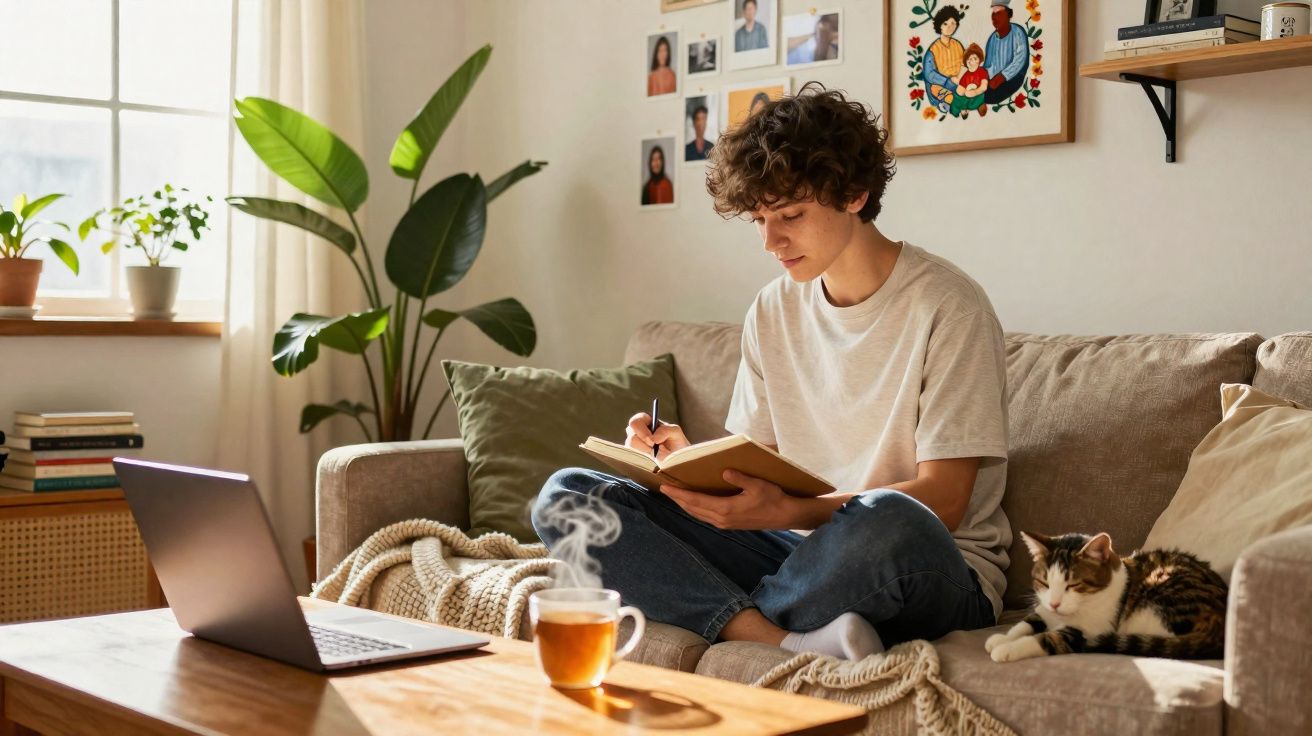
Far from being lazy or antisocial, homebodies often show a distinct relationship with comfort, safety and connection. Beneath the “stay-at-home” label sits a blend of family patterns, emotional drivers and personal equilibrium that influences how they live, love and socialise.
Being a homebody is not the same as being antisocial
The cliché is well known: someone who turns down invitations, dreads going out and spends the weekend in pyjamas. It is easy to assume they do not like people. In practice, plenty of homebodies enjoy others’ company-just more comfortably on their own patch.
Therapists frequently observe that people who prefer staying in are often delighted to host. Their lounge can turn into a mini social centre: meals with friends, children staying over, neighbours popping in for a quick drink. The key difference is not whether anyone is present, but where the socialising happens.
Homebodies are often socially active, but they prefer relationships that unfold on their own ground, on their own terms.
This tendency often traces back to early experiences of welcoming others into the family space. In some households, the front door was always open, with relatives and visitors coming and going. From the beginning, home life and social life were intertwined.
1. They carry strong family traditions into adulthood
Many homebodies were raised in big or close-knit families where the home was the main venue for togetherness. Sunday lunch stretched into the evening, cousins slept on spare mattresses, and the kitchen table hosted conversations that seemed to never end.
Psychiatrists suggest this kind of upbringing leaves a lasting imprint. For the homebody, “being together” is strongly linked with sharing a familiar setting. Their flat or house becomes a grown-up extension of childhood: somewhere you welcome people, feed them and generate a sense of warmth.
- They like to host: dinners, game nights, movie marathons.
- They plan ahead: food, atmosphere, seating, playlists.
- They value rituals: Friday-night pizza, annual barbecues, festive decorations.
What may look like retreat can, in fact, be a way of keeping family-style rituals alive. Rather than escaping society, the homebody often rebuilds a familiar, close version of it within four walls.
For many homebodies, the home is not a refuge from people, but a stage for a gentler, curated social life.
2. They seek security and emotional grounding
Another common thread is a pronounced need for safety-not only physical safety, but emotional anchoring too: a place where surprises are limited and the body can properly unclench.
Therapists sometimes describe it like a ball attached to an elastic string. You can knock it far away, yet it always returns to its base. For some homebodies, that base can feel a little vulnerable. Travel, crowds or unfamiliar settings may spark low-level anxiety, even when they manage everyday life perfectly well.
In that context, the home becomes soothing. It offers a controllable environment: light, sound, food, temperature and the people present can all be managed. With so much predictable, the nervous system-sometimes more sensitive than average-settles more easily.
| Outside | At home |
|---|---|
| Uncertain schedules and delays | Self-chosen pace and routines |
| Unknown people and places | Familiar objects and known faces |
| Noise, lights, social pressure | Controlled atmosphere, easy escape route |
From a psychological perspective, a stable home can compensate for an earlier sense of insecurity. If childhood bonds felt shaky or unpredictable, creating a calm, dependable living space in adulthood can function as an emotional buffer.
For some, home is less a location and more a self-built safety zone that keeps anxiety at a manageable level.
The subtle difference between “house” and “home” for homebodies
English usefully distinguishes between “house” (a building) and “home” (a place loaded with feeling). Some people can feel “at home” nearly anywhere-on a friend’s sofa, in a hotel room, in a new city. Others feel unsettled each time they step outside their own front door.
Homebodies typically pour a great deal into one particular place. Their identity, memories and sense of continuity are anchored to that address. As a result, travelling or moving can feel not merely like a change of scenery, but like a small uprooting.
3. They are often self-sufficient and at ease with themselves
Staying in can also reflect a strength. Many homebodies do not require constant outside stimulation. They may happily spend hours reading, cooking, tinkering, gaming or simply thinking, without feeling bored or hollow.
Finding peace alone in a room signals a solid inner life, not a lack of one.
Practitioners note that needing fewer social mirrors can indicate healthy self-acceptance. The homebody does not have to chase every invitation in order to feel they matter. Their self-worth is not dependent on being seen in the right pubs or checking in at the right places.
Does that make them self-absorbed? Not automatically. Philosophers have often argued that people who only truly love themselves can struggle most with solitude. The ability to stay home contentedly can instead point to an inner conversation that is calmer, kinder and less combative.
What homebodies tend to enjoy doing alone
- Creative hobbies: writing, drawing, playing music, crafting
- Deep-focus activities: reading long novels, learning a language, coding
- Quiet comforts: long baths, baking, gardening on a balcony or in a garden
- Online communities: gaming, forums, group chats that do not require leaving home
For many, these pursuits provide clearer structure and more reliable satisfaction than late nights out that end in fatigue and superficial chat.
Three practical strategies for homebodies
Opening up gradually without forcing it
Some homebodies notice their comfort zone has narrowed more than they would like. Specialists tend to caution against harsh “exposure”, which often backfires, and suggest building “symbolic corridors” between home and the outside world.
This could mean starting with visits to people nearby before committing to longer journeys, or choosing small local events rather than big anonymous crowds. Joining a local association, club or class can also create continuity-same place, same faces, returning regularly over time.
The goal is not to become an extrovert, but to gently widen the radius around your safe base.
Listening to desire, not guilt
A number of homebodies are propelled by self-criticism. A nagging inner voice says: “You should go out more, normal people don’t stay in this much.” Therapists recommend turning that around. Before accepting or declining, they encourage asking: “What could this bring me, genuinely?”
A museum becomes a chance to be genuinely moved by art. A drink with colleagues becomes an opportunity to know one person better, rather than trying to impress everyone. When the reason is pleasure or curiosity instead of shame, leaving home is less exhausting.
Becoming your own motivator
Often, the homebody goes out mainly when someone else pushes: a partner insists, a friend pleads, a relative applies pressure. That sort of external fuel rarely lasts. Mental health practitioners suggest developing an internal engine instead.
A straightforward exercise is to run a gentle inner conversation, as though speaking to a close friend: “Come on, let’s go out. There’s that film everyone says is worth seeing, and we might actually like it.” When the inner voice is warm and persuasive rather than strict, it can help you take small, manageable risks.
When staying home helps – and when it starts to hurt
For many people, a strong attachment to home is neutral or even helpful. It can curb spending on constant entertainment, reduce exposure to late-night risks, and free up more time for sleep and personal projects. In relationships, a partner who enjoys nesting may contribute stability and routine.
Difficulties arise when preference turns into avoidance. Red flags include declining nearly every invitation, panicking when far from home, or using the house as a barrier against any challenge-new job, new people, new experiences.
A healthy homebody enjoys staying in but still feels capable of going out when life truly requires it.
One way to gauge where you stand is to picture a specific scenario: a close friend asks you to a small birthday dinner nearby. If you feel a touch of reluctance alongside curiosity, the balance is likely fine. If you feel dread, bodily tension and thoughts such as “I just can’t face it, I’ll make any excuse”, the comfort of home may be masking deeper anxiety.
Making the most of a homebody nature
Approached intentionally, a homebody temperament can become a genuine advantage. People who love staying in are often brilliant at organising intimate get-togethers. They may also develop substantial hobbies that translate into work: a passion for cooking that evolves into a catering project, or long hours online that build valuable digital skills.
They can shape shared rituals too: weekly film nights with friends, remote board games, or book clubs hosted at home. These options fit their preference for familiar surroundings while still maintaining closeness.
For those who see themselves in this profile, the real question is not “How do I stop being a homebody?” but “How do I shape a life where my love of home supports, rather than limits, my relationships and opportunities?” When that balance is achieved, the living room is not a cage-it is a base camp from which you can step into the wider world when it genuinely matters.




Comments
No comments yet. Be the first to comment!
Leave a Comment