
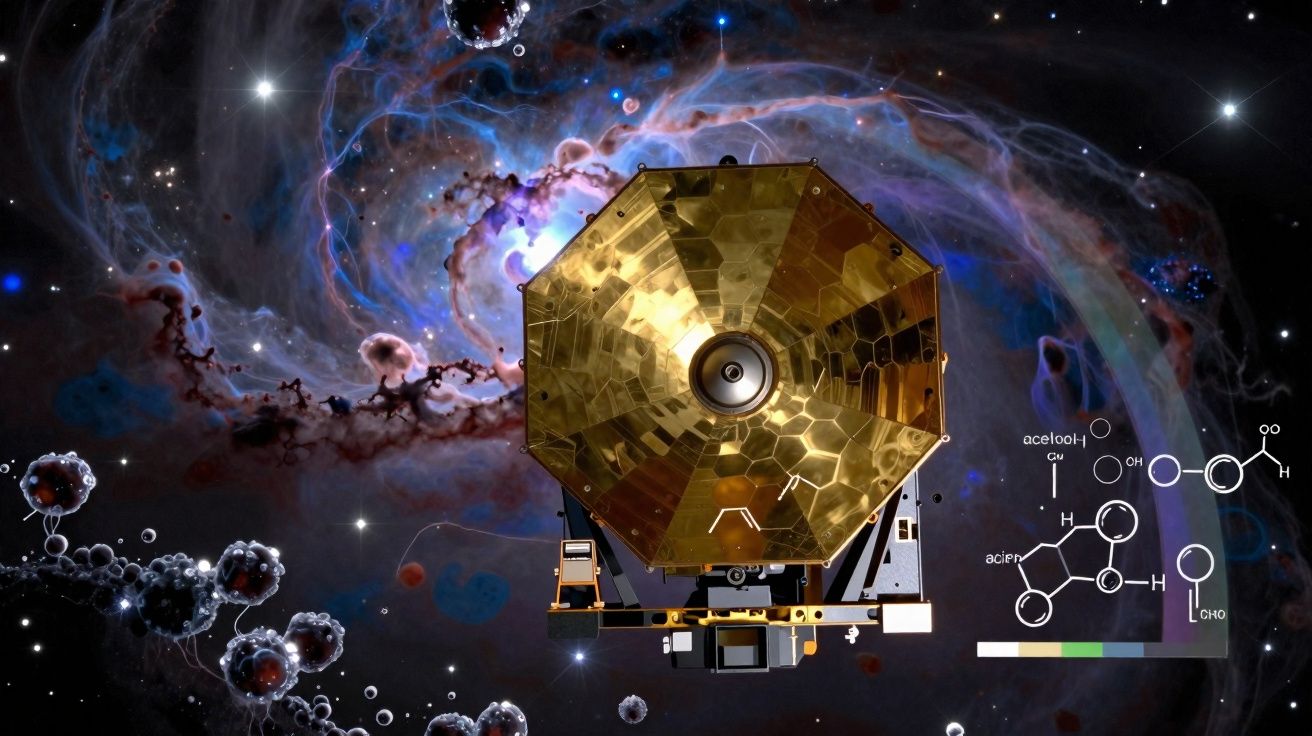
Using the James Webb Space Telescope, scientists have detected five complex organic molecules trapped in ice surrounding a star that is still forming in the Large Magellanic Cloud. This single observation broadens the landscape of prebiotic chemistry well beyond the familiar territory of the Milky Way.
James Webb spots frozen organics beyond the Milky Way
An international group led by Marta Sewiło has reported the first identification of solid-phase complex organic molecules beyond our own galaxy. Their target was ST6, a young protostar in the Large Magellanic Cloud roughly 160,000 light-years away, where JWST’s MIRI instrument recorded clear mid-infrared absorption features.
"Five carbon‑rich molecules-methanol, ethanol, acetaldehyde, methyl formate, and acetic acid-were identified as ices coating interstellar dust grains."
The same spectrum includes another standout result: acetic acid is being seen in solid form in space for the first time, in any setting. The measurements indicate extremely cold ice mantles-around 20 kelvins (around −250 °C)-where atoms and simple molecules can stick, encounter one another, and chemically react.
What the spectra show
In the mid-infrared, each molecule leaves characteristic “fingerprints” as particular chemical bonds vibrate and absorb light at specific wavelengths. With JWST’s sensitivity and spectral resolution, one observation could be turned into a detailed chemical inventory. This level of detail let the researchers estimate relative abundances and disentangle blended signals that earlier facilities could not cleanly separate.
| Molecule | Formula | Why it matters |
|---|---|---|
| Methanol | CH3OH | A crucial starting point for assembling larger organics on icy dust. |
| Ethanol | C2H5OH | Shows that carbon–oxygen chemistry can proceed efficiently in cold ices. |
| Acetaldehyde | CH3CHO | A stepping-stone towards sugars and longer carbon frameworks. |
| Methyl formate | HCOOCH3 | Commonly associated with warm-up chemistry in star-forming environments. |
| Acetic acid | CH3COOH | First solid-state detection; signals advanced reactions on grain surfaces. |
The team also reports spectral indications consistent with glycolaldehyde, a precursor connected with ribose chemistry. However, that potential detection will require confirmation using deeper observations. If it is verified, it would add weight to the view that sugar-related building blocks can be produced within icy mantles before planets have formed.
Why the Large Magellanic Cloud matters
The Large Magellanic Cloud (LMC) has low metallicity, meaning it contains fewer heavy elements-such as carbon, nitrogen and oxygen-than the Milky Way. With fewer heavy atoms available, chemical complexity is often expected to be harder to achieve. On top of that, the observed region lies within an energetic superbubble known as N158, close to the Tarantula Nebula, where intense ultraviolet radiation can destroy delicate molecules.
"Finding complex organics as ices in a harsh, low‑metal environment shows that grain‑surface chemistry can thrive under conditions long considered unfavorable."
This result implies that the routes to chemical complexity are resilient. It also reinforces the idea that dust grains coated in ice can function as both protection and production: shielding fragile intermediates from damaging radiation while providing surfaces that make reactions more likely.
Low metals, bright radiation, yet persistent chemistry
Even with reduced raw ingredients and a stronger radiation environment, the surroundings of ST6 still created-and preserved-these organics. A plausible explanation is that dust-surface reactions can move forward with very small energy inputs. Cosmic rays, slight heating and ultraviolet photons can trigger radical-driven chemistry in incremental steps. Over long periods, ice layers can build up more complex products, keeping them frozen in place until a young star heats the area enough for some of that material to enter the gas phase.
How cold ices build molecules on dust
Astrochemists commonly describe the process as unfolding in two phases. First, relatively simple substances-such as water, carbon monoxide and methanol-collect into multiple ice layers. Second, modest energy sources allow atoms and radicals within those layers to move. With that mobility, carbon, oxygen and hydrogen can rearrange into larger structures and new functional groups. As the protostar brightens, parts of the ice mantle desorb, enriching nearby gas with complex organic molecules.
- Dust grains provide surfaces that help reactants meet even at very low temperatures.
- Radiation can generate radicals that drive reactions which would otherwise stall under such cold conditions.
- Layered ices serve as long-term storage and as reaction media over extended timescales.
Within the Milky Way, this same warm-up cycle has been observed across many sources. The LMC detection shows the same basic chemistry operating in an environment with fewer heavy elements, making ST6 a valuable reference point for modelling organic synthesis on galaxy-wide scales.
What this means for life’s ingredients
The researchers are not suggesting that life exists near ST6. The key point is when these molecules appear: they are present during the earliest stages of star formation, well before planets are assembled. If such ices are widespread, solid material drifting into young planetary discs could carry pre-made organics into regions where planets are built. Comets and planetesimals could then redistribute that inventory to emerging worlds.
"The detection supports scenarios where prebiotic ingredients form early, ride along on ice‑rich solids, and later seed young planetary systems."
This proposed pathway matches lines of evidence closer to home. Samples and remote spectra of cometary comae show a range of complex organic species. Connecting protostellar ices to what comets contain supports the idea of a continuous chemical supply chain that runs from star birth through to the surfaces of planets.
Next steps with James Webb and other facilities
The team intends to examine more protostars in both the Large and Small Magellanic Clouds. With a broader sample, they can determine how frequently these ices occur, how their abundances change from source to source, and which settings preferentially produce particular molecules. Observations alongside radio interferometers could also connect solid-state inventories to the gas-phase molecules released as regions warm, linking the two stages of this chemical life cycle.
Dates, methods, and where this fits in
Published on October 20, 2025 in The Astrophysical Journal Letters, the study used MIRI mid-infrared spectroscopy to resolve ice features that overlap in wavelength. Because the LMC is distant and includes active star-forming complexes, it serves as an excellent testbed for chemistry under low-metallicity conditions. The results also feed into laboratory efforts that determine exact band positions and strengths for ices at cryogenic temperatures, improving both identifications and abundance estimates.
Key terms and practical notes
- Metallicity: In astronomy, “metals” are all elements heavier than helium. Lower metallicity reduces the starting ingredients available for organic chemistry.
- MIRI: JWST’s Mid-Infrared Instrument covers 5–28 micrometres, a prime range for detecting vibrational features from ices and organic molecules.
- Grain-surface chemistry: Chemistry occurring on dust grains coated in ice mantles, proceeding through radicals and slow diffusion at extremely low temperatures.
Extra context for readers
Laboratory experiments are central to interpreting spectra from space. Researchers deposit thin ice layers onto cryogenic substrates, expose them to ultraviolet light or ions, and track how new spectral features emerge as molecules rearrange. These controlled studies connect particular band shapes to specific molecular structures, providing the reference keys applied in JWST analyses.
Modellers are now exploring how radiation intensity, dust-grain sizes and warm-up rates influence the production of acetic acid, methyl formate and related compounds. One straightforward example is that smaller grains heat and cool more rapidly than larger grains, which changes diffusion timescales and therefore reaction efficiency. By adjusting such parameters, simulations can either reproduce the ST6 mixture or forecast where other organics should be most abundant. Those predictions help shape the next set of JWST observations and inform which targets merit the longest exposure times.






Comments
No comments yet. Be the first to comment!
Leave a Comment