
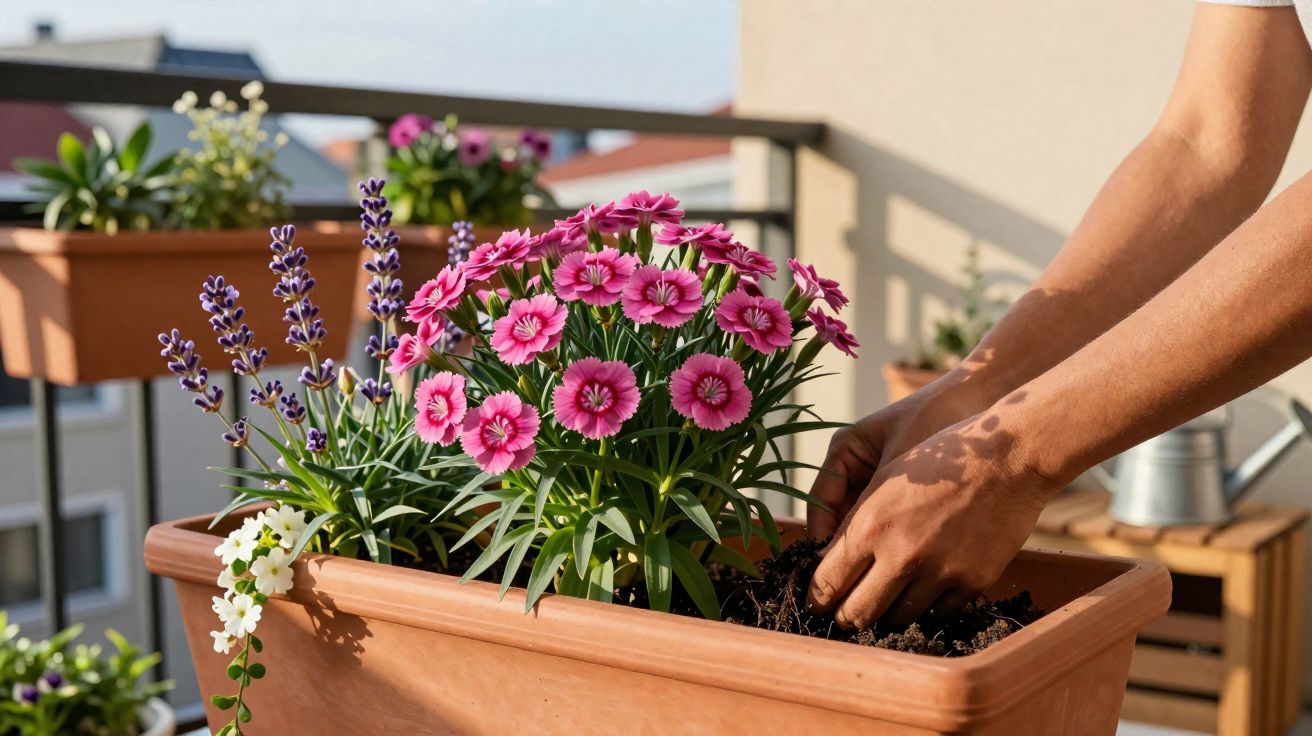
Many hobby gardeners are after exactly this: a low-maintenance plant that looks good all summer, takes up very little space, and still acts as a small statement feature. The perennial carnation Dianthus ‘Bumbleberry Pie’ ticks every one of those boxes and fits neatly into modern gardens, city balconies and compact terraces.
Why this perennial is suddenly everyone’s quiet favourite
A compact shape that instantly tidies up a border
Dianthus ‘Bumbleberry Pie’ grows into dense, rounded cushions at about 25–30 cm tall. Its grey-green foliage feels calm and refined, like a neat little pillow of fine leaves. Strong stems keep the flowers upright, so the plant rarely flops and looks consistently tidy.
That’s precisely why it works so well along narrow bed edges, in rock gardens, or at the front of a mixed perennial border. On a terrace, a low container planted with this carnation can add real structure without blocking the view.
Grey-green foliage, sturdy stems and dense growth: this perennial reads like a natural mini-shrub in a border or on a balcony.
Eye-catching flowers with a noticeable scent
The blooms are the first thing most people notice: bright pink, delicately fringed, with a darker, almost burgundy centre. The contrast creates a gentle watercolour effect that becomes even more striking in sunlight. Flowers appear in abundance above the foliage, forming bold cushions of colour.
On top of that, there’s a soft yet clearly detectable fragrance that brings to mind traditional garden pinks. Placed beside a seating area, near a balcony chair or along the edge of a garden path, you get the best of both worlds: colour and scent. The flowers also work well for small posy-style table arrangements that stay fresh for a few days.
Flowering from spring right into autumn
A major benefit is that this perennial doesn’t just bloom briefly-it keeps going for weeks. The first buds open from spring onwards. With good care, flowering lasts into late summer and, in milder areas, can even continue into autumn.
Removing faded flowers regularly encourages fresh buds to form again and again. This helps the cushion stay colourful for much of the season. The blooms also draw in plenty of insects, including butterflies and other pollinators. Deer and other wildlife generally leave carnations alone, which can be a genuine advantage in rural areas.
Position: where this carnation truly thrives
The best conditions in the garden
For Dianthus ‘Bumbleberry Pie’ to perform at its best, one thing matters most: sun. At least six hours of direct sunlight per day is ideal. Partial shade often leads to fewer flowers and a looser, less compact habit.
The soil should be:
- loose and free-draining
- not stay wet for long periods
- preferably a little chalky
- free from winter waterlogging
If your soil is heavy and clay-based, it’s worth mixing in sand or fine gravel before planting. This improves drainage so excess water can run off more easily and roots are less likely to rot. Planting is best done in spring once the ground has started to warm up. That gives the plant time to establish before the hotter summer days arrive.
| Factor | Recommendation |
|---|---|
| Light | full sun, at least 6 hours of sun |
| Soil | free-draining, light, rather chalky |
| Plant spacing | 25–30 cm between plants |
| Height | around 25–30 cm |
A perfect option for window boxes and pots
You don’t need a garden to enjoy this perennial. On a balcony or rooftop terrace it does very well in a pot or balcony planter. The key is a container at least 25 cm across with drainage holes in the base. A good-quality compost mixed with sand or lava granules makes a suitable growing medium.
Because compost in containers dries out faster than garden soil, watering will be needed more often than in a border. The plant won’t tolerate sitting in water, but it can cope with briefly drying out between waterings. This makes it an easy way to lift modern, minimal balconies with a plant that adds colour without feeling cluttered.
Anyone with only a small city balcony can bring a real slice of garden up to the fourth floor with this carnation.
Care: a few simple steps for a long flowering season
Watering, feeding, pruning-how to keep it neat
Maintenance is straightforward, though a few habits are worth keeping up:
- Watering: Keep evenly moist during hot spells, especially in pots. Avoid constant wetness.
- Feeding: From May to August, apply a light liquid feed for flowering plants every three to four weeks.
- Deadheading: Cutting off wilted blooms encourages new buds and extends the season.
- Cutting back: At the end of winter, trim away dry or brown shoots so the cushion regrows dense and fresh.
With this minimal routine, the plant stays attractive for years. Plant a few together and you’ll quickly get a thick ribbon of flowers that frames beds and gives paths a clear edge.
Combining it with other plants
Thanks to its compact growth, Dianthus ‘Bumbleberry Pie’ mixes easily with other perennials and herbs. Particularly pleasing combinations include:
- lavender or thyme in sunny, dry spots
- low ornamental grasses to add movement in the border
- white or purple flowering plants that make the vivid pink stand out
- early-flowering bulbs to fill the gap before the carnation begins
In pots, this carnation pairs well with silvery foliage, such as Helichrysum or Euphorbia (spurge). The result is a modern, Mediterranean feel that also suits city balconies.
What beginners should also know
If you’re new to perennials, this carnation is a reliable starting point. It forgives short dry spells, grows slowly but steadily, and can remain in the same spot for years. It strongly dislikes just two things: wet, heavy soil and deep shade.
Another bonus is that, as a hardy perennial, it doesn’t need replacing every year. Once established, it can even be divided after a few years and replanted elsewhere. Over time, that lets you create several islands of colour in a garden or across different balcony containers.
It’s also a good choice for families with children. The low height makes it easy to reach, children can snip fragrant flowers for small posies, and they can learn along the way how important pollinator-friendly plants are for outdoor spaces.
So if you’d rather not pack your space with short-lived seasonal bedding plants, this offers a long-lasting, flexible and visually striking alternative. In small areas especially, this compact carnation shows just how much impact one well-chosen perennial can make.






Comments
No comments yet. Be the first to comment!
Leave a Comment