
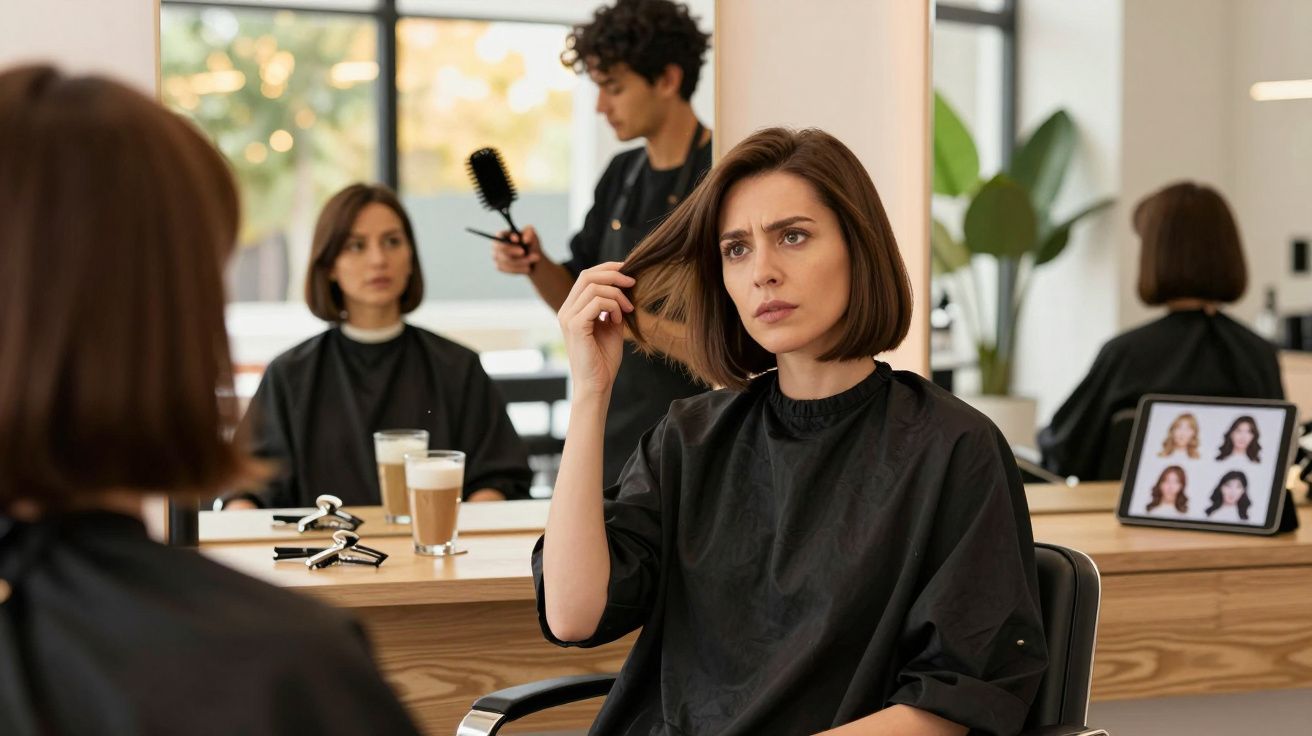
A mid-length cut with a blunt, lightly “swept-out” finish has taken over social feeds and celebrity red carpets. Hair professionals have started referring to it as the broom bob, and among women over 40 it’s proving surprisingly divisive: some call it effortlessly chic, others say it looks ageing - and plenty think it’s simply too high-maintenance.
What is the broom bob haircut, exactly?
Sitting somewhere between the jawline and the collarbone, the broom bob is shaped with ends cut straight across, then softened with the bare minimum of texture. The overall effect is smooth and tidy rather than severe - more “just swept into place” than rigidly straight.
The broom bob is defined by a blunt hemline, a clean outline, and movement that flicks just away from the face.
Its name comes from the way the tips can fan out slightly, like broom bristles laid flat. Depending on how it’s finished, the perimeter may curve under or flick gently outwards. In practice, that final look is largely determined by how the hair is blow-dried or straightened.
Key features of the trend
- Length: between chin and collarbone
- Ends: blunt, with subtle texturising to create movement
- Shape: straight or softly curved, typically with minimal layers
- Styling: sleek finish, often achieved with a round brush or straighteners
- Fringe: optional curtain fringe or a side parting; rarely a heavy, full fringe
The point is to deliver definition without looking stiff. It sharpens the jawline, tidies the neckline and reveals the collarbones - details many stylists consider especially flattering beyond 40.
Why spring 2026 is becoming the season of the mid length
After years dominated by extra-long hair and shaggy, heavily layered cuts, a growing number of clients are requesting something cleaner and more controlled. Mid-length bobs offer that “reset” without the shock of going very short, and they sit neatly under coats and scarves - a practical bonus in a changeable, in-between season.
Online, the broom bob also slots neatly into the quiet luxury mood: pared-back, glossy, and apparently effortless (even when it quietly takes time). Meanwhile, fashion weeks in New York and London have leaned into more tailored silhouettes - and hair is echoing that sharper, more polished direction.
For women navigating work, perimenopause, parenting and dating in their 40s and 50s, a low-fuss yet sharp haircut promises control.
Hairdressers have also noticed more mid-length appointments since January, particularly from clients wanting to remove dry, compromised ends after years of colouring.
Why stylists are split on the broom bob
Most of the disagreement isn’t really about whether it looks good in photos - it’s about how it behaves on real hair, in real life, between appointments.
The case for the cut
Fans of the broom bob argue it delivers instant architecture, especially for hair that has started to feel finer with age or hormonal change. A blunt perimeter can make the hair look denser, and the controlled length often means less knotting and less breakage.
Colourists also like the shape because it acts as a crisp frame for modern colour work such as soft balayage and grey blending. With a straight baseline, highlights can appear more even, and collarbone length helps subtle tonal shifts show up as the hair moves.
Reservations from sceptical stylists
Those who hesitate point out that a strong blunt edge can be unforgiving. On coarse or wavy textures, the ends may puff outward, turning the outline blocky - a silhouette many clients end up regretting.
Without the right texture and styling effort, the broom bob risks looking like “helmet hair with a broom handle edge,” as one London stylist puts it.
There’s also the risk of it reading too harsh on very angular faces if it’s cut too straight or sits too high on the jaw. For that reason, some stylists prefer “invisible” layers through the interior or a slightly rounded perimeter to soften the effect while keeping the blunt impression.
Why women over 40 feel so strongly about it
For many women in their 40s and 50s, mid-length trends come with baggage: memories of “The Rachel”, the poker-straight bobs of the 2000s, and the dreaded school-run “mum cut”. When a new shoulder-adjacent shape becomes fashionable, strong reactions are almost inevitable.
Why some love it
Supporters often describe the broom bob as a welcome counterpoint to the pressure of long, mermaid hair - hair that can feel harder to keep healthy and styled after 40. Many also say the cut gives a more decisive, capable look at work, particularly on video calls.
There’s an emotional layer, too. Cutting to the collarbone can feel like taking yourself back after years of compromise styles shaped by children, corporate expectations or the convenience of a practical ponytail.
Why others say “not for me”
Plenty of women see mid-length as an awkward “no man’s land”: neither youthful nor timeless, neither dramatic nor deliberately classic. Some feel that if they’re going shorter, they’d rather commit to a strong pixie or a cropped bob than choose something they perceive as in-between.
Others push back for a different reason: trend fatigue and age expectations. Some women over 40 reject the idea that getting older should mean choosing a tidier, more controlled haircut, and they read the broom bob as a subtle rule about looking “appropriate”.
Who the broom bob actually suits
Stylists who cut a lot of mid-life hair usually agree it’s not a one-size-fits-all look - it works best when it’s tailored rather than copied directly from a celebrity photo. Practical factors matter.
| Factor | Best broom bob approach |
|---|---|
| Face shape | Round faces often suit a length slightly below the chin; longer faces tend to suit collarbone length paired with a curtain fringe. |
| Hair texture | Straight to softly wavy hair usually looks best with a cleaner edge; curls typically need extra layering and shaping. |
| Hair density | Fine hair can look wider with a blunt cut; thick hair often needs internal layers to prevent a triangular silhouette. |
| Lifestyle | People willing to use a brush or a heat tool a few times a week usually get the best results from the shape. |
One extra consideration that’s easy to overlook: neckline and posture. Because the broom bob exposes the neck and collarbones, the cut can draw attention to the area - which some people love and others prefer to soften with a longer front or a curtain fringe.
Maintenance, styling and the real-life effort
Despite its reputation for being “polished but easy”, the broom bob usually takes some routine. To keep the edge looking intentional, many people need trims every 6 to 8 weeks. Even 1–2 cm of growth can shift the balance and make the line look less crisp.
At home, most versions benefit from a blow-dry using a medium round brush, or a quick pass with straighteners to nudge the ends into that subtle outward flick. Heat protection is essential, particularly for colour-treated hair or peri-menopausal hair, which can feel drier and more fragile.
The broom bob is low on complexity but medium on upkeep. It’s not a wash-and-go cut for most people.
Some salons suggest a discreet undercut internal layer for very thick hair to remove bulk and speed up day-to-day styling. For finer hair, a root-lifting spray or lightweight mousse can stop the look collapsing flat against the scalp.
Added reality check: if you air-dry most days, ask your stylist to cut and test the shape on your natural texture in the salon. A broom bob that looks perfect after a smooth blow-dry can behave very differently once it’s left to dry on its own.
Ageing, confidence and the politics of a haircut
The intensity of the broom bob debate isn’t only about face shape and follicles. For many women over 40, hair length has long been tied up with ideas about youth, femininity and professionalism.
Social expectations still hint that “grown-up” women should keep hair neat: not too long, not too wild. The broom bob fits that template, which is exactly why some embrace it for its clean lines - and why others reject it as yet another quiet instruction about how to look acceptable.
Mental health professionals also note that hair changes in mid-life frequently follow identity shifts. Someone leaving a long-term job or relationship, or navigating menopause, may choose a cut that communicates clarity and control. Someone else may deliberately keep her hair long as a signal that she won’t be managed by unwritten rules.
Trying the broom bob without regret
If you’re tempted but cautious, there are straightforward ways to lower the risk. A sensible first step is asking for a length just above the collarbone: it grows out quickly and still pulls back easily. Bring reference photos of what you like - and just as importantly, images of what you absolutely don’t want.
During your consultation, ask your stylist to show where the line will sit when your hair is straight, loosely waved and air-dried. A quick “mock-up” using clips or pins can reveal whether the shape complements your jaw and neck. Sometimes a soft fringe or a slightly shifted parting makes the style feel immediately more wearable.
If maintenance is your main worry, consider a transitional option: a slightly layered lob with a softened edge. It borrows the broom bob’s structure, but it usually copes better with air-drying and grows out without the shape collapsing so obviously.
Ultimately, the broom bob is less a rule than a prompt. It invites questions about how mid-life women want to be seen - sharp or soft, classic or carefree, trend-aware or entirely indifferent. In the end, the most important decision isn’t in the scissors; it’s how much of that conversation you want your hair to carry each day.






Comments
No comments yet. Be the first to comment!
Leave a Comment