
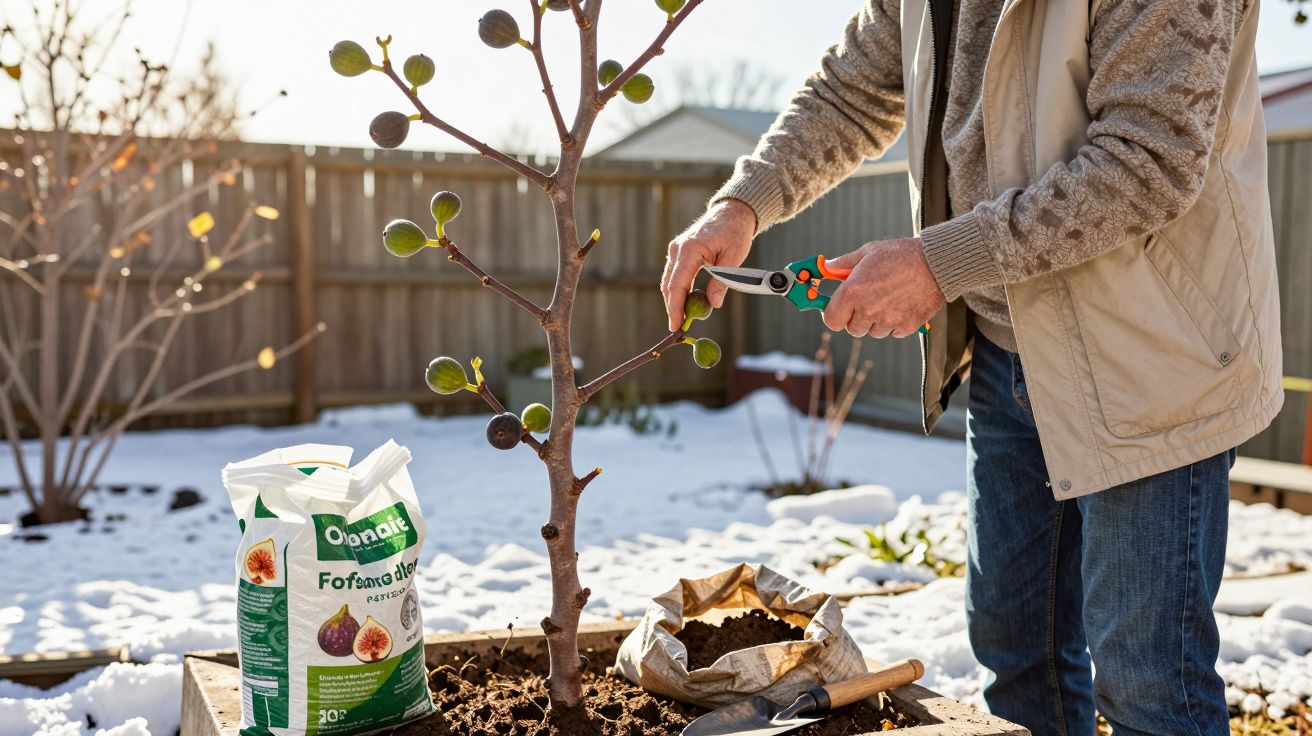
In the neighbour’s garden, branches groan under sweet figs; in your own, the crop is frustratingly sparse. Before blaming the variety or the weather alone, it pays to focus on something many people simply overlook: the right pruning at the end of winter - plus the supporting care that makes that pruning work.
Why late-winter pruning determines whether branches are full or bare
A fig tree left to its own devices gradually turns into a tangle of wood. Shoots cross, grow back into the centre, and the canopy closes in until the crown becomes almost sealed.
A dark, congested crown is bad news for fruit buds - without light and airflow, disease takes hold far more easily.
In that stuffy interior, fruit buds remain weak. Fungal problems spread faster, and the tree’s energy is wasted on unnecessary wood and oversized leaves instead of plump figs.
The opposite approach is just as unhelpful: if you cut a fig tree back too hard, you can remove a large share of the fruit buds. In particular, the so-called “fig flowers” - the very early first crop - are often sacrificed. The tree may look vigorous and healthy afterwards, yet it produces very little.
The best window for pruning is late winter into very early spring - roughly February to March - on frost-free days. At that point, sap flow is beginning to stir and the buds are close to breaking. That timing lets you direct the tree’s strength into the fruiting parts without exhausting it.
The ideal framework: four to six strong leaders for a fig tree
Specialists recommend building a fig tree around a simple, airy framework. The aim is four to six robust main branches (leaders) arranged around the trunk like an open goblet.
- Choose only the strongest, most vigorous branches
- Space them evenly around the trunk
- Prefer growth that angles slightly outwards, not back into the centre
- Avoid branches showing splits, wounds, or signs of disease
These leaders create a sturdy scaffold that allows light to reach deep into the crown. Remove dead wood, crossing shoots, and anything growing back towards the middle - cutting cleanly at the point of origin. That keeps the tree’s heart bright and well ventilated.
Also look at the base: figs commonly push up “water shoots” and suckers from the root area or the trunk base. They can look full of life, but they siphon off a significant share of energy and rarely yield good-quality fruit.
Remove these shoots as close to the source as possible rather than cutting them halfway. A neat, smooth cut heals more quickly and lowers the risk of rot.
How much to cut back - and exactly where to make the cut
Once your leaders are set, move on to the finishing prune. Each main branch carries several side extensions that can grow strongly through the season. A practical rule of thumb is to shorten each extension by about one third.
Cutting back by a third awakens dormant buds lower down - those buds produce the new shoots that later carry the figs.
If you barely shorten anything, growth stays out at the tips and the crown becomes old and unproductive from the inside. If you prune too aggressively, you lose a great deal of fruiting wood. The middle ground keeps the tree both shapely and productive.
The crucial detail: cut to an outward-facing bud for your fig tree
Don’t cut at a random point along the branch. Make the cut just above a bud that points outwards. This small detail has a big impact: the next shoot grows away from the centre, opening the crown rather than closing it again.
Over several years, this develops a stable, bowl-shaped crown: light in the middle, more growth around the outside, and plenty of fruiting branches in the well-lit canopy edge. Disease spreads more slowly, and in many gardens chemical treatments become unnecessary.
Site, soil, fertiliser: without these basics, the crown stays empty
Even perfect pruning can’t fully compensate for the wrong location. Figs need one thing above all else: sun. As a guide, aim for at least six hours of direct sunshine per day.
A spot in front of a south- or south-west-facing wall is ideal, as it stores warmth and shelters the tree from wind. Exposed positions - especially where cold easterly winds hit - slow growth and can damage young shoots.
Soil is best kept on the lighter side with good drainage. Waterlogging around the roots quickly causes trouble. A slightly acidic to neutral pH of around 6 to 6.5 is ideal.
A mulch layer around the base is extremely useful:
- Depth of around 5 to 20 centimetres
- Materials such as leaves, chipped prunings, straw, or bark mulch
- Keep it off the trunk itself; leave a small gap
Mulch helps the soil hold moisture, buffers the roots against temperature swings, and encourages healthy soil life. In dry summers, this often makes the difference between steady growth and a stressed, stop-start tree.
Fertilising properly: fewer leaves, more fruit
Many gardeners try to “help” their fig tree with a high-nitrogen feed. The usual outcome is huge leaves and long shoots - and an underwhelming fig harvest.
Too much nitrogen fuels leaf growth, not fruit. For figs, potassium and phosphorus matter far more.
Choose a balanced fruit-tree or soft-fruit fertiliser with a higher proportion of potassium and phosphorus. Well-rotted compost also works very well, lightly worked into the topsoil in late winter or early spring.
In most gardens, feeding once a year is plenty. Where soil is already fertile, mulching and adding a little compost from time to time may be all that’s needed. Overfeeding makes the tree more vulnerable to frost and pests and pushes the balance towards foliage rather than figs.
Unifere or bifere figs - and why the variety matters in the north
Fig trees differ in how often they crop each year:
- Unifere figs: one main crop in late summer
- Bifere figs: a first crop in early summer (“fig flowers”), and a second in late summer
In cooler areas with late frosts, bifere varieties often struggle. The early fruitlets are easily killed before they can ripen. If you garden further north or in an exposed climate, unifere varieties are frequently the safer choice, putting all their energy into a single, reliable late harvest.
There’s another factor many people miss: some traditional fig varieties require pollination by a specific tiny wasp. In many regions that wasp is absent. Those varieties may form flower structures but still fail to produce worthwhile fruit without a pollinator - no matter how carefully you prune.
Practical timing tips and common pruning mistakes
If you’re tackling your first winter prune, take your time and study the tree from every angle before cutting. A sensible sequence is:
- Remove dead wood and anything clearly diseased
- Cut out suckers and water shoots at the base
- Select four to six leaders and remove competing branches
- Shorten remaining shoots by about one third, always cutting to an outward-facing bud
Common mistakes include:
- Pruning during hard frost or just before a predicted cold snap
- Leaving “stubs” that heal poorly
- Failing to establish a clear framework - too many leaders shading one another
- Applying high-nitrogen fertiliser after pruning, which triggers excessive leaf growth
Why patience pays off with a fig tree
Many fig trees take three to five years before they really get going. If you consistently maintain an open crown, prune regularly but moderately, and give the tree a suitable site, you lay the groundwork for heavy crops for decades.
Figs respond far more strongly to light levels and air circulation than many traditional orchard trees. A tree trained into a neat “open goblet” nearly always bears more - and better - fruit than a wild, bushy plant of the same age.
If space is limited, you can even train a fig as an espalier against a warm house wall. The principles stay the same: a small number of strong axes, clear structure, cuts made to outward- or side-facing buds, and a sharp eye for dead or diseased wood.
Each winter you’ll gain confidence. After two or three seasons, the change is usually obvious: where a few miserable figs once clung on, branches begin to bend under a noticeably heavier crop - and what used to be an unremarkable plant becomes the quiet star of the garden.




Comments
No comments yet. Be the first to comment!
Leave a Comment