
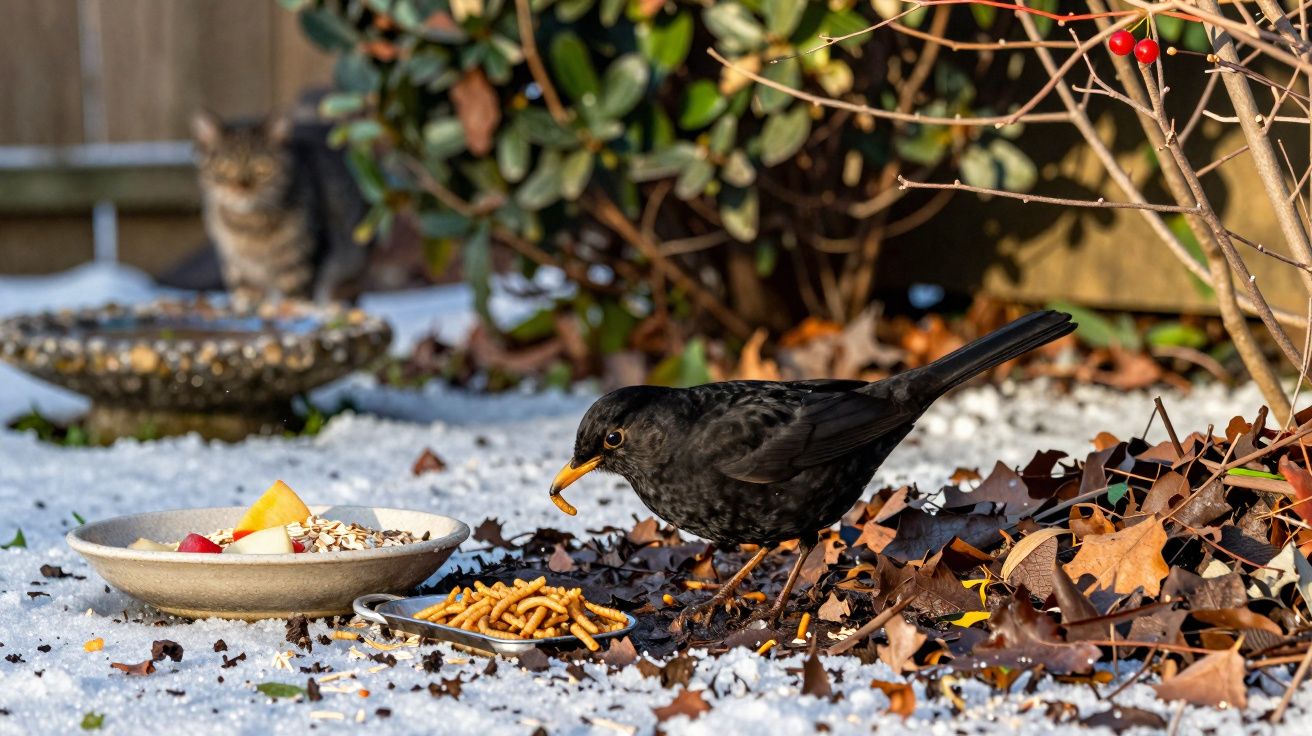
That is no coincidence.
In harsh winters, many garden owners notice the same pattern: tits and sparrows crowd around feeders, and sunflower seeds and fat blocks disappear in no time. Meanwhile, the blackbird with its yellow beak hops about on the ground, apparently unimpressed. It can look like ingratitude – but in reality it is a finely tuned survival strategy rooted deep in this bird’s biology.
Why blackbirds often ignore raised feeding stations
The garden bird that pointedly stays on the ground
When winter really bites and the ground turns solid with frost, people often assume every bird will grab any easy source of energy. Fat, seeds, suet balls – it sounds like a gift to a chilled body. Yet it is mostly tits, finches and sparrows that take over the feeding tables. The blackbird paces beneath them and barely glances upwards.
That seems odd when you consider how much energy a small bird burns each day just to maintain its body temperature. The explanation lies in the blackbird’s way of life: it is a ground forager, and it sticks to its method even when temperatures plunge.
"Blackbirds are not aerial acrobats but ground workers – their entire body is built for searching for food in leaf litter and soft soil."
Born scrapers, not daredevil climbers
Compared with tits, the blackbird lacks the kit needed for gymnastic performances on dangling feeders. Its feet are strong, but they are designed for scratching, hopping and running rather than gripping thin twigs. With a relatively heavy body, balancing on swinging hangers is correspondingly awkward.
Its advantage is elsewhere: with sharp eyesight and practised movements, it flicks leaves aside, probes loose ground and rummages for whatever is hiding underneath. That behaviour is so ingrained that hunger and cold do not simply make it “switch modes”. For a blackbird, the buffet is at ground level – not in the feeder above its head.
The leaf-litter trick: how a microclimate carries blackbirds through winter
Under leaves, the ground stays “open” for longer
Anyone who meticulously rakes up every last leaf in autumn usually believes they are doing their lawn a favour. For blackbirds, however, that tidiness comes at a cost. A thick layer of leaves acts like a natural blanket: it insulates the soil, holds on to residual warmth and slows the deep freeze.
Even if the surface looks frozen, the earth a few centimetres down often remains surprisingly soft. As the leaf layer breaks down, it generates a tiny amount of heat – not much, but enough to make a crucial difference. That is precisely the zone where blackbirds search for food.
Worms and insects instead of tough seed mixes
Beneath leaves, in loose soil and in mulch, you will find earthworms, larvae, beetles and other creeping creatures. Add to that leftover seeds, soft plant material and the occasional forgotten berry. Above all, this mix provides one thing: protein.
"For blackbirds, animal protein in winter is worth its weight in gold – it keeps them capable and warms them better than any hard seed mix at the feeder."
When berries on shrubs turn rock-hard in frosts and gradually lose nutritional value, the bird is ultimately left with the ground as its dependable source. If you allow leaf piles, dead perennial stems and a bit of “mess” in the garden, you are effectively building your blackbirds a natural larder.
The “soft bill”: why sunflower seeds are not the answer
The wrong tool for hard shells
Blackbirds belong to the group often described as “soft-billed” birds. They can pierce fruit, pull worms from the soil and take soft foods with ease – but hard seeds are another matter. Unlike finches, they do not have a powerful, cone-shaped beak made for cracking shells.
A striped sunflower-seed mix may be a treat for tits, but for a blackbird it is close to useless. It can hardly open the husk, wastes valuable effort and may end up getting too little energy in return. In extreme cases, it eats too little even though the bowl looks full.
Frozen berries: attractive decoration, barely any food
In late autumn, blackbirds enthusiastically feed in ivy, elder and ornamental shrubs. The fruit is still soft and energy-rich then. Later, in deep winter, many berries freeze into hard pellets that are difficult to peck at. With every freeze–thaw cycle, they also lose nutrients.
That is when things become precarious for the blackbird: the visible supply in the shrubs is still there, but it is no longer truly usable. If it cannot find enough on the ground, it can slide quickly into a dangerous energy deficit – especially during clear, bitter nights.
How to feed blackbirds properly in winter
Blackbird winter feeding: menu ideas for the ideal ground-level table
If you want to help blackbirds specifically, think less about hard grains and more about soft, energy-dense foods. Good options include:
- Apples and pears: ideally slightly overripe or shrivelled, halved and placed cut-side up on the ground.
- Raisins or sultanas: soak in lukewarm water first so they are softer and easier to digest.
- Oats: mix with a little rapeseed or sunflower oil to boost energy and fat content.
- Insect feed: specialist mixes or dried mealworms from a pet shop, ideal for a protein boost.
Hard foods from the kitchen, especially anything heavily salted or seasoned, are unsuitable. Bread also burdens a bird’s stomach and can swell unfavourably. It is better to put out a small selection of appropriate foods on purpose than to offer whatever happens to be “left over”.
Location matters: safety and comfort for the blackbird
Where you feed is at least as important as what you feed. Blackbirds feel safest along the edge of dense shrubs or hedges. From there, they can dart into cover instantly and keep watch for threats from above.
"The ideal setup is a feeding spot directly on soil or grass, a few decimetres in front of a hedge – with clear sightlines all around for spotting danger."
If you place food in the middle of a bare patio, you push the birds into an unnatural and risky situation. Better: scatter fruit pieces lightly on the ground (not piled up), in two or three spots along bushes. This also reduces conflict, because blackbirds defend their winter feeding patch with surprising determination.
Protection from cats and more: keeping the feeding area safe
Neighbourhood danger
Feeding on the ground inevitably increases the risk from cats. A bird distracted with its head buried in an apple piece has little awareness of what may be creeping in from the side. Many free-roaming pet cats are excellent hunters and take every opportunity.
So, if you want to support blackbirds, keep a clear safety ring around the feeding area. Tall grass, plant pots or decorative items that could hide a cat ready to pounce should not be within that zone.
How to set up a safe feeding zone
| Aspect | What makes sense | What to avoid |
|---|---|---|
| Field of view | 1–2 metres of clear ground around the food | Dense ornaments, wall corners, log piles right beside it |
| Cover | Shrubs or a hedge close by as an escape route | A completely open area with no retreat |
| Surface | Soil, lawn, leaf litter or mulch | Smooth paving or high balcony ledges |
| Neighbourhood cats | Place the feeding spot where it is easy to see from windows so you can intervene | Hidden corners of the garden that you can barely monitor yourself |
How the garden itself can become a life-saver
Leaves, shrubs, water: simple steps with big impact
Only putting out food for blackbirds misses a lot of potential. Help becomes far more effective when the garden itself works as winter habitat. That includes:
- Leaving leaf piles under trees and hedges instead of clearing everything away.
- Planting berry-bearing shrubs such as ivy, wild roses, elder, firethorn or hawthorn.
- Providing a shallow dish of fresh, ideally slightly tempered water, replaced regularly.
- Not making every corner “neat” – dead perennial stems provide seeds and hiding places.
These structures do several jobs at once: they supply food, offer cover from birds of prey and cats, and create small, warmer pockets in the garden. It benefits not only blackbirds, but also robins, wrens and many insect species.
What many people underestimate: energy demand and risk
On an icy winter day, a blackbird can burn through critical energy reserves within hours. If it is repeatedly disturbed, forced to flee or can find only unsuitable food, those losses increase even more. Just a few consecutive bad days can decide whether an animal makes it through winter.
Purposeful feeding with suitable food, a structurally rich garden and a little consideration with winter gardening tasks combine to produce a powerful effect. That strengthens not just a single bird, but an entire chorus of songbirds that will provide the background soundtrack in your garden again in spring.






Comments
No comments yet. Be the first to comment!
Leave a Comment