
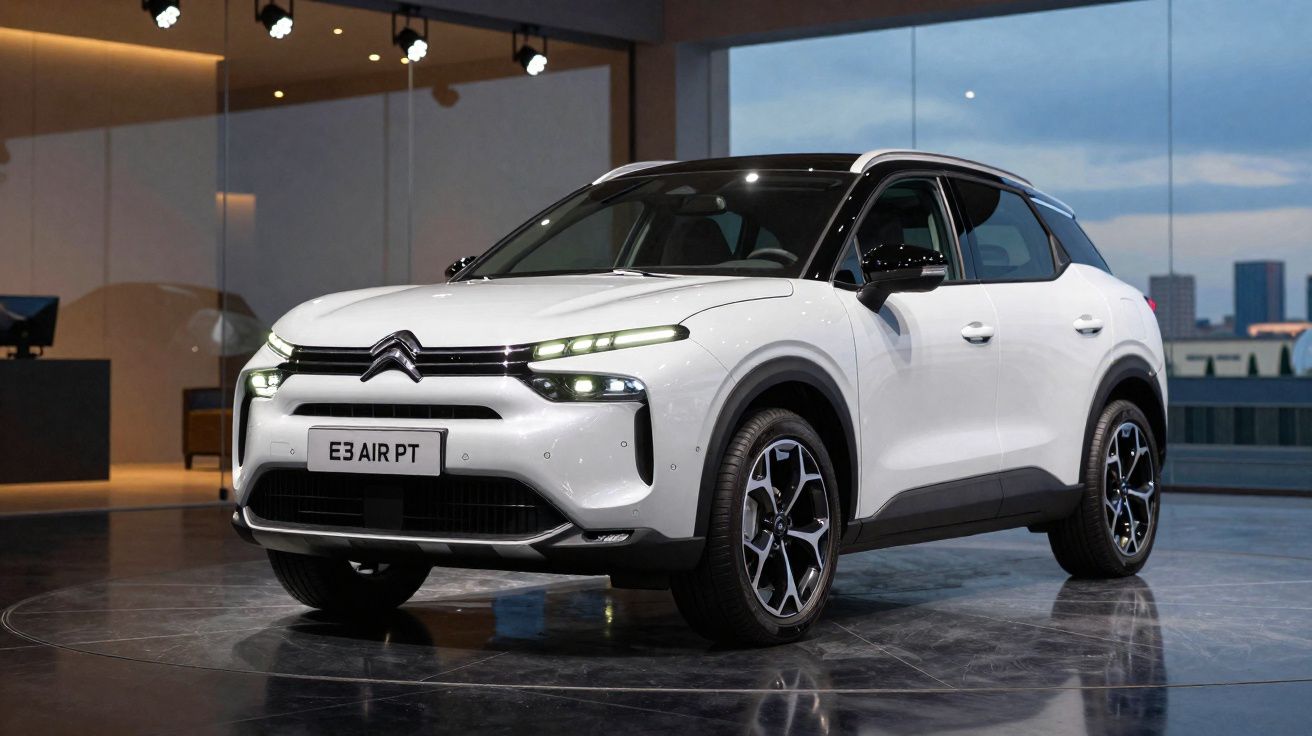
Even in this MAX version-the best-equipped of the range-the Citroën ë-C3 Aircross still has price as one of its strongest selling points.
The Citroën C3 Aircross has a very obvious target in its sights: the hugely successful Dacia Duster. Like the Duster, it aims to deliver plenty for not much money-and it goes a step further than the Romanian rival by offering up to seven seats and a fully electric variant, identified by the “ë”.
You cannot, however, combine those two options into one vehicle. Even so, I approached this test with a fair amount of anticipation. I had already read Miguel Dias’s first drive of the C3 Aircross, but after many years of testing cars, nothing beats forming your own opinion.
The car on test is the Citroën ë-C3 Aircross MAX, which tells me it is also the most fully loaded version available. A black-painted roof sets off the triple-layer Elixir Red paint-perhaps the best colour for this model, in my view-and the 17" alloy wheels reinforce the same message. This is the ë-C3 Aircross with everything on it.
At the same time, it is impossible to overlook the fact that this model’s key weapon is its pricing. In electric form it is, in fact, the cheapest electric SUV you can buy. Even in MAX trim, it remains among the most affordable.
Which immediately raises a question about the formula Stellantis engineers have used to offer so much kit for so little money: what is the real cost of being cheap?
A robust first impression: Citroën ë-C3 Aircross presence
From the outside, the first thing that comes across is toughness. Although the Citroën ë-C3 Aircross sits in the B-SUV segment, it has a generously sized body and a tall ride height (19 cm), giving it the look of a ready-for-anything SUV.
Climb inside and that sturdy feel continues, helped by a pared-back, minimalist dashboard design-and by the smaller steering wheel, very much “à la Peugeot”.
Trim materials are a blend of patterned cloth, synthetic leather with matching stitching, and also hard plastics (the door panels, for example) that are not especially pleasant to the touch. Even so, the car feels solidly assembled and, so far, there are not (many) unwanted rattles in the cabin.
The familiar French comfort
If there is an area where the Citroën ë-C3 does not invite much criticism, it is the space on offer. Up front, the seats have wide-ranging adjustments, provide good support, and help deliver a high level of comfort. In the second row, the outer passengers will be happier if the centre seat is left empty so they can spread out a bit more, but overall the rear seats in the ë-C3 Aircross are perfectly acceptable for travelling.
Further back, in the boot, Citroën quotes a maximum of 460 litres under the parcel shelf-though in reality it even looks like more. The boot floor is movable and can be set at two different heights; in the upper position it creates extra underfloor storage, ideal for charging cables.
Unlike many electric models, there is no frunk under the bonnet. Here, the first hints of cost control begin to show.
A tightly controlled budget
To hit an accessible price point, it is not hard to guess that this model was engineered under strict cost constraints. There are no financial miracles, and like any other car it still has to be profitable for its manufacturer.
You see that approach in the lack of a frunk, but also in the minimalist instrument display-limited to the essentials for driving-and in the central touchscreen, which is very straightforward and runs an interface with few customisation options.
Even before moving off, there is another “cut”-and this one is stranger. In 2025, what sense does it make to have an electric car where you must insert a key into the “ignition” and turn it to start the system? Yes, “ignition” is something that does not exist in this 100% electric ë-C3 Aircross. Moving on…
An SUV that suits the city
Before setting off, the instrument display shows 98% battery and a range estimate of 277 km. This is the version with the smaller 44 kWh battery, and an official combined WLTP range of just 303 km-meanwhile, the ë-C3 Aircross with the 54.2 kWh (total) battery has already arrived in Portugal, claiming 400 km.
If you like keeping an eye on average consumption (as I do), forget it. In the Citroën ë-C3 Aircross you do not have that option. The trip computer only shows remaining range, battery charge, and total and trip kilometres.
Within the first few urban kilometres, it becomes obvious that this is where the ë-C3 Aircross feels most at home-and that comfort is the guiding theme.
That impression was only reinforced once I joined the motorway, where a SUV body (aerodynamics are not its strong suit), just 113 hp, and a modest-capacity battery can only produce one outcome: the battery percentage drops at a rather brisk pace. You are better off choosing A-roads and keeping a more relaxed speed.
With no trip computer readout, I had to resort to a calculator to get the consumption figures I wanted. Given that I did more city and suburban driving, I managed an average better than the official number: 17.2 kWh/100 km, below the claimed 18.3 kWh/100 km. On the motorway, though, I was seeing almost 22 kWh/100 km.
Better equipped-but at what price?
The Citroën ë-C3 Aircross makes a strong case for itself on the equipment list: LED lighting, automatic climate control, and a rear parking camera all count in its favour.
The 10.25" touchscreen and 3D navigation are also welcome additions. Even so, with wireless smartphone integration via Apple CarPlay or Android Auto (also included), the built-in navigation becomes entirely optional. Personally, I would like to see more user-interface customisation and… average-consumption data in the trip computer (an update is planned).
In MAX trim, and already including the €900 Elixir Red paint, the Citroën ë-C3 Aircross lists at €31,790. And yes, that is a difficult figure to beat for a fully electric car that is well equipped and roomy enough to carry almost anything.
What the ë-C3 Aircross is missing
On the other hand, the cabin reveals exposed sections of bodywork without trim, the material quality has plenty of room for improvement, and the whole “key in the barrel” requirement makes little sense.
Beyond the appealing exterior styling-especially in this colour-the ë-C3 Aircross also features some charming details, such as the engraving inside the glovebox lid showing several of the French brand’s best-known models, alongside the message “Iconic Since 1919”.
There are upbeat messages on the doors too, but they led me to another thought: “it is not enough to look the part-you have to be the part.” And that is exactly the impression I was left with by the Citroën ë-C3 Aircross: it only seems like a very interesting proposition with a competitive price.





Comments
No comments yet. Be the first to comment!
Leave a Comment