
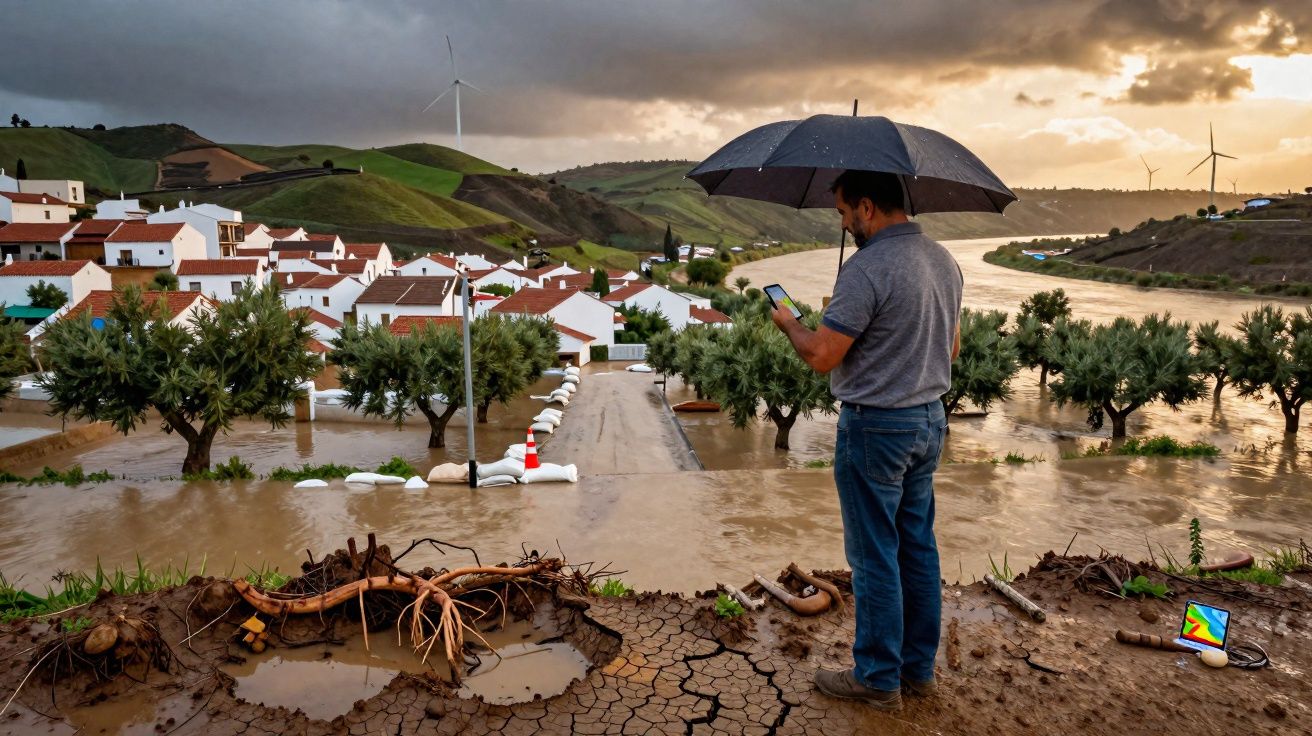
Spain is living through a winter unlike anything many people can remember. Instead of anxiously watching reservoir levels drop, residents are now dealing with swollen rivers, flooded roads and slopes giving way. Meteorologists describe it as the wettest winter in almost half a century - and interpret it as a clear sign of a worsening climate.
Eleven storms back-to-back - Spain under relentless rain
From late December to mid-February, the Iberian Peninsula was hit by eleven consecutive storms. In southern Spain - better known for sunshine - weeks became a repetitive cycle of rain radar, severe weather alerts and sandbags stacked outside front doors.
"According to the national weather service, this winter is the wettest in 47 years - a historic record that is hitting southern Spain particularly hard."
Normally, the region’s attention is on the opposite issue: water scarcity. Reservoir capacity, groundwater levels and calls to conserve are routine in Andalusia. This time, however, the story is too much water arriving far too quickly - and many towns were simply not prepared for this kind of extreme weather.
Storm “Leonardo” cuts off Andalusian communities within hours
The storm named “Leonardo” was especially destructive in the south of the peninsula. In parts of Andalusia, as much as 120 millimetres of rain fell in a single day. Gusts reached about 150 kilometres per hour. Quiet valleys turned into torrents of mud, tearing through anything in their path with immense force.
In Granada province, roads effectively vanished beneath brown floodwater before emergency teams could even set out. In smaller settlements, links to the outside world failed within hours.
In Bayacas, a village on the slopes of the Sierra Nevada, the Chico river burst its banks with unusual violence. Water pipes ruptured under the pressure, leaving entire streets without drinking water - at the very moment muddy floodwater was everywhere, yet barely any clean water came from the tap.
Near the Guadalfeo river, lightweight buildings were inundated within minutes. Residents had little time to gather essentials. In several places, bridges collapsed, cars were swept away and riverbanks crumbled. Two people died in connection with the storm, and many others were forced to leave their homes.
A year’s rain in just a few days in Grazalema, Spain
The figures from Grazalema are particularly striking - a place already known as one of the wettest parts of Spain. There, within only a few days, rainfall matched what would usually be expected across an entire year. Meteorologists call it an extreme event that surprised even long-time observers.
"The combination of persistent storms, unusually high rainfall totals and strong gusts shows how vulnerable even familiar landscapes have become."
Infrastructure stress test: built for drought, not flood, in southern Spain
Southern Spain averages about 320 sunny days per year. Urban planning, farming and water management have been shaped around shortage rather than surplus. Reservoirs, channels and irrigation networks were primarily designed to capture infrequent rainfall and carry communities through long, dry summers.
But many systems are not engineered for repeated downpours arriving in rapid succession. Over recent weeks, that has been visible in several weak points:
- Pipes and channels burst under the intense pressure of floodwaters.
- Country roads and access routes were undermined or washed away entirely.
- Hillsides slipped because waterlogged ground could no longer hold.
- Emergency services reached some places only after delays lasting hours.
In numerous villages, residents grabbed shovels, stones and sandbags. They built makeshift barriers, diverted flows temporarily and cleared debris long before heavy official vehicles arrived. Many say local initiative made the biggest difference in protecting homes and smallholdings, at least in part.
Hidden damage: soils, rivers and fields under strain
The impact is not limited to destroyed roads or fallen bridges. When heavy rain persists, soils become saturated until they can absorb almost nothing. From there, a domino effect begins:
| Impact | Specific consequence |
|---|---|
| Waterlogged soils | Higher risk of landslides, slope failures and cracks in the terrain |
| Swollen river channels | Rivers carve new routes; banks are eroded or shifted |
| Erosion on farmland | Fertile topsoil is lost, leaving stones and rubble behind |
| Mud deposits | Fields are covered with sediment; irrigation systems become clogged |
For many farmers, the damage lands twice. First, floodwater wipes out crop after crop. Then, the land may need years to recover from erosion and soil loss. Those who had already been struggling with drought now face a completely different - but equally existential - challenge.
When extreme weather becomes the new normal
Spanish meteorologists stress that this episode will not sit alone in the records. This winter fits into a broader pattern: for eight consecutive years, authorities have logged winters that were markedly warm or very warm. That shift changes atmospheric dynamics.
"Warmer air can hold more water vapour. When a low-pressure system forms, that stored moisture is released as particularly intense rainfall."
Scientists link the force of storm “Leonardo” directly to this mechanism. Warmer sea surfaces drive extra evaporation; moist air masses build up until they are discharged abruptly over land. The energy released shows up as short-lived but exceptionally intense bursts of rain.
Neighbouring Portugal also reported its wettest February in 47 years. Taken together, these events underline that this was not merely a local anomaly, but a widespread change in patterns across the entire Iberian Peninsula.
Between scorching summers and flood winters: Spain under climate strain
Spring forecasts already hint at the next disruption to everyday climate expectations. Specialists anticipate temperatures once again above the long-term average. That means heatwaves and extreme rainfall spells no longer keep their distance - they can occur closer together in time.
Spain - particularly the south - must therefore prepare for a future in which two opposing extremes become more common:
- prolonged drought periods with falling reservoir levels
- short, very intense rainfall events with flooding and landslides
For local and regional planners, this becomes a balancing act. They are expected to store more water from intense downpours, slow flash floods, and still build enough reserves for hot summers. Traditional water policy focused mainly on drought is no longer sufficient for this double burden.
What this winter signals for Spain’s future
Hydrologists talk about a “climate under high tension”. Anyone building near river corridors will need to allow for larger floodplains in future. New roads and rail routes require far stronger protection against undermining. Tourism - one of Spain’s most important industries - is also under pressure to adapt: winters marked by storm damage and closed coastal sections do not sit easily with the image of a dependable sun destination.
At the same time, fresh debates are emerging around slope protection, reforestation, and how to manage soils that decades of cultivation have made more erosion-prone. Many experts argue for restoring natural retention areas and wetlands, rather than sealing or developing every available square metre.
For the German-speaking world, Spain’s winter offers an early glimpse of trends that could also arrive closer to home: longer heat spells followed by severe, widespread downpours. Straightening rivers, building over open land and constricting watercourses will intensify the force of such events in future. The scenes from flooded villages in Andalusia show how quickly a familiar climate can tip - and how costly lost time on adaptation can become.






Comments
No comments yet. Be the first to comment!
Leave a Comment