
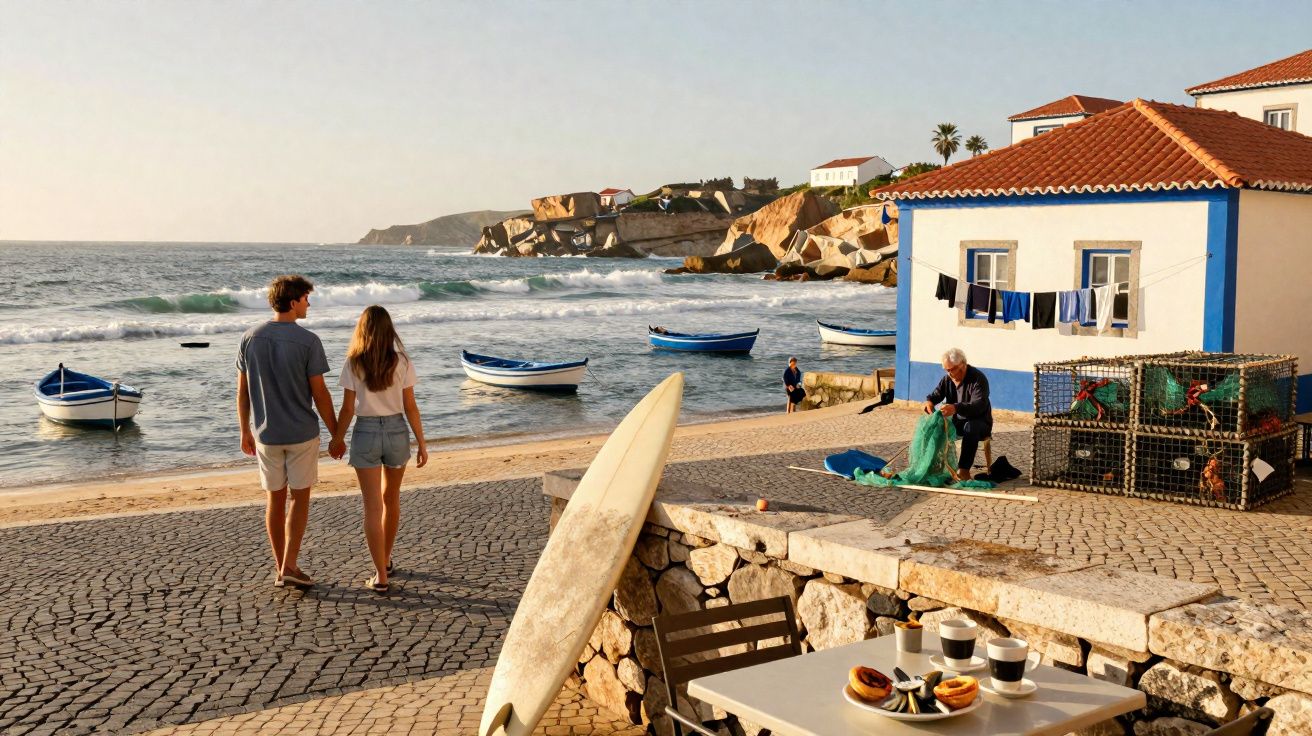
Anyone who has had their fill of crowded seafront promenades and eye-watering accommodation prices will find a refreshingly down-to-earth coastal base north of Lisbon. Here, fishing nets are still hung out to dry, while just metres away people pad towards the water with boards tucked under an arm. Between cliffs, historic lanes and rideable Atlantic sets, one place has held on to a holiday feel without the luxury posturing-yet with plenty of atmosphere-and at prices that now seem almost nostalgic for southern Europe.
Ericeira: Between fishing boats and surfboards
Around 45 km north-west of Lisbon, Ericeira is a former fishing village that has kept its personality surprisingly intact. The town sits on rocky outcrops above the Atlantic. Below, waves fold into small coves; above, rows of whitewashed houses line up with blue or yellow trim. Many façades still feature classic azulejos-Portuguese tiles showing everyday scenes or simple decorative patterns.
Rather than towering resort blocks, the accommodation is mostly small pensions, guesthouses and self-catering flats. Many occupy old townhouses and are often family-run, with breakfast in a courtyard instead of a buffet hall. A morning wander through the lanes quickly leads to the market, where early fishermen set down crates of squid, sardines and sea bream.
"Ericeira feels like a village that has made the leap into the tourist present without giving away its core."
Down by the small harbour at Praia dos Pescadores, brightly painted boats still sit as working craft, more about daily labour than holiday decoration. At the same time, in cafés above the beach, young people with salt in their hair-wetsuit half unzipped, cappuccino in hand-settle in. It’s precisely this side-by-side of traditional fishing and surf culture that gives the town its appeal.
Why Ericeira is considered a “surf reserve”
In 2011, the coastline around Ericeira received a special designation: it was recognised as Europe’s first World Surfing Reserve. The title is more than a marketing badge. The stretch includes several spots with highly consistent, high-quality waves, and there are strict rules designed to keep development and erosion under control.
The best-known areas include:
- Ribeira d’Ilhas – long, orderly waves and a venue for international competitions
- Coxos – powerful waves, generally one for very experienced surfers
- Foz do Lizandro – a wide bay with gentler conditions and plenty of space for beginners
Around these beaches, surf schools and surf camps offer lessons by the hour or multi-day packages. Equipment hire is straightforward, from softboards for first attempts through to high-quality shortboards.
Attractive even if you don’t surf
If wave-riding isn’t your thing, Ericeira doesn’t make you suffer for it. Sheltered coves-especially near the harbour-work well for swimming or simply watching. The sea stays on the cool side at 14–20 °C, but on low-wind days the beaches still fill with families building sandcastles and collecting shells.
A favourite pastime is following the surf scene from a safe distance-say, from the rocks above Ribeira d’Ilhas or from a beach bar serving Portuguese beer and grilled squid. If you like, you can take a single taster session in the water and spend the rest of the day on cliff-top walks.
"Atlantic air, the sound of waves and sunsets over the water-Ericeira delivers that package, without a glossy façade and without moon-high prices."
A holiday at a comparatively low cost
Compared with hotspots such as Comporta or the island on France’s Atlantic coast that constantly pops up in travel magazines, Ericeira is still seen as moderate. Outside the absolute peak season, simple rooms or studio apartments can be booked at rates that have long disappeared in many other seaside towns.
Typical costs, as a rough guide:
| Category | Price level | Note |
|---|---|---|
| Pension / guesthouse | medium | Small properties, often with personal contact with the owner family |
| Eating out | relatively inexpensive | Fresh fish, set dishes, often below big-city prices |
| Surf lessons | medium | Package deals are usually cheaper than in well-known surf capitals |
| Public transport | inexpensive | Bus links from Lisbon; a hire car is optional |
The town becomes particularly appealing for travellers who don’t have to go in July or August. In late spring and early autumn, the beaches are far quieter, the weather is mild, many restaurants remain open, and prices are often noticeably lower than at peak-season levels.
A historic centre with everyday life
Ericeira’s historic centre is compact and easy to cover on foot. Cobblestones, small squares, chapels and houses with tiny balconies define the look. Despite surf schools and bars, the centre doesn’t turn into a stage-set holiday village. Children still go to school, older locals sit for hours outside cafés watching the world go by, and tradespeople edge vans through the narrow streets.
Take your time and it becomes obvious that fishing still matters. Early in the morning, the harbour smells of diesel and salt; men repair nets, and crates packed with ice are wheeled along. Some restaurants buy directly from the harbour and handwrite the day’s catch on boards outside the door.
"Ericeira’s charm comes from lots of small everyday scenes, not from perfect postcard views."
Food and drink between sea and village square
In Ericeira, the sea sets the tone on the menu. Grilled sardines, caldo verde with chouriço, stews with mussels and prawns, plus vinho verde or a local white wine: the cards are often simple, but the dishes are honest and fresh.
Typical evening plans include:
- eating charcoal-grilled fish on a terrace above the cliffs
- trying the daily dish and house wine in a no-frills tavern
- moving on later to a bar where surf videos play on big screens
If you have a sweet tooth, try local pastries made with puff pastry or egg-yolk cream. Quite a few bakeries have been family-owned for decades, keeping recipes that have been handed down through generations.
Practical tips for planning your trip
From Lisbon, travellers can reach Ericeira in under an hour. A bus runs several times a day, though a hire car can be worth it for maximum flexibility. The town itself is small, but in high summer parking can be scarce, particularly near the beaches.
The best times to visit are periods when sea temperatures aren’t tropical but still bearable, and the swell isn’t running too heavy. If you’re travelling with children or want to swim, choose calmer, more sheltered coves and days with less wind. For ambitious surfers, the swell forecast matters more than the thermometer.
As you’d expect on the Atlantic coast, there are a few natural risks. Currents can be strong, seabed conditions can change quickly, and not every beach has continuous lifeguard cover. If you’re getting in the water, take flags and beach notices seriously and, when in doubt, ask locally at surf schools or from lifeguards.
One more factor people often underestimate is the wind. Even at 25 °C air temperature, a brisk breeze on the cliffs can chill you fast. That’s why a light jacket belongs in every bag, especially for sunset walks.
More than an alternative to expensive trend islands
Ericeira works both as a stand-alone holiday and as a stop on a Portugal road trip. Three or four days in the village combine easily with city time in Lisbon. If you stay longer, you can plan outings to the nearby Sintra hills, vineyards inland, or other stretches of beach along the region.
For travellers from German-speaking countries in particular who want sun, sea and a manageable budget, this fishing village offers a compelling mix: a genuinely local setting, sporting options, good food and scenery that doesn’t need a filter. If you’d rather feel you’re truly on the Atlantic edge of a traditional country than chase jet-set vibes, you’ll find a destination here that still feels remarkably grounded.



Comments
No comments yet. Be the first to comment!
Leave a Comment